You’ve probably read the word in a history class, a court case, or a heated online debate and paused. It sounds important, almost sacred, but nobody ever stops to actually explain it in plain English.
That’s exactly what this guide is here to do. By the end, you’ll know what does unalienable mean, where it came from, how it’s different from its cousin inalienable, and how to use either one with confidence. No jargon, no legal-speak just a clear, human answer to a question that shapes how we talk about rights, freedom, and fairness. Keep reading, because the meaning of unalienable is more interesting than you’d expect.
What does unalienable mean?
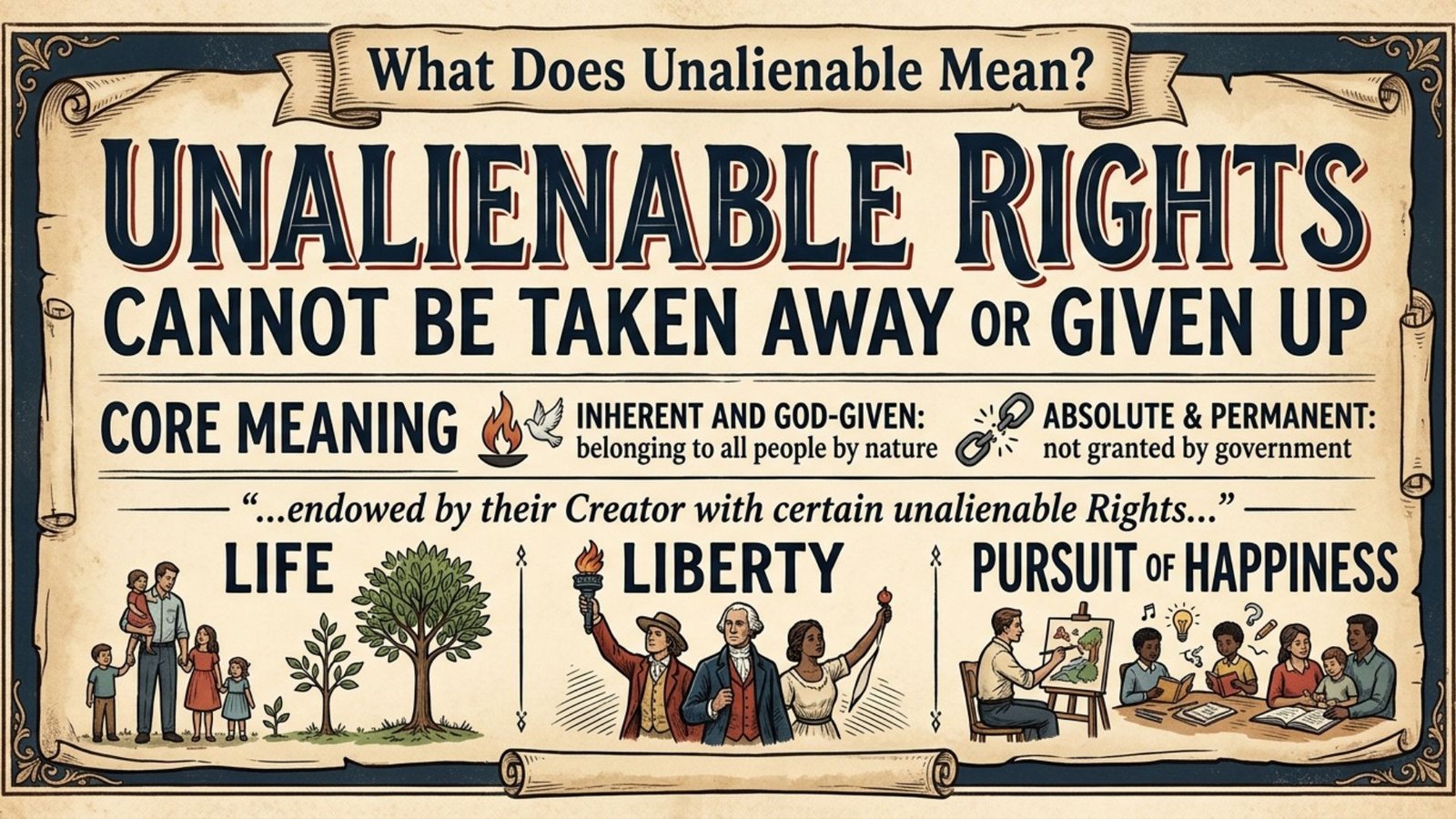
If you’ve ever wondered what does unalienable mean, the short answer is simple: it describes something that cannot be given away, sold, or taken from a person, even by force or law. Unalienable rights belong to a person simply because they exist.
What Is the Simple Definition of Unalienable?
The word is an adjective, and it almost always shows up next to the word “rights.” Understanding it starts with breaking down where it sits in everyday and historical language.
- Cannot be transferred from one person to another, ever.
- Belongs to a person by birth, not by government approval.
- Exists before laws, constitutions, or courts were ever written.
- Applies to life, liberty, and the pursuit of happiness classically.
- Differs slightly in spelling from its more modern twin, inalienable.
- Shows up most often in historical and patriotic American writing.
- Signals moral weight rather than strict legal procedure.
Example in texting: Friend 1: omg my teacher said unalienable isn’t even a real word 😭 Friend 2: it is!! it means rights that can’t be taken away, it’s in the Declaration lol
What Do Unalienable and Inalienable Mean?
Here’s where most people get tripped up: unalienable and inalienable mean almost the same thing, yet writers use them in very different settings depending on tone and audience.
Are Unalienable and Inalienable Really Different Words?
Both terms describe rights that cannot be transferred, surrendered, or stripped away by anyone, including the government itself. The difference lives in history and register, not in core meaning.
- Unalienable grew out of early modern English usage centuries ago.
- Inalienable comes from the Latin root inalienabilis, meaning inseparable.
- Both function as adjectives describing rights, freedoms, or entitlements.
- Neither word changes the legal weight of the right itself.
- Context decides which spelling sounds correct to a trained ear.
- Formal legal writing almost always defaults to inalienable today.
| Feature | Unalienable | Inalienable |
| Root | Early Modern English | Latin (inalienabilis) |
| Tone | Historical, rhetorical | Legal, formal |
| Typical Use | Speeches, historical texts | Contracts, human rights law |
| Modern Frequency | Moderate | High |
| Grammatical Role | Adjective | Adjective |
Example in chat: Friend 1: so which one do I use in my essay Friend 2: if it’s about the Declaration, use unalienable otherwise go with inalienable, it’s the modern standard
Unalienable The American Historical Term
This is the version most Americans grew up hearing, mostly because one man wrote it into the country’s founding document and never looked back.
Why Is Unalienable Tied to American History?
Thomas Jefferson chose this exact spelling in 1776, and that single decision cemented the word’s place in American identity for the next two and a half centuries.
- Jefferson used the word directly in the Declaration of Independence text.
- Early drafts actually used inalienable before the final rewrite happened.
- Sound mattered unalienable felt more native and less Latin-based.
- Speeches and civic ceremonies still favor this historical spelling today.
- Textbooks covering the founding era usually preserve the original wording.
- Patriotic writing leans on it for emotional and historical resonance.
Example in texting: Friend 1: why did Jefferson pick unalienable instead of inalienable Friend 2: apparently it just sounded more natural in English at the time, less fancy-Latin
Why Did Thomas Jefferson Choose Unalienable Over Inalienable?
This is one of the most searched questions about the word, and the honest answer involves sound, audience, and a very human editing decision.
Was Jefferson’s Word Choice Intentional or Accidental?
Historians generally agree it was a deliberate stylistic choice, made so ordinary citizens not just lawyers could read and understand the document easily.
- Clarity for everyday readers mattered more than Latin formality.
- Editing notes show the switch happened during final document revisions.
- Rhythm of the sentence may have influenced the final spelling pick.
- Legacy of that choice still shapes American vocabulary today.
- Debate among historians continues over whether it was truly deliberate.
Example in chat: Friend 1: did Jefferson mess up the spelling or was it on purpose Friend 2: pretty sure it was on purpose, he wanted regular people to actually understand it
Inalienable The Legal and Global Standard
Step outside historical American writing, and the word changes almost entirely. Courts, treaties, and international bodies overwhelmingly prefer the other spelling.
Where Does Inalienable Dominate Modern Writing?
The United Nations Universal Declaration of Human Rights uses this spelling exclusively, and that single fact tells you almost everything about its global legal standing.
- Courts and legal scholars consistently choose inalienable over the alternative.
- International treaties and human rights documents use it as standard.
- Academic philosophy papers favor its more formal, classical tone.
- Noun form, inalienability, appears often in judicial rulings and journals.
- Precision matters in law, and this spelling reads as more exact.
- Global legal English treats it as the only correct modern option.
Example in texting: Friend 1: is it inalienable rights or unalienable rights in law school Friend 2: 100% inalienable, that’s what every legal textbook and treaty uses
Is Unalienable Even a Real Word?
Yes despite the rumors floating around classrooms and comment sections, this spelling is a fully legitimate, dictionary-recognized English word with a long documented history.
Do Dictionaries Actually Recognize Unalienable?
Major dictionaries list it as a standard adjective, though several mark it as slightly less common than its Latin-rooted counterpart in everyday modern writing.
- Dictionaries confirm it as valid, standard English vocabulary.
- Usage has declined outside historical contexts over recent decades.
- Confusion often starts because spellcheck tools sometimes flag it.
- History proves its legitimacy through continuous use since the 1700s.
- Myth that it’s a “Jefferson typo” has no real historical support.
Example in chat: Friend 1: my spellcheck keeps underlining unalienable, is it even correct Friend 2: yeah it’s real, spellcheck just prefers the more common inalienable spelling
Unalienable vs. Inalienable Key Differences at a Glance
Sometimes the fastest way to understand two similar words is to line them up side by side and see exactly where they diverge.
How Do These Two Words Compare Directly?
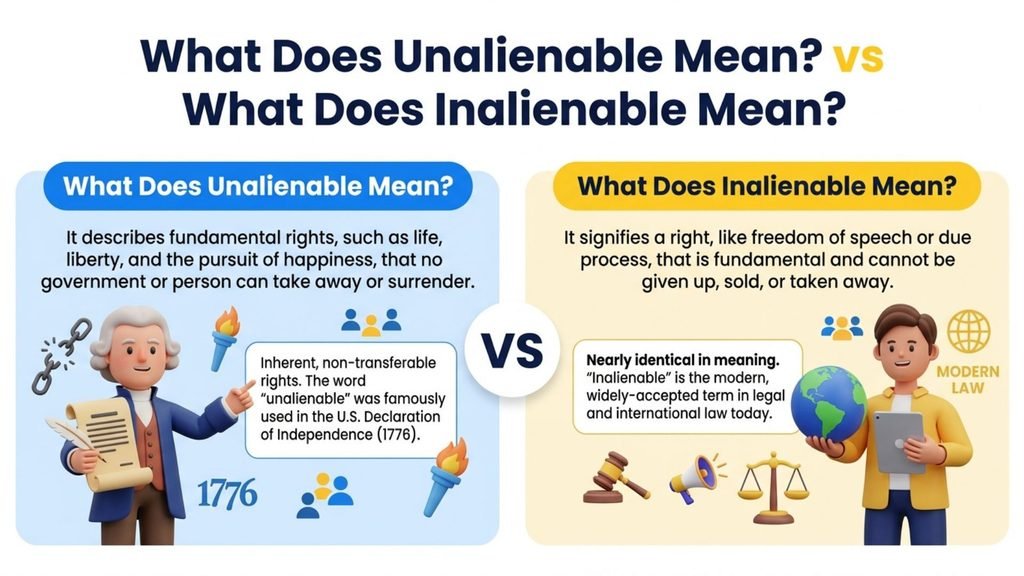
Both describe rights nobody can take away, but the context, audience, and historical weight behind each word shift depending on where and how it’s used.
- Core meaning stays nearly identical across both spellings and traditions.
- Best setting for unalienable is historical or philosophical writing specifically.
- Best setting for inalienable is legal, formal, or international contexts.
- Famous usage anchors unalienable firmly to the Declaration of Independence.
- Modern preference leans heavily toward inalienable in everyday professional writing.
| Aspect | Unalienable | Inalienable |
| Core Meaning | Cannot be morally taken away | Cannot be legally transferred |
| Best Use Case | Historical, philosophical writing | Legal, formal, global writing |
| Famous Usage | Declaration of Independence | UN Human Rights Declaration |
| Modern Preference | Less common today | Widely accepted, safer default |
| Substitution Test | “Cannot be morally taken away” fits | “Cannot be legally transferred” fits |
Example in texting: Friend 1: quick which word sounds more “legal” to you Friend 2: inalienable for sure, unalienable sounds more like a speech or history book
Unalienable Rights Meaning in the Declaration of Independence
No discussion of this word is complete without returning to the exact sentence that made it famous and permanently linked it to American civic language.
What Does the Declaration Actually Say About These Rights?
Jefferson listed life, liberty, and the pursuit of happiness as examples of rights government cannot revoke, framing them as gifts of nature rather than privileges from the state.
- Three rights life, liberty, and happiness anchor the famous phrase.
- Government is described as a protector of rights, not their source.
- Nature and a creator are cited as the origin of these rights.
- Consent of the governed becomes the document’s next major argument.
- Legacy of this single sentence still shapes American political rhetoric.
- Quoting it correctly means preserving the original historical spelling always.
Example in chat: Friend 1: what rights does the Declaration actually call unalienable Friend 2: life, liberty, and the pursuit of happiness the classic three
Synonyms and Related Terms for Unalienable
Widening your vocabulary around this word helps you write with more precision, especially when the exact spelling feels too formal or too historical for your sentence.
What Words Can Replace Unalienable in a Sentence?
Several close synonyms carry similar weight without pulling in the same historical baggage, and each one fits slightly different writing situations depending on tone and formality.
- Natural rights entitlements derived from human nature, not government law.
- Fundamental rights protections written directly into a constitution or charter.
- Human rights universally recognized entitlements found in global treaties.
- Nontransferable a plain, practical synonym common in contracts.
- Irrevocable describes something that cannot be cancelled or withdrawn.
- Sacrosanct used loosely for rights treated as beyond question.
| Term | Best Context | Formality Level |
| Natural rights | Philosophy, ethics | Medium |
| Fundamental rights | Constitutional law | High |
| Human rights | International policy | High |
| Nontransferable | Contracts, business | Medium |
| Irrevocable | Legal documents | High |
Example in texting: Friend 1: need a synonym for unalienable that doesn’t sound so old-fashioned Friend 2: try “fundamental rights” or “nontransferable,” way more modern-sounding
Common Mistakes People Make With Unalienable
Even confident writers slip up here, usually by mixing spellings mid-document or misquoting the one sentence everyone half-remembers from history class.
Which Errors Come Up Most Often With This Word?
Most mistakes involve inconsistency switching between unalienable and inalienable within the same piece of writing, which instantly signals a lack of careful editing to readers.
- Switching spellings mid-document confuses readers and weakens credibility.
- Misquoting the Declaration by altering the original historical wording.
- Assuming the words are always fully interchangeable in every context.
- Using unalienable in legal contracts where inalienable reads more correctly.
- Forgetting that spellcheck often defaults to the more common spelling.
- Overusing the word when a simpler synonym would read more naturally.
Example in chat: Friend 1: I used both spellings in my essay by accident lol Friend 2: pick one and stick with it, mixing them looks sloppy to graders
Can Unalienable Rights Ever Be Taken Away?
This question sounds contradictory at first, but the honest answer involves an important distinction between a right’s existence and its real-world protection.
Does “Unalienable” Mean These Rights Are Impossible to Violate?
In theory these rights can never be surrendered or transferred, but history shows they can absolutely be violated or ignored by governments, wars, or unjust systems in practice.
- Theory says these rights are permanent and cannot be legally erased.
- Practice shows history full of governments violating them anyway.
- Violation does not mean the right stops existing in principle.
- Protection of these rights depends heavily on functioning legal systems.
- Philosophy treats the right as constant even when enforcement fails.
Example in texting: Friend 1: so can unalienable rights actually be taken away or not Friend 2: not legally or morally, but sadly yes in practice throughout history
Unalienable in Modern Legal and Political Writing
Outside of history textbooks, the word still shows up in speeches, op-eds, and political debates, usually chosen deliberately for its emotional and patriotic undertone.
Is Unalienable Still Used in Political Speeches Today?
Politicians frequently reach for it during civic ceremonies, Fourth of July addresses, and constitutional debates because it instantly evokes the founding generation and shared national memory.
- Speeches on national holidays often quote the word directly.
- Op-eds use it to add historical or emotional weight quickly.
- Constitutional debates sometimes reference it alongside inalienable rights language.
- Campaigns invoke it to connect policy positions with founding ideals.
- Journalists occasionally misquote it, swapping spellings without noticing the error.
- Civic education programs teach both spellings side by side deliberately.
| Setting | Preferred Word | Reason |
| Political speeches | Unalienable | Historical, emotional resonance |
| Legal contracts | Inalienable | Formal, precise standard |
| News journalism | Either, context-dependent | Style guide preference |
| Academic philosophy | Inalienable | Classical, scholarly tone |
Example in chat: Friend 1: politicians say unalienable a lot in speeches right Friend 2: yeah especially around July 4th, it just hits different than inalienable
When to Use Which Practical Tips for Writers
Choosing correctly really comes down to one simple question: what is the actual purpose and audience of the piece you’re writing right now?
How Do You Decide Between Unalienable and Inalienable Quickly?
A quick mental test works well if you’re quoting history, keep the original spelling; if you’re writing anything formal or legal, default to the modern standard.
- Citing the Declaration? Keep unalienable and preserve the original wording.
- Writing a legal brief? Choose inalienable or a plain synonym instead.
- Drafting an academic essay? Inalienable fits the expected scholarly register.
- Giving a civic speech? Either works, though unalienable adds historical weight.
- Addressing a mixed audience? Briefly define the term before moving forward.
- Unsure? Read the sentence aloud if it sounds stiff, switch words.
Example in texting: Friend 1: which spelling should I use for my scholarship essay Friend 2: go with inalienable, sounds more polished for that kind of formal writing
FAQs
What does unalienable mean in simple terms?
It means a right that cannot be taken away, sold, or transferred from a person, no matter what.
Is unalienable the same as inalienable?
They share the same core meaning, but unalienable leans historical while inalienable is the modern legal standard.
Why does the Declaration of Independence use unalienable?
Jefferson chose it because it sounded more naturally English and easier for ordinary citizens to understand than the Latin-based alternative.
Can I use unalienable and inalienable interchangeably?
In casual writing, yes; in legal or historical writing, the correct choice depends heavily on your specific context.
What are examples of unalienable rights?
Life, liberty, and the pursuit of happiness are the most famous examples tied to this exact word.
Is unalienable used outside the United States?
Rarely British and international legal writing almost always favors inalienable instead of the historical American spelling.
Does unalienable have a legal definition?
Not a separate one; legally, it functions the same as inalienable, describing rights that cannot be surrendered or revoked.
Conclusion
So, what does unalienable mean at the end of the day? It means a right so deeply tied to being human that no government, contract, or circumstance can rightfully strip it away. Understanding unalienable isn’t just a vocabulary exercise; it connects you to one of the most quoted sentences in American history and a concept that still shapes political debate worldwide.
Whether you’re quoting Jefferson, writing a legal brief, or just settling an argument with a friend, knowing what does unalienable mean gives your words real weight. Next time you see the word, you won’t just recognize it you’ll know exactly why it was chosen, and when to choose it yourself.

Ella Brooks is a passionate writer sharing thoughtful words, inspiring ideas, helpful tips, and engaging content for everyday readers.










2 thoughts on “What Does Unalienable Mean? A Powerful Meaning 2026”