LSI / NLP Keywords, Entities & Related Terms Extracted From Competitor Article
(bolded and woven naturally throughout the article below)
at the house, in the house, on the house, general location, inside the building, preposition, indoor space, outdoor space, property, grammar rule, English phrase, free of charge, restaurant idiom, house vs home, around the house, outside the house, location marker, casual conversation, grammatically correct, contextual meaning, usage comparison, native speaker, everyday English, precise location, indoors, outdoors
Ever said something and then instantly wondered if it even made sense? That’s exactly what happens with on the house or in the house three tiny words that completely flip the meaning of a sentence, and most people never stop to notice.
Here’s the good news: by the end of this guide, you’ll never second-guess yourself again. We’re breaking down at the house or in the house, comparing it with on the house, and giving you real examples so the meaning finally clicks. Keep reading it’s simpler than you think.
When to Use “At the House”
Picture texting a friend “meet me there” without saying where that’s basically what at the house does, and honestly, it works perfectly for casual, low-stakes plans.
How Is “At the House” Used in Everyday Conversations?
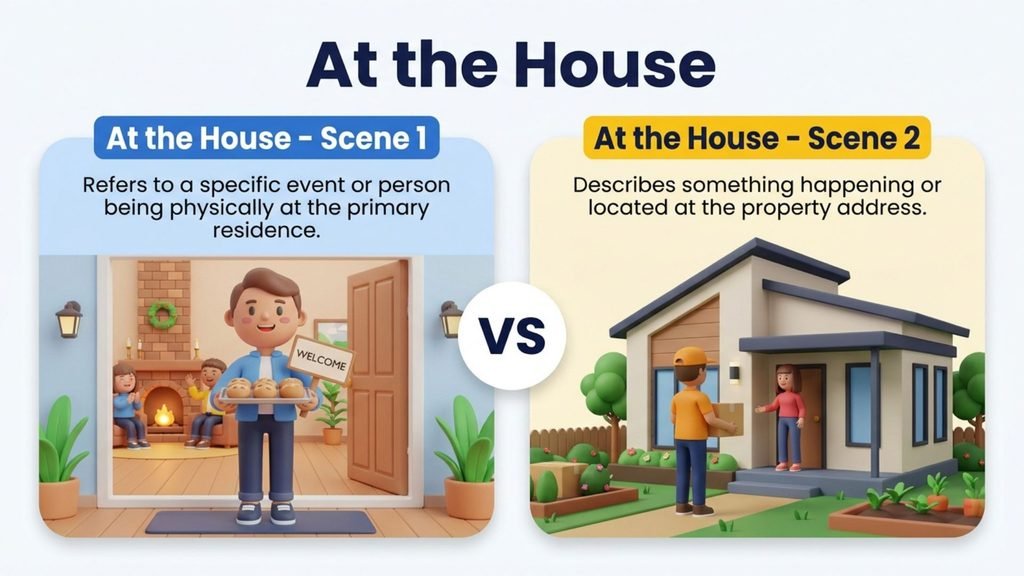
“At the house” is a flexible location phrase. It tells someone that a person or object is somewhere on or near the property, without pinning down the exact spot inside, outside, or in between.
- Use it when the exact spot doesn’t matter to the conversation.
- Say “meet me at the house” for casual plans with friends or family.
- Apply it to deliveries, like “the package is at the house.”
- Pair it with time, such as “I’ll be at the house by six.”
- Keep it vague on purpose when location details aren’t relevant.
- Avoid it when you specifically need to say someone is indoors.
| Situation | Example Sentence | Meaning |
| Meeting friends | “We’re all meeting at the house before the game.” | Somewhere on the property |
| Delivery | “The courier left the box at the house.” | Near the front door or porch |
| Work schedule | “She’s at the house on Mondays.” | Present on the property generally |
Example in texting: Friend 1: Where are you rn? Friend 2: at the house, come round back 🙂
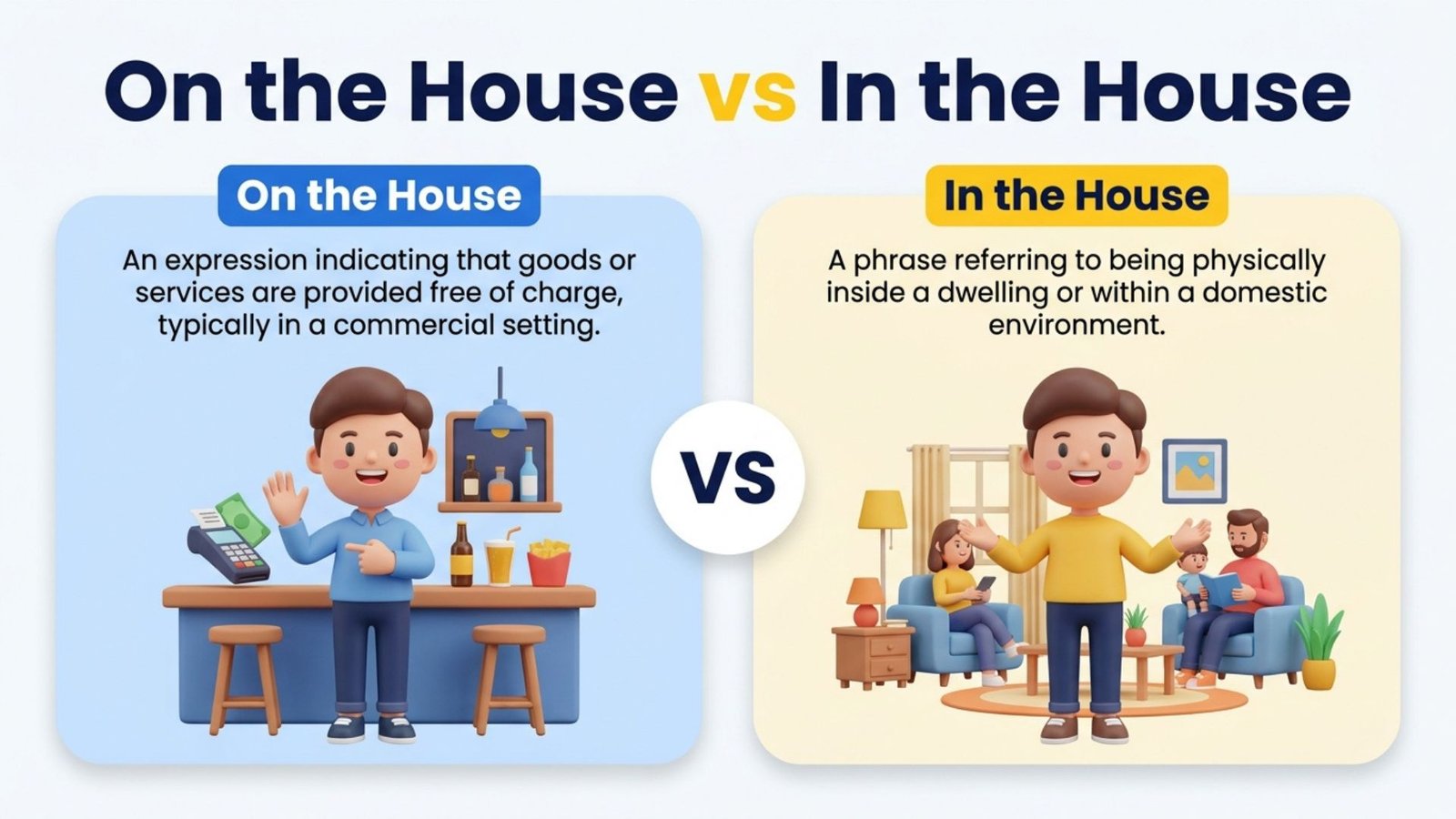
On the House or In the House
Here’s where it gets interesting: on the house doesn’t describe location at all it’s an idiom meaning something is free, while in the house is purely about physical space.
What Does “On the House” Really Mean?
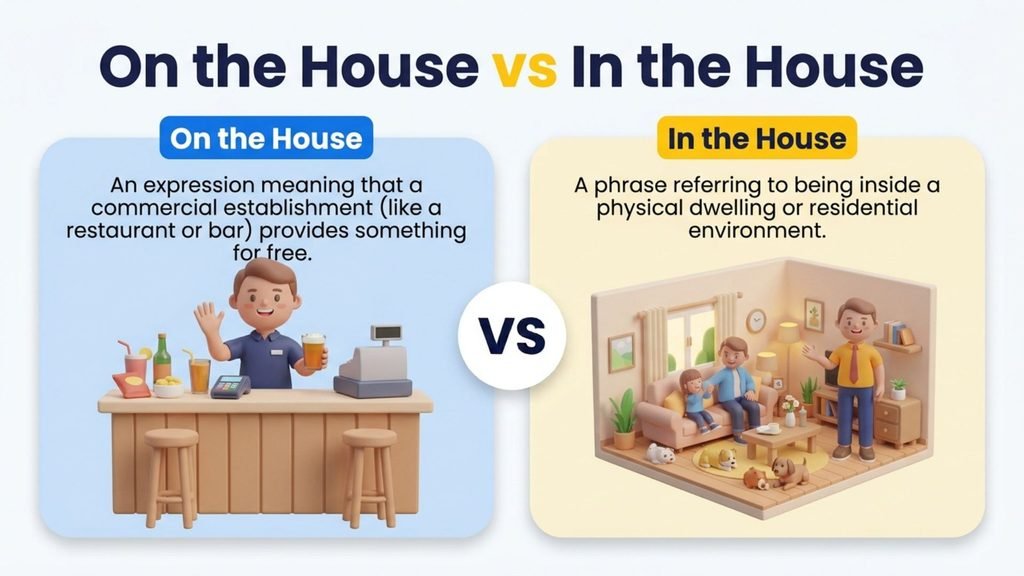
“On the house” is a common phrase used mostly in restaurants, bars, and shops. It means the business is giving you something without charging you a small gesture of goodwill.
- Order a coffee, and the waiter might say it’s on the house.
- Expect this phrase after a complaint the staff wants to smooth over.
- Hear it on birthdays, when a free dessert appears on the house.
- Notice it’s never about location it’s strictly about cost.
- Compare it directly with in the house, which is purely spatial.
- Remember loyalty perks often come on the house at cafés and bars.
| Phrase | Category | Real Meaning |
| On the house | Idiom | Free of charge, given by a business |
| In the house | Location | Physically inside the building |
| At the house | Location | Somewhere on or near the property |
Example in chat: Friend 1: This round’s on the house btw Friend 2: wait seriously? best bartender ever
In the House or On the House
People often type one phrase when they mean the other, especially in fast texting, and that tiny mix-up can genuinely confuse the person reading it.
Why Do People Confuse “In the House” With “On the House”?
The confusion mostly comes from speed-typing and autocorrect, not actual grammar knowledge. Both phrases sound similar in rhythm, which trips up even confident English speakers occasionally.
- Autocorrect swaps prepositions more than people realize while texting fast.
- “On” and “in” feel interchangeable to non-native speakers at first.
- Restaurant slang crosses over into everyday texting without people noticing.
- Context saves the sentence, since readers usually infer the intended meaning.
- Reading the sentence aloud helps catch which phrase actually fits.
- Double-checking before sending avoids awkward, confusing messages entirely.
Example in texting: Friend 1: dessert was on the house lol Friend 2: nice!! were you guys in the house or on the patio?
When to Use “In the House”
Nothing beats the cozy certainty of knowing exactly where someone is, and that’s the entire job of in the house it draws a clear line between indoors and outdoors.
What Does “In the House” Really Mean?
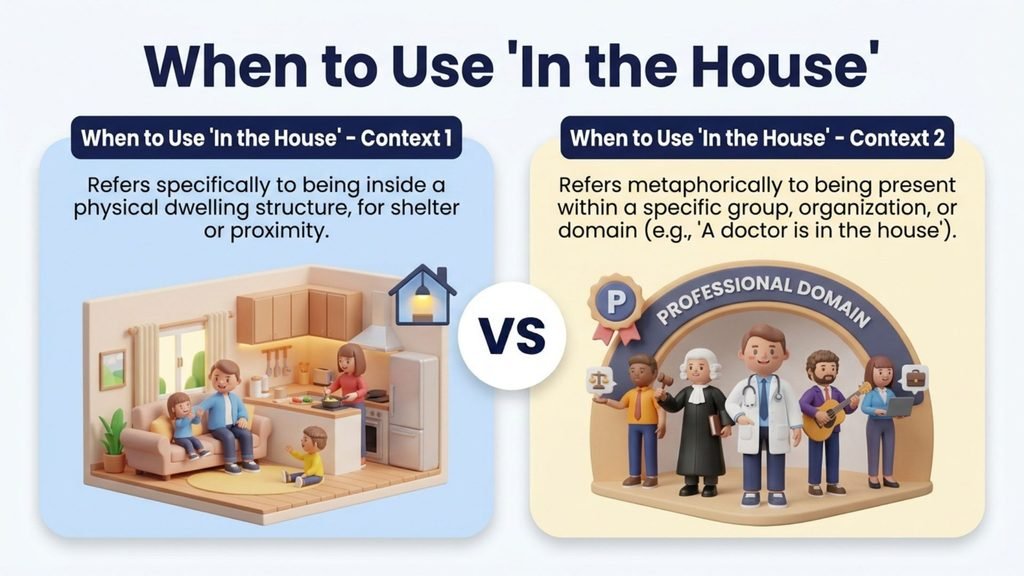
“In the house” always means physically inside the building, within its four walls. It excludes yards, porches, garages, and driveways completely, leaving zero room for guessing.
- Use it when contrasting indoor and outdoor activity directly.
- Say “the kids are in the house” to mean strictly indoors.
- Apply it to weather talk, like staying in the house during rain.
- Pair it with rules, such as “no shoes in the house.”
- Rely on it for precise, unambiguous location statements.
- Skip it if you actually mean somewhere near the property, not inside.
| Word | Precision Level | Best Used For |
| In | High (specific) | Indoor-only statements |
| At | Low (general) | Broad property references |
| On (idiom) | Not spatial | Free-of-charge statements |
Example in chat: Friend 1: is it raining there? Friend 2: yeah we’re all in the house watching movies
At the House or In the House
Choosing between these two phrases comes down to one simple question: does your listener need to know the exact spot, or just the general area someone’s in?
Is It Correct to Say “At the House” or “In the House”?
Both are grammatically correct, but they answer different questions. “At the house” answers where generally, while “in the house” answers whether someone is indoors specifically.
- Pick “at the house” for meeting points and general references.
- Pick “in the house” when indoor versus outdoor actually matters.
- Test it by asking if the exact spot changes the message.
- Notice native speakers switch naturally between both without thinking twice.
- Avoid overcorrecting both phrases are equally proper English.
Example in texting: Friend 1: you at the house yet? Friend 2: yeah, in the house actually, door’s unlocked
“At the House” vs “In the House” Usage Comparison
Seeing both phrases laid out side by side makes the pattern click instantly, and that clarity is exactly what turns confused writers into confident ones.
Which Phrase Sounds More Natural in Everyday Speech?
Native speakers lean on context more than rules. Casual plans favor “at the house,” while stories about indoor moments almost always favor “in the house” instead.
- Casual invitations favor at the house almost every time.
- Weather-related stories favor in the house for clarity.
- Formal writing benefits from the more precise in the house.
- Texting shorthand often blends both loosely, and that’s fine.
- Regional habits shift preference slightly, but both remain correct.
- Idiomatic “on the house” never competes grammatically with either one.
- Consistency within a sentence keeps your meaning crystal clear.
| Phrase | Meaning | Common Usage |
| At the house | General location (inside, outside, or nearby) | Meeting points, general reference |
| In the house | Specifically inside the building | Indoor activities, contrasting with outside |
| On the house | Free, given by a business | Restaurants, bars, promotions |
| Around the house | Various locations near the property | Chores, general activities |
House vs Home: Does It Change the Meaning?
Swapping “house” for “home” feels small, but it quietly shifts the emotional tone of the entire sentence, adding warmth that “house” alone doesn’t carry.
Does Saying “Home” Instead of “House” Change the Meaning?
“Home” adds emotional weight, while “house” stays neutral and structural. Both at the house and in the house can technically be swapped with “home,” but the feeling shifts.
- “Home” suggests belonging, while “house” describes a building only.
- Use “house” in neutral, factual, or logistical sentences.
- Use “home” when warmth or comfort matters to the message.
- Real estate listings almost always say “house,” never “home.”
- Personal texts lean toward “home” for a softer tone.
Example in chat: Friend 1: heading home now Friend 2: cool, see you at the house in 20
Common Mistakes With “At,” “In,” and “On” the House
Small preposition slips happen constantly, and while most get forgiven in casual chat, a few mistakes genuinely confuse the reader’s understanding of where someone actually is.
What Are the Most Common Mistakes People Make?
Most errors come from mixing spatial phrases with the idiomatic “on the house,” or using “in” when the speaker actually means somewhere nearby on the property.
- Saying “on the house” when meaning free is correct, but never for location.
- Writing “in the house” for outdoor events is a common slip.
- Overusing “at the house” in formal writing sounds vague.
- Forgetting context clues leads to genuinely confusing sentences.
- Mixing idiom and location in one sentence without realizing it.
- Autocorrect errors silently swap these prepositions in fast texting.
Example in texting: Friend 1: dinner’s on the house tonight, come at the house around 7 Friend 2: say less, I’m in
Regional and Cultural Differences in Using These Phrases
English shifts slightly depending on where you are, and at the house or in the house can sound more or less common depending on regional speech habits.
Do British and American English Use These Phrases Differently?
American English uses at the house more casually in everyday speech, while British English often prefers “at home” or “round the house” for similar meaning.
- American speakers favor at the house for informal plans.
- British speakers often say “round mine” instead of at the house.
- “On the house” stays consistent as a restaurant idiom worldwide.
- In the house remains universally understood across English dialects.
- Texting slang blends regional habits together more than formal writing does.
Example in chat: Friend 1: you coming round mine later? Friend 2: yeah, I’ll be at the house by 8
“On the House” in Restaurants and Everyday Talk
Few phrases feel as generous as hearing your bill just got lighter, and that’s exactly the warmth on the house brings into casual, everyday conversation.
When Do Businesses Actually Say “On the House”?
Businesses use this phrase to build goodwill, apologize for mistakes, or reward loyal customers, and it always signals something given without cost, never a location.
- Apology gestures, like a free dessert after a slow order.
- Loyalty rewards, offered quietly to regular customers.
- Birthday freebies, a small drink or treat on the house.
- Marketing tactics, used to build word-of-mouth goodwill.
- Never a location, despite sounding similar to house phrases.
Example in texting: Friend 1: the appetizer was on the house!! Friend 2: okay we’re definitely going back there
FAQs
Is it “on the house” or “in the house”?
They mean completely different things. On the house means free of charge, while in the house means physically inside the building.
What does “at the house” mean exactly?
At the house means someone is generally on or near the property, without specifying whether they’re indoors or outside.
Is “on the house” grammatically correct?
Yes, on the house is a correct, widely used idiom meaning something given without payment, especially in restaurants and bars.
Which is correct, “at the house” or “in the house”?
Both are correct English. At the house gives a general location, while in the house specifically means indoors only.
Can you say “on the house” about a location?
No, on the house never refers to location. Confusing it with at the house or in the house is a common mistake.
Why do people mix up these three phrases?
Because they sound similar and share the word “house,” people mix on the house or in the house more than any other preposition pair.
Does “in the house” ever mean free, like “on the house”?
No, in the house always describes physical location, never cost, which clearly separates it from the idiom on the house.
Conclusion
Choosing between on the house or in the house really just comes down to context. On the house means something’s free, while in the house always points to a physical, indoor location and at the house or in the house simply decides how specific you need to be about where someone is.
Once you notice the pattern, you’ll stop second-guessing yourself in texts, emails, and casual conversations. Next time someone offers you a drink on the house, or tells you they’re already in the house, you’ll know exactly what they mean and you’ll say it with confidence too.

Ella Brooks is a passionate writer sharing thoughtful words, inspiring ideas, helpful tips, and engaging content for everyday readers.










3 thoughts on “On the House or In the House: The Meaning Everyone Gets Wrong 2026”