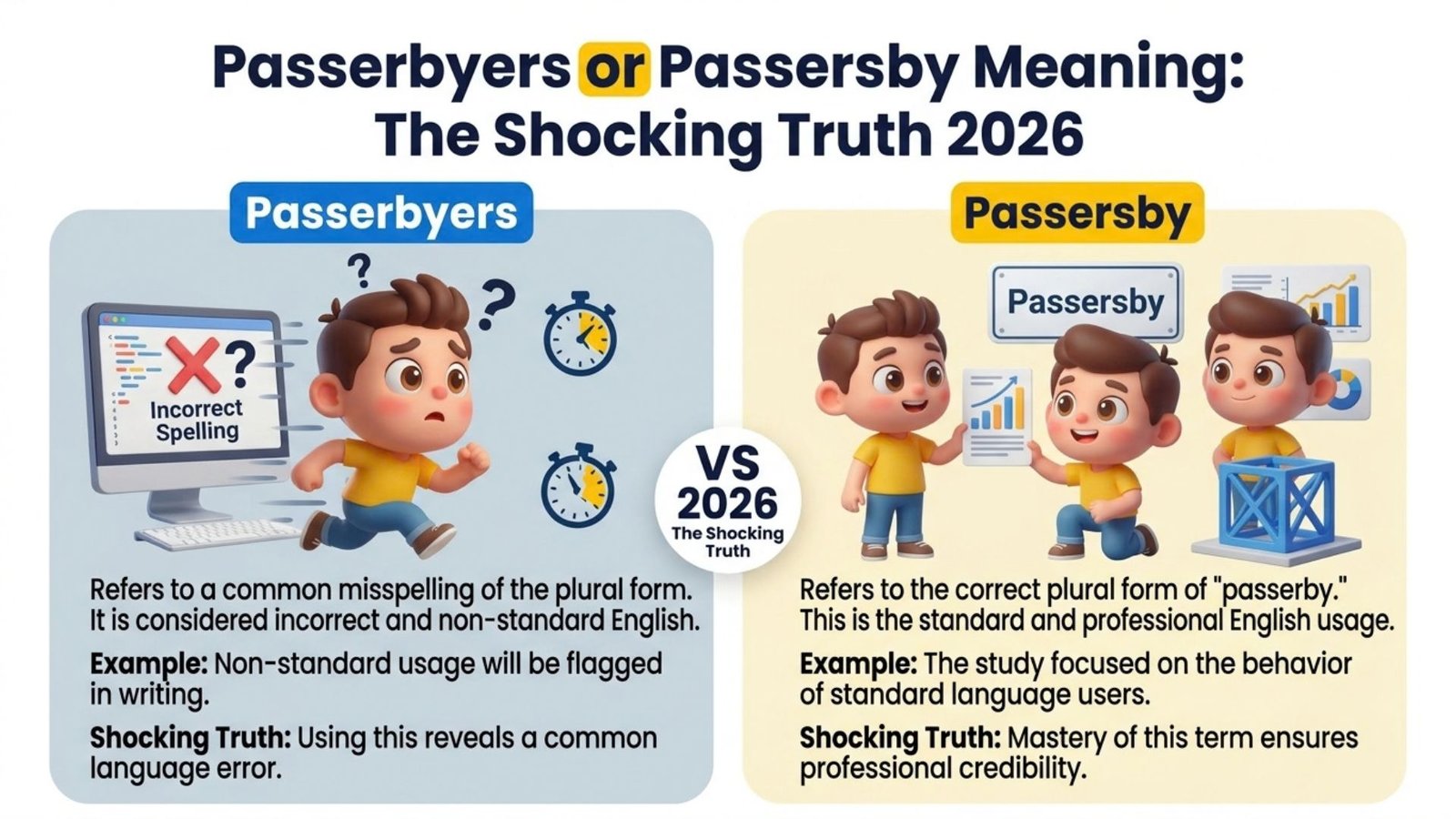
You’re typing a sentence, you reach the word for people walking past, and your fingers freeze. Is it passerbyers or passersby? Spellcheck won’t save you, and you don’t want to look careless in front of your readers.
This guide clears it up fast. You’ll get the passerbyers meaning, the grammar rule behind the plural, real example sentences, and a memory trick that sticks. By the end, you’ll know exactly which form belongs in your writing. Keep reading, and let’s sort it out together.
Passerbyers or Passersby: Which Is Correct?
Ever stared at a sentence wondering whether it’s passerbyers or passersby? You’re not alone. The passerbyers meaning puzzle trips up writers daily, so let’s settle it with one clear answer.
Which Spelling Do Dictionaries Actually Accept?
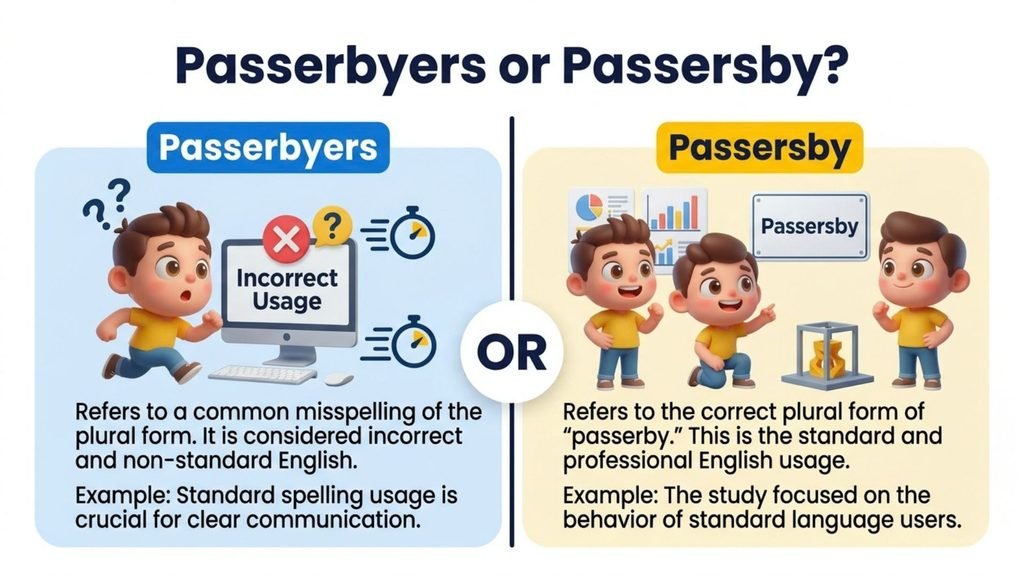
The answer is passersby. It’s the standard plural form of passerby, a compound noun that names a person walking past a place or event. Major dictionaries such as Merriam-Webster list this form, and style guides follow along. The other spelling in your head isn’t part of standard English, no matter how natural it sounds aloud.
- Passersby is the accepted plural in standard English.
- Passerby is the singular, meaning one person walking past.
- Passerbyers appears in no major dictionary.
- Passerbys is a common misspelling, not a variant.
- Always pluralize the first part of the compound.
- When unsure, check a trusted dictionary before publishing.
| Form | Status | Use It? |
| passerby | Singular | Yes |
| passersby | Plural | Yes |
| passerbys | Common misspelling | No |
| passerbyers | Not a word | No |
Example in texting:
Friend 1: Is it “passerbyers” or “passersby” for the crowd outside?
Friend 2: Passersby. Add the s in the middle, not at the end.
Is “Passerbyers” a Word?
Short answer: no. But why does passerbyers feel so believable? Let’s look at how this passerbyers or passersby word mix-up starts, and where the passerbyers meaning people intend really belongs.
Why Does Passerbyers Sound Like a Real Word?
Because English loves the -er suffix. We turn verbs into people all the time: runner, teacher, passer. Add a plural ending and the brain assembles something that looks legitimate. But passerbyers stacks a second agent ending onto a word that already has one, and no dictionary entry supports that. It’s an invented form, not a regional variant.
- Passerbyers is not listed in any major dictionary.
- The -er ending already sits inside “passer.”
- Adding -yers doubles the agent suffix unnecessarily.
- Search engines may autocorrect it to “passersby.”
- Editors will flag it as an error immediately.
- Use passersby for any group of people walking past.
Example in chat:
Friend 1: Spellcheck keeps underlining “passerbyers.” Is it even real?
Friend 2: Nope. It’s passersby, one word with the s in the middle.
Passerbyers Meaning
Curious about the passerbyers meaning? Here’s the truth: the word doesn’t exist, yet everyone who types passerbyers or passersby is really describing one thing, a crowd of people strolling past.
What Do People Mean When They Write Passerbyers?
When someone writes passerbyers, they almost always mean multiple people who happen to walk by a place, event, or incident. That is exactly what passersby covers. So the intended meaning is real and useful; only the spelling is wrong. Think of it as a misspelling with a clear destination, not a new vocabulary item.
- Intended meaning: several people casually walking past.
- Real word: passersby carries that exact meaning.
- Singular: passerby names just one such person.
- Tone: neutral, often used in news and storytelling.
- Context: accidents, street scenes, shop windows, public events.
- Avoid inventing plurals when a standard one exists.
| What People Type | What They Mean | Correct Word |
| passerbyers | many people walking by | passersby |
| passerbys | many people walking by | passersby |
| passerbyer | one person walking by | passerby |
Example in texting:
Friend 1: Lots of passerbyers filmed the street fight.
Friend 2: You mean passersby. Same idea, correct spelling.
What Is the Plural of Passerby?
Here’s the clean answer to the passerbyers or passersby debate: the plural of passerby is passersby. Knowing that, the passerbyers meaning question disappears, because only one plural form is correct.
How Do You Form the Plural of Passerby?
Move the plural marker to the noun inside the word. Passer becomes passers, and by stays untouched, giving you passersby. It looks odd because the s sits mid-word, yet this is exactly how English handles many compound nouns. Once you see the pattern, you can predict the plural without memorizing it.
- Singular: one passerby.
- Plural: two or more passersby.
- Add s to “passer,” not to “by.”
- Keep the word closed, with no space or hyphen in American usage.
- Never add -s or -ers at the very end.
- Test the rule by saying “passers who go by.”
Example in chat:
Friend 1: One passerby called 911, but there were more.
Friend 2: Right, several passersby stayed until help arrived.
Passerby, Passersby, Passerbys, or Passerbyers?
Four spellings, one winner. Comparing all four side by side makes the passerbyers or passersby choice obvious, and the passerbyers meaning people search for points to one correct, standard form.
Which of These Four Forms Is Right?
Only two of them belong in your writing: passerby for one person and passersby for several. The others come from habit. People hear a plural, reach for the usual -s ending, or pile on -ers. Neither instinct matches the grammar rule that governs this particular compound noun.
- Passerby: correct singular for one person walking past.
- Passersby: correct plural for a group.
- Passerbys: incorrect, copies the usual -s pattern.
- Passerbyers: incorrect, invented by doubling the agent ending.
- Choose passerby or passersby depending on how many people.
- Proofread for the other two before you hit publish.
| Spelling | Number | Correct? |
| passerby | Singular | ✔ Yes |
| passersby | Plural | ✔ Yes |
| passerbys | Plural attempt | ✘ No |
| passerbyers | Plural attempt | ✘ No |
Example in texting:
Friend 1: Should I write passerbys in my essay?
Friend 2: Use passersby. Passerbys will get a red mark.
The Grammar Rule Behind the Confusion
Behind every passerbyers or passersby slip-up sits one tidy rule. Understand it once, and the passerbyers meaning confusion fades for good, along with plenty of other tricky plurals you meet.
Why Do You Pluralize the Noun in a Compound?
A passerby is built from passer, a noun meaning the person who passes, plus by, an adverb showing direction. Grammarians call the noun the head of the compound. English puts plural endings on the head, so passer becomes passers, and the adverb simply rides along behind it.
- Passer is the noun and the head word.
- By is an adverb that adds direction.
- Pluralize the head, never the trailing adverb.
- The same logic explains mothers-in-law and attorneys general.
- Reading it as passers (who go) by makes the rule stick.
- The pattern feels odd only because -s usually lands last.
Example in chat:
Friend 1: Why isn’t it passerbys if it ends in “by”?
Friend 2: The noun is “passer,” so it takes the s: passersby.
Other Compound Nouns That Pluralize Like Passersby
Passersby isn’t a lone oddball. Plenty of English words follow the same simple logic, and seeing them together makes the passerbyers or passersby choice natural, even clarifying the passerbyers meaning.
Which Words Follow the Same Plural Pattern?
Many hyphenated compounds and phrasal nouns keep the plural on the first element. Sister-in-law, runner-up, and hanger-on all work this way. Passerby is simply the version that merged into one word over time, which is why the middle s looks stranger than it really is. Once you spot the head noun, the plural almost writes itself.
- Mothers-in-law: the noun mother takes the plural.
- Runners-up: the noun runner takes the plural.
- Hangers-on: the noun hanger takes the plural.
- Lookers-on: the noun looker takes the plural.
- Attorneys general: the noun attorney takes the plural.
- Spot the head noun first, then add the s.
| Singular | Plural | Plural Goes On |
| passerby | passersby | passer |
| runner-up | runners-up | runner |
| hanger-on | hangers-on | hanger |
| looker-on | lookers-on | looker |
| mother-in-law | mothers-in-law | mother |
Example in chat:
Friend 1: Is it runner-ups or runners-up?
Friend 2: Runners-up, same trick as passersby.
Common Mistakes: Why People Write “Passerbys” or “Passerbyers”
Everyone makes plural mistakes. Spotting why people slip on passerbyers or passersby helps you avoid the trap, and it explains the passerbyers meaning most online searchers really hope to confirm.
Why Do Writers Add -s or -ers at the End?
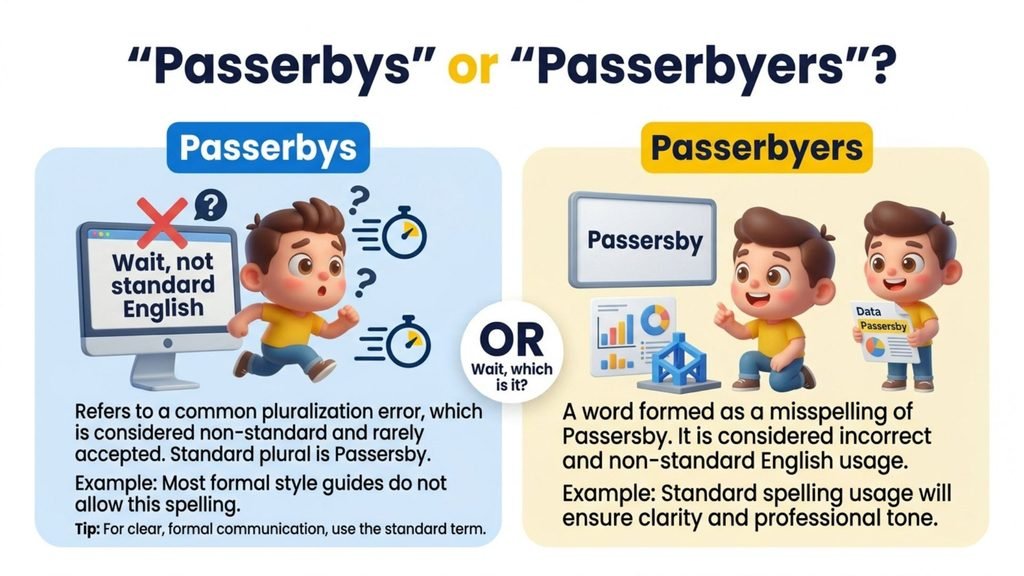
The biggest culprit is pattern habit. Most English nouns take a simple -s, so the brain runs on autopilot. A second cause is hearing the word spoken, where the plural s blurs into the sentence. In spoken English nobody notices, but in print the spelling error stands out fast and can quietly dent your credibility.
- Autopilot: most English plurals end in -s or -es.
- Misreading: some treat “passer” and “by” as separate ideas.
- Sound: spoken plural endings blur in fast conversation.
- Autocomplete: phones sometimes suggest wrong forms without warning.
- Overcorrection: adding -ers feels more “plural” to some writers.
- Fix: slow down and ask which part is the noun.
Example in texting:
Friend 1: I wrote passerbys in my report. Big deal?
Friend 2: Small fix, big credibility boost. Change it to passersby.
Why Does the S Go in the Middle of Passersby?
It looks like a typo, but it isn’t. The middle s is the point of passersby, and understanding it settles passerbyers or passersby while clearing up the passerbyers meaning puzzle.
Where Does the Plural S Belong in Compound Nouns?
The plural s attaches to the part that names the thing being counted. You’re counting people who pass, not people who “by.” So the s lands after passer. Writing it at the end would suggest you’re counting the trailing adverb, which makes no sense grammatically. The middle position is exactly where the plural marker should sit.
- Count the person, not the direction word.
- Passer is the person; by only describes movement.
- Middle s marks the counted noun clearly.
- End s wrongly pluralizes the adverb.
- Read it aloud as “passers” plus “by.”
- Trust the rule over your plural reflex.
Example in chat:
Friend 1: Why is the s in the middle?
Friend 2: Because passers are the people. “By” just shows they’re walking past.
How to Use “Passersby” Correctly in Sentences
Rules stick when you see them working. These real-world sentences show passersby in action, helping you settle passerbyers or passersby and giving the passerbyers meaning a clear context you’ll remember.
What Are Good Example Sentences With Passersby?
Notice how passersby works as the subject, the object, and even part of a longer phrase. It fits news reporting, fiction, marketing copy, and casual chats. The tone stays neutral, so you can drop it into formal or relaxed writing without sounding stiff.
- News: “Several passersby called 911 after the crash.”
- Street scene: “Musicians drew passersby with an upbeat melody.”
- Rescue: “Passersby helped the driver out before firefighters arrived.”
- Business: “Our window display caught many passersby at lunchtime.”
- Fiction: “She watched passersby hurry through the rain.”
- Police: “Officers asked passersby whether anyone saw the suspect.”
- Singular: “A passerby returned my wallet this morning.”
Example in texting:
Friend 1: Did anyone help after the bike crash?
Friend 2: Yes, two passersby stopped, and one passerby called an ambulance.
Passerby vs. Bystander: What’s the Difference?
Are passersby and bystanders the same people? Not quite. Clearing this up sharpens the passerbyers meaning and keeps your passerbyers or passersby choice precise in news stories, essays, and storytelling.
How Is a Passerby Different From a Bystander?
A passerby is moving. They happen to pass a spot and may not stop at all. A bystander is present and watching, often because something is happening. One person can start as a passerby and become a bystander the moment they pause to see what’s going on. That small shift changes which word fits best.
- Passerby: someone walking past, usually without stopping.
- Bystander: someone standing nearby while something happens.
- Onlooker: a person who watches an event unfold.
- Witness: a person who sees and can describe an incident.
- Pedestrian: anyone traveling on foot, in any situation.
- Choose the word that matches whether the person stopped.
| Term | Moving or Still? | Typical Use |
| Passerby | Moving | Street scenes, news |
| Bystander | Standing | Accidents, emergencies |
| Onlooker | Watching | Events, performances |
| Pedestrian | Moving on foot | Traffic, safety |
Example in texting:
Friend 1: Was he a bystander or a passerby?
Friend 2: Passerby at first, then he stopped to help and became a bystander.
Passerby Synonyms: Better Words for Passersby
Repeating one word gets dull. Fresh alternatives keep your writing lively, and knowing them reinforces the passerbyers meaning while the passerbyers or passersby spelling stays rock solid in your head.
What Are Some Synonyms for Passersby?
Synonyms shift the mood. Pedestrians feels practical, onlookers feels observant, and strangers adds distance. Pick the one that fits your scene, but remember that passersby stays the most precise choice for people simply walking past. Just check that each synonym’s plural is spelled correctly too, since small slips can undo good word choice.
- Pedestrians: people traveling on foot along streets.
- Onlookers: people who stop and watch something.
- Bystanders: people nearby when an event happens.
- Strangers: people you don’t know, passing through.
- Walkers: casual word for people on foot.
- Spectators: people watching a planned event or show.
Example in chat:
Friend 1: Can I swap passersby for pedestrians?
Friend 2: Sure, if you only mean people on foot.
How Do You Make Passersby Possessive?
Possessives add another layer of doubt. Luckily, the very same rule that answers passerbyers or passersby also guides the apostrophe, and it quietly supports the passerbyers meaning you already understand.
What Is the Possessive Form of Passerby and Passersby?
Treat the word like any noun that doesn’t end in a plural s. Add an apostrophe plus s to both the singular and the plural. Because passersby ends in y, not s, it takes ‘s just as “children” becomes “children’s.” If the result sounds clumsy in your sentence, simply reword it for a smoother read.
- Singular possessive: passerby’s, as in “the passerby’s quick thinking.”
- Plural possessive: passersby’s, as in “the passersby’s cell phone videos.”
- Add apostrophe-s because the plural doesn’t end in s.
- Skip passersbys’, which is wrong on two counts.
- Reread the sentence to confirm who owns what.
- Reword when the possessive feels heavy.
Example in texting:
Friend 1: Whose videos helped the police?
Friend 2: The passersby’s. They filmed everything.
Passerby vs. Passer-by: Correct Spelling
Hyphen or no hyphen? Spelling varies by region, which fuels the passerbyers or passersby mess. Here’s how it connects to the passerbyers meaning and when each style is perfectly acceptable.
Is It Passerby or Passer-by in British and American English?
American dictionaries such as Merriam-Webster list the closed form passerby with the plural passersby. British sources like Oxford and Cambridge commonly show the hyphenated passer-by with passers-by. Both are standard in their regions. Pick one spelling convention, follow your publisher’s style guide if you have one, and stay consistent through your whole piece.
- American English: passerby and passersby, closed forms.
- British English: passer-by and passers-by, hyphenated forms.
- Consistency matters more than which accepted style you choose.
- Never mix styles, such as passer-bys or passerbys.
- Follow your publisher’s style guide when one exists.
- Avoid two-word versions like “passer by” in any region.
| Style | Singular | Plural | Region |
| Closed | passerby | passersby | US |
| Hyphenated | passer-by | passers-by | UK |
| Incorrect | passer-bys | passerbyers | None |
Example in chat:
Friend 1: My UK editor changed passersby to passers-by.
Friend 2: Both are right. They’re just following British style.
How to Pronounce Passersby Correctly
Saying it right builds confidence in writing it right. A clear pronunciation anchors the passerbyers meaning, so the passerbyers or passersby question never trips you up in speech or text.
How Do You Say Passersby Out Loud?
Say it as three beats: PASS-erz-BY. The plural s between vowels sounds like a z, and the strongest stress falls on the final by, with a lighter stress on the first syllable. Speakers often rush the word, which is exactly why the plural s gets forgotten when people write it down.
- Syllables: pass, erz, by.
- Stress: strongest on the last syllable, “by.”
- Sound: the plural s becomes a soft z.
- Rhyme: the final syllable rhymes with “buy” and “sky.”
- Practice by saying “passers go by” quickly three times.
- Remember the sound hints at the spelling’s middle s.
Example in chat:
Friend 1: Do I say pass-er-BY or PASS-er-by?
Friend 2: Stress the last part: pass-erz-BY.
What Does Passersby Mean in Everyday English?
At its core, the word is simple. Seeing how passersby lives in daily speech finishes the passerbyers meaning story and keeps your passerbyers or passersby decision easy from now on.
How Is Passersby Used in Everyday Conversations?
Passersby means people who happen to walk past a place, person, or event without a planned reason to be there. It often signals chance and anonymity. Journalists use it for eyewitnesses, shop owners use it for foot traffic, and novelists use it to paint a busy, indifferent city scene.
- Meaning: people walking past a place or event.
- Feeling: random, anonymous, unplanned presence.
- News: often points to unplanned eyewitnesses or helpers.
- Retail: describes foot traffic outside a shop window.
- Fiction: sets a busy, indifferent background scene.
- Origin: formed from “pass by,” the phrasal verb.
Example in texting:
Friend 1: What did the article mean by “passersby”?
Friend 2: Just random people walking past when it happened.
Quick Reference Guide
Need the short version? Bookmark this cheat sheet. It settles passerbyers or passersby in seconds and keeps the passerbyers meaning straight whenever you write emails, essays, captions, or quick reports.
What Should You Remember About Passerby and Passersby?
Keep three ideas in mind: one person is a passerby, several people are passersby, and the plural s goes on passer. Everything else, from possessives to hyphens, grows from that base. Memorize the trick below and you’ll never second-guess yourself again.
- Singular: passerby, one person walking past.
- Plural: passersby, two or more people.
- Rule: pluralize the noun, not the adverb.
- Avoid: passerbys, passerbyers, passer-bys.
- Possessive: passerby’s and passersby’s.
- Memory trick: think “passers who go by.”
| Need | Correct Form | Example |
| One person | passerby | A passerby waved. |
| Many people | passersby | Passersby gathered. |
| British style | passer-by / passers-by | Passers-by stopped. |
| Possessive plural | passersby’s | The passersby’s photos. |
Example in texting:
Friend 1: Final check: passerbyers or passersby?
Friend 2: Passersby. Every time.
FAQs
Is passerbyers a real word?
No, in the passerbyers or passersby debate, only passersby is a real word. Passerbyers appears in no major dictionary.
Is passerbys ever correct?
No. When choosing between passerbyers or passersby, remember that passerbys is wrong too. The plural of passerby is always passersby.
What is the plural of passerby?
The passerbyers or passersby answer is passersby. Add the s to passer, the noun, and leave by unchanged.
Is passersby one word or two?
In the passerbyers or passersby question, passersby is one word in American English. British writers often hyphenate it as passers-by.
What is the possessive of passersby?
Whichever you pick in passerbyers or passersby, the possessive is passersby’s. Simply add an apostrophe and s to the plural.
How do you pronounce passersby?
Beyond the passerbyers or passersby spelling, say it PASS-erz-BY. The plural s sounds like z, and the last syllable gets the strongest stress.
What is the difference between passerby and bystander?
Past the passerbyers or passersby choice, a passerby is simply walking past. A bystander is standing nearby while something happens.
Conclusion
So, passerbyers or passersby? The answer is passersby, every time you mean more than one person walking past. The passerbyers meaning people hope to find really points to this standard plural, because passerbyers never made it into any dictionary.
Remember the simple rule: pluralize the noun, not the adverb, just like mothers-in-law and runners-up. Whether you write American passersby or British passers-by, stay consistent and proofread for passerbys. Once you’ve settled passerbyers or passersby in your own mind, the doubt tends to disappear for good.
Next time you’re typing fast, picture “passers who go by” and trust the rule. Try it today: scan one recent email or post and fix any shaky plurals. Small corrections like this quietly build the credibility readers feel but rarely mention.

Ella Brooks is a passionate writer sharing thoughtful words, inspiring ideas, helpful tips, and engaging content for everyday readers.