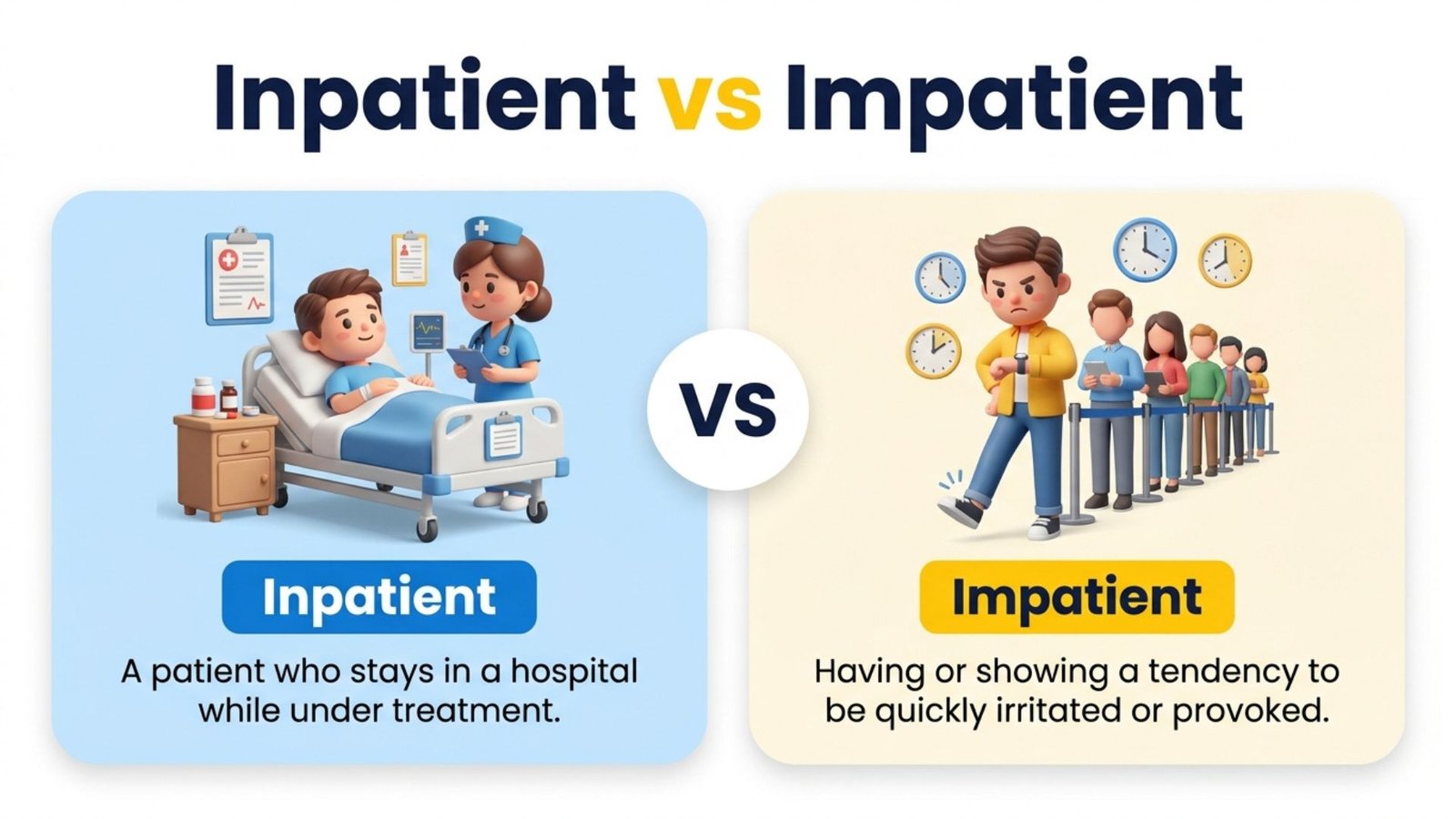
You type the sentence, pause, and stare at it. One letter looks off. Is it inpatient vs impatient? That tiny “m” and “n” have embarrassed nurses, students, bloggers, and people writing insurance emails at 11 p.m.
Here you’ll get the plain inpatient vs impatient meaning, clear examples, quick memory tricks, and a test you can run in two seconds before you hit send. No grammar lecture, no jargon. Just the difference between impatient and inpatient explained the way a friend would explain it, plus the correct usage patterns that make your writing look sharp. Keep reading, it takes five minutes.
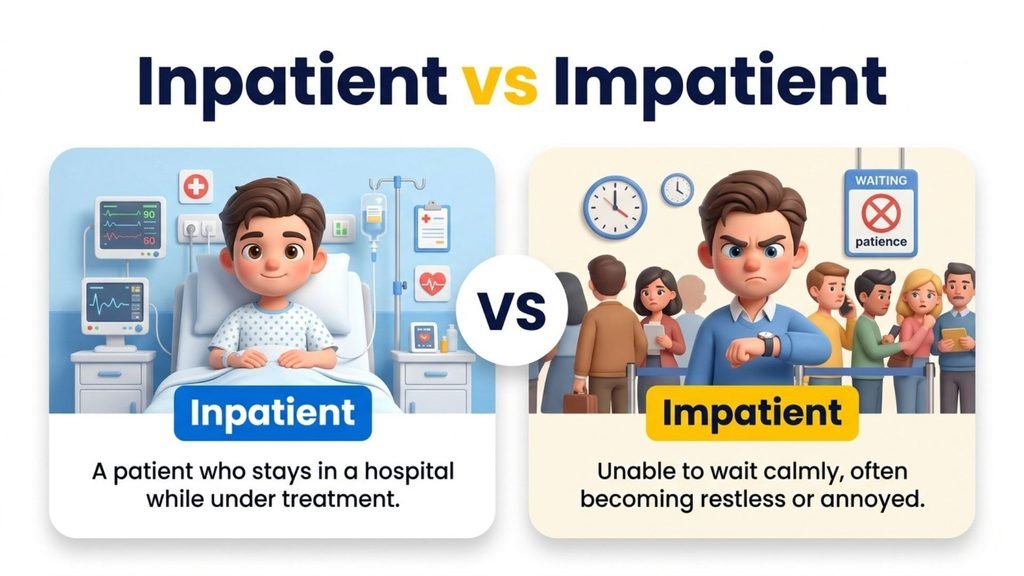
Inpatient vs Impatient: What’s the Difference?
Two words, one letter apart, two completely different worlds. The inpatient vs impatient confusion happens because your ear hears almost nothing, while your spelling carries the whole meaning.
What Separates Inpatient From Impatient in One Line?
- Impatient is an adjective describing a restless, frustrated emotional state.
- Inpatient is a medical term for a hospital-admitted patient staying overnight.
- Prefix “im-“ means not, so not patient equals annoyed.
- Prefix “in-“ means inside, so inside the hospital equals admitted.
- Stress changes too: im-PAY-shunt versus IN-pay-shunt.
- Context decides: feelings pick impatient, healthcare picks inpatient.
| Word | Type | Core Meaning | Everyday Sentence |
| Impatient | Adjective | Restless, eager, frustrated while waiting | He gets impatient in slow checkout lines. |
| Inpatient | Noun / Adjective | Patient admitted for overnight care | She spent four days as an inpatient. |
Example in chat: Friend 1: “Was your dad impatient or inpatient last night?” Friend 2: “Both honestly. Admitted at 9, complaining about the food by 10.”
Inpatient or Impatient: Which Word Should You Use?
Choosing feels risky when both spellings look plausible on screen. The impatient vs inpatient decision gets simple once you ask what kind of situation you’re actually describing right now.
How Do You Pick the Right Word in Five Seconds?
- Swap test first: replace with “frustrated” or “hospitalized” and see which fits.
- Check the subject: people feel impatient, people become an inpatient.
- Look for a hospital word nearby: admission, ward, discharge, inpatient care.
- Look for an emotion word nearby: waiting, delay, traffic, restless.
- Never write “an impatient” as a noun. That’s a common grammar mistake.
- Read it out loud; the stressed syllable usually gives you the answer.
Example in texting: Friend 1: “Autocorrect changed my note to ‘impatient unit.’ Fix it?” Friend 2: “Yep, make it inpatient unit. Otherwise the ward sounds cranky.”
Patient vs Impatient: Understanding the Difference
Before the inpatient vs impatient puzzle even starts, there’s an older pair worth sorting out. “Patient” wears two hats, and that double life is where confusion quietly begins.
Why Does “Patient” Have Two Completely Different Meanings?
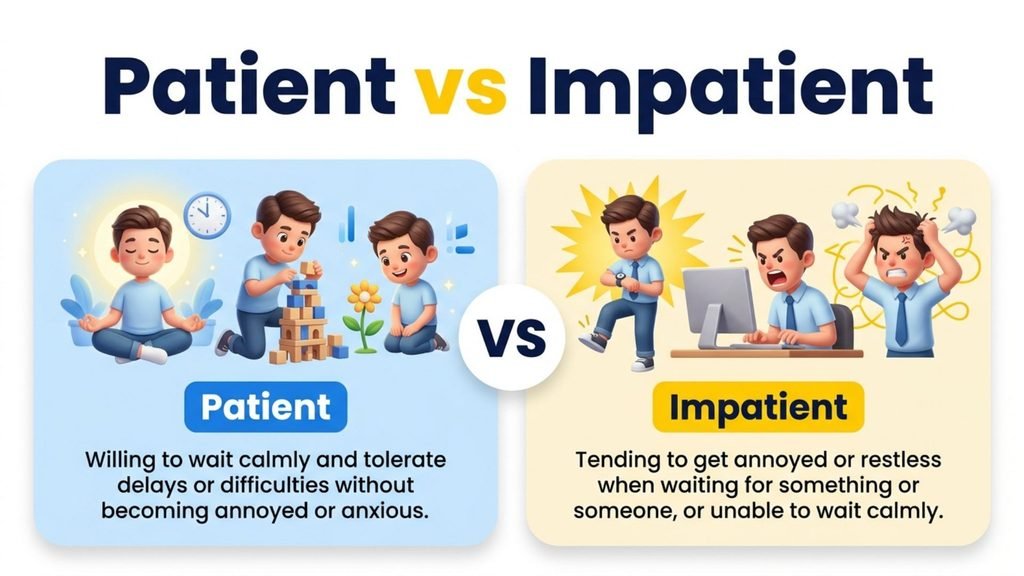
- Patient (adjective) means calm, tolerant, willing to wait without frustration.
- Patient (noun) means a person receiving medical treatment from a provider.
- Impatient only negates the adjective sense, never the medical noun.
- Inpatient builds on the noun sense, adding location, not attitude.
- Same root word, Latin patiens, meaning “enduring” or “suffering.”
- One root, two branches: emotion on one side, healthcare on the other.
| Word | Sense | Meaning | Example |
| Patient | Adjective | Calm while waiting | Be patient, the results take an hour. |
| Impatient | Adjective | Restless, irritated | She’s impatient with slow replies. |
| Patient | Noun | Person under care | The patient signed the consent form. |
| Inpatient | Noun | Admitted person | The inpatient moved to room 214. |
Example in chat: Friend 1: “So a patient can be impatient?” Friend 2: “Exactly. Half the waiting room is proof.”
The Core Rule Explained Simply
Forget rules for a second and think pictures. One word shows a tapping foot, the other shows a hospital bracelet. That single image handles most inpatient vs impatient decisions instantly.
What’s the One Rule That Covers Every Case?
- Feelings equal impatient, always, with zero medical exceptions.
- Hospital admission equals inpatient, including billing and insurance coverage notes.
- The prefix carries the meaning, not the rest of the word.
- Emotion cannot be admitted to a hospital, so impatient stays personal.
- Location cannot feel annoyed, so inpatient stays clinical.
- When both apply, use both words in the same sentence proudly.
Impatient: The Emotional State
Impatience is human. It shows up in traffic, in waiting rooms, in group chats where someone leaves you on read for eleven agonizing minutes straight.
How Does Impatient Show Up in Real Life?
- Describes people, moods, tones, gestures, and behavior under delay.
- Common synonyms: restless, antsy, eager, irritable, short-tempered.
- Pairs with prepositions: impatient with someone, impatient for something.
- Works in professional writing about deadlines, service, or customer frustration.
- Never appears in medical charts, admission forms, or discharge summaries.
- Has a noun form: impatience, which describes the feeling itself.
Example in texting: Friend 1: “Any update from the clinic yet?” Friend 2: “Nope. I’m getting seriously impatient over here.”
Inpatient: The Medical Status
Inpatient is paperwork language. It marks a person formally admitted, occupying a bed, tracked by a chart, covered under a specific line of hospital billing.
What Makes Someone an Inpatient?
- Formal admission by a physician’s order, not just a visit.
- Overnight stay or longer inside a hospital facility.
- Assigned bed in a ward, unit, or inpatient department.
- Different billing code from outpatient or emergency services.
- Used as an adjective too: inpatient rehab, inpatient treatment, inpatient care.
- Applies across settings: surgical, psychiatric, and rehabilitation units.
Example in chat: Friend 1: “Is he still in the ER?” Friend 2: “No, they admitted him. He’s an inpatient now.”
Inpatient vs Impatient: Side-by-Side Comparison
Sometimes a table settles an argument faster than a paragraph. Here’s the full inpatient vs impatient breakdown covering origin, tone, usage, and the errors people repeat constantly.
Which Details Actually Matter When Comparing These Words?
- Origin explains the prefix logic better than memorization ever will.
- Part of speech stops you from writing “an impatient” by accident.
- Setting tells you whether you’re in feelings or clinical documentation.
- Pronunciation stress is the fastest spoken clue available.
- Register differs: one is casual, one is formal medical language.
- Error patterns repeat, so learning them once prevents future slips.
| Aspect | Impatient | Inpatient |
| Origin | Latin impatientem, “unable to endure” | English compound: in + patient |
| Part of speech | Adjective only | Noun and adjective |
| Setting | Emotions, daily life, workplace | Hospitals, healthcare records, insurance |
| Stress | im-PAY-shunt | IN-pay-shunt |
| Typical partner words | waiting, delay, traffic, queue | admission, ward, overnight stay, discharge |
| Common error | “Mark all impatient admissions” | “The inpatient driver honked” |
Example in texting: Friend 1: “Which one goes in the report?” Friend 2: “Inpatient. The report’s about admissions, not attitudes.”
Deep Dive Into “Impatient”
This word describes something everyone has felt this week. Understanding impatient vs inpatient starts with owning how flexible and emotional this particular adjective really is in practice.
Where Does “Impatient” Fit Most Naturally?
- Personal writing: journals, texts, captions, casual conversation.
- Business writing: describing customer expectations or stalled projects.
- Fiction and storytelling: revealing character through small restless actions.
- Reviews and complaints: explaining why a delay felt unreasonable.
- Self-description: admitting your own impatience without sounding harsh.
- Never in charts, codes, claims, or medical terminology of any kind.
When to Use Impatient
Use it whenever waiting is the problem and a feeling is the subject. If nobody is admitted anywhere, impatient is almost certainly your word.
What Situations Call for “Impatient” Specifically?
- Delays: slow service, late trains, buffering videos, long queues.
- Anticipation: waiting for results, replies, packages, or good news.
- Irritation with people: impatient with a coworker who keeps rescheduling.
- Describing tone: an impatient sigh, glance, or clipped reply.
- Habitual traits: someone who is naturally impatient by temperament.
- Urgency without anger: impatient to begin, start, or get going.
Example in chat: Friend 1: “You’ve checked that tracking link six times.” Friend 2: “I know. I’m impatient. Let me live.”
Clear Examples of Impatient in Action
Reading real sentences beats memorizing definitions. These lines show the word doing its job naturally across everyday, workplace, and slightly emotional contexts you’ll actually write.
What Do Good “Impatient” Sentences Look Like?
- The impatient crowd started clapping before the doors opened.
- I’m impatient for Friday, and it’s only Tuesday morning.
- She sounded impatient on the call, but she apologized after.
- Don’t get impatient with beginners; everyone starts somewhere.
- His impatience cost him the deal he’d chased for months.
- Toddlers are gloriously, loudly impatient about literally everything.
Example in texting: Friend 1: “Sorry, still ten minutes out.” Friend 2: “All good. I’m impatient but I’ll survive.”
The Quick Test for Impatient
One substitution ends the doubt. Say the sentence with “frustrated” instead. If nothing breaks, you’ve found your answer and the impatient vs inpatient question disappears.
How Does the Substitution Test Work?
- Swap in “frustrated” and reread the sentence out loud.
- If it still makes sense, impatient is correct.
- If it sounds absurd, you probably needed the medical term.
- Check for an article: “an impatient” alone signals an error.
- Scan nearby nouns for hospital words that contradict your choice.
- Trust the emotion cue; feelings never belong in admission records.
Example in chat: Friend 1: “‘The frustrated ward has 40 beds’?” Friend 2: “Yeah, that’s your clue. Change it to inpatient.”
Deep Dive Into “Inpatient”
This one lives in hospitals, claim forms, and clinical reports. Getting inpatient vs impatient right here matters more, because the wrong letter changes a document’s meaning.
Why Is “Inpatient” Considered Technical Language?
- It signals a legal status, not just a physical location.
- It triggers different billing, coverage rules, and reimbursement rates.
- It appears in policy documents, hospital reports, and health insurance plans.
- It pairs with department names: inpatient psychiatric care, inpatient rehab.
- It contrasts directly with outpatient and ambulatory services.
- It rarely appears in casual writing unless someone’s genuinely hospitalized.
When to Use Inpatient in Healthcare
Use it when a doctor has formally admitted someone. Not a check-up, not an ER visit that ended at midnight, but an actual hospital admission with a bed.
Which Healthcare Situations Require “Inpatient”?
- Surgery recovery requiring monitored overnight care.
- Intensive care and other high-acuity hospital units.
- Psychiatric admission for stabilization or inpatient treatment programs.
- Rehabilitation stays after stroke, injury, or major surgery.
- Maternity stays extending beyond same-day discharge.
- Insurance paperwork distinguishing inpatient claims from outpatient ones.
Example in texting: Friend 1: “Does insurance cover this?” Friend 2: “Only if it’s coded inpatient. Outpatient has a separate limit.”
Clear Examples of Inpatient in Action
Seeing the word inside real clinical sentences builds instinct fast. Notice how every line involves admission, a facility, a bed, or medical care that continues overnight.
What Do Correct “Inpatient” Sentences Look Like?
- He was admitted as an inpatient after the second scan.
- The new inpatient wing opens in March with 90 beds.
- Inpatient rehabilitation lasted three weeks following the accident.
- Her plan covers inpatient care at eighty percent.
- The hospital reported record inpatient admissions last winter.
- He transferred from outpatient therapy to an inpatient program.
Example in chat: Friend 1: “How long is the stay?” Friend 2: “Five days inpatient, then outpatient follow-ups weekly.”
Recognizing Common Medical Patterns
Certain words travel together. Once you spot these companions in a sentence, the correct spelling becomes obvious before you finish reading the line.
Which Words Signal You Need “Inpatient”?
- Admitted, discharged, ward, unit, bed, facility.
- Claim, coverage, deductible, coding, reimbursement.
- Overnight, 24-hour, extended stay, length of stay.
- Physician order, chart, attending, nursing staff.
- Rehab, psychiatric, surgical, maternity department names.
- Outpatient appearing nearby as the contrasting term.
| Signal Word Nearby | Correct Choice | Why |
| admission, ward, discharge | Inpatient | Describes hospital status |
| waiting, delay, traffic | Impatient | Describes emotional reaction |
| claim, coverage, billing | Inpatient | Insurance terminology |
| annoyed, restless, eager | Impatient | Feeling-based description |
Example in texting: Friend 1: “Draft says ‘impatient discharge summary.'” Friend 2: “Ha. Unless the summary is angry, make it inpatient.”
The Meaning Shift and Important Nuances
Language gets interesting at the edges. The inpatient vs impatient pair has a few subtleties that even confident writers miss when they’re moving quickly through a draft.
What Nuances Do Most People Overlook?
- Inpatient works as an adjective, but impatient never works as a noun.
- “Impatient of” is a formal, older construction meaning intolerant of something.
- Inpatient is rarely pluralized as a noun in clinical writing; “inpatients” exists but reads dated.
- Hyphenation is wrong: never write “in-patient” in modern American usage.
- British texts occasionally still use “in-patient” with a hyphen.
- Both can coexist: an inpatient who is impatient is perfectly grammatical.
Example in chat: Friend 1: “Is ‘in-patient’ acceptable?” Friend 2: “In older British docs, sure. In US writing, drop the hyphen.”
Why Do People Confuse Inpatient and Impatient?
The mix-up isn’t laziness, it’s phonetics. Your mouth blurs “m” and “n” before a “p,” so the impatient vs inpatient difference vanishes the moment you speak.
What Actually Causes This Specific Mistake?
- Nasal assimilation: “n” naturally shifts toward “m” before p sounds.
- Identical syllable count and nearly identical rhythm when spoken casually.
- Autocorrect bias toward impatient, the far more common word.
- Voice-to-text errors in fast-paced clinical documentation.
- Overlapping contexts: hospitals are genuinely full of impatient people.
- Low visual contrast: one letter in a nine-letter word hides easily.
Example in texting: Friend 1: “Dictation wrote ‘impatient bed count.'” Friend 2: “Classic. Your phone assumes everyone’s annoyed, not admitted.”
What Does Inpatient Mean in Simple Terms?
Strip away the paperwork language and it’s straightforward. Someone stayed the night in a hospital because a doctor decided they needed continuous medical supervision for a while.
How Would You Explain Inpatient to a Ten-Year-Old?
- You sleep there; that’s the simplest possible definition.
- A doctor decided you needed watching, not just a quick fix.
- You get a bed, a chart, and a room number.
- Nurses check on you through the night at intervals.
- It costs differently than a same-day visit on most plans.
- You leave through discharge, not by simply walking out.
Example in chat: Friend 1: “What’s inpatient mean again?” Friend 2: “You slept at the hospital. That’s it, basically.”
Inpatient vs Outpatient: The Difference That Actually Matters
Here’s the comparison that affects your wallet. Once you understand this pair, the impatient vs inpatient spelling stops feeling abstract and starts feeling genuinely practical.
How Do Inpatient and Outpatient Care Differ?
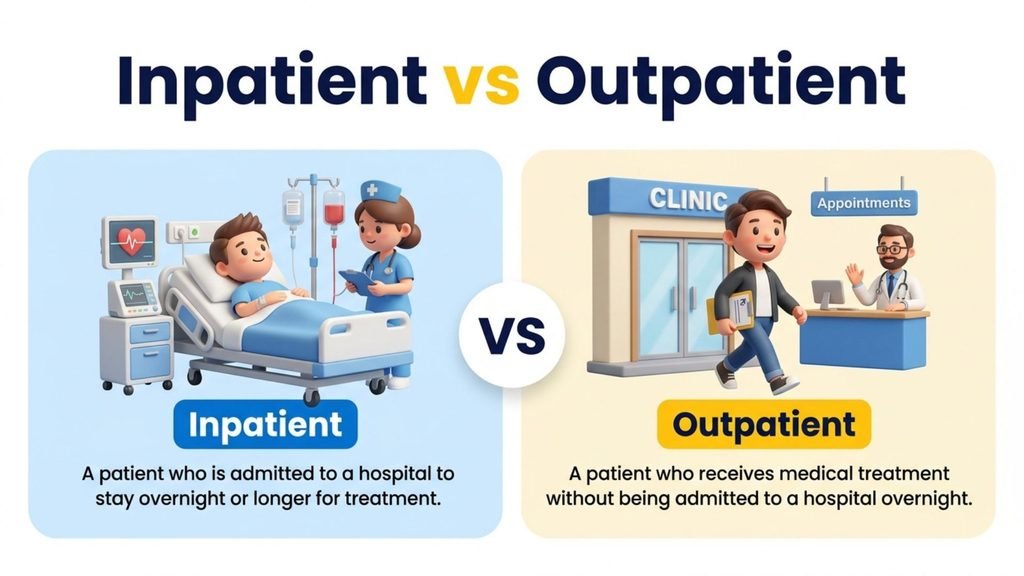
- Inpatient requires formal admission and at least one overnight.
- Outpatient means treatment plus same-day discharge, no bed assigned.
- Cost gap is large: inpatient care carries facility and nursing charges.
- Observation status sits awkwardly between both categories on many bills.
- Same procedure can be either, depending on clinical judgment.
- Always check your plan before assuming coverage applies equally.
| Feature | Inpatient | Outpatient |
| Overnight stay | Yes | No |
| Formal admission | Required | Not required |
| Typical services | Surgery, ICU, rehabilitation | Checkups, imaging, minor procedures |
| Relative cost | Higher | Lower |
| Billing category | Inpatient claim | Outpatient claim |
Example in texting: Friend 1: “Same surgery, why is mine cheaper?” Friend 2: “Yours was outpatient. Hers was inpatient with two nights.”
Inpatient vs Impatient in Formal and Casual Contexts
Register changes everything. The inpatient vs impatient choice depends partly on where your sentence lives, whether that’s a claim form or a group chat.
Where Does Each Word Belong?
- Medical records demand inpatient with zero tolerance for error.
- Insurance emails use inpatient when discussing coverage tiers.
- Academic writing uses inpatient in healthcare research and statistics.
- Workplace emails use impatient when describing stakeholder pressure.
- Social posts and texts almost always mean impatient.
- Customer service scripts use impatient to describe user frustration.
| Context | Word You Need | Sample Line |
| Hospital chart | Inpatient | Patient converted to inpatient status. |
| Insurance claim | Inpatient | Inpatient benefits apply after deductible. |
| Work email | Impatient | The client is getting impatient about timelines. |
| Text message | Impatient | I’m so impatient for this weekend. |
| Novel or essay | Impatient | He drummed impatient fingers on the table. |
Example in chat: Friend 1: “Writing my discharge notes.” Friend 2: “Then it’s inpatient every time. Save impatient for the group chat.”
Is “Impatient” Ever Correct in a Hospital Sentence?
Absolutely, and this trips people up. Hospitals are full of feelings, so impatient vs inpatient sometimes means using both words in one honest sentence.
When Does “Impatient” Belong in a Medical Setting?
- Describing a patient’s mood: The inpatient grew impatient waiting for rounds.
- Describing families pacing in waiting rooms for updates.
- Describing staff under pressure during understaffed night shifts.
- In narrative writing about patient experience or bedside manner.
- In satisfaction surveys referencing wait times and frustration.
- Never in the status field, code, or admission record itself.
Example in texting: Friend 1: “Can I say the inpatient was impatient?” Friend 2: “Yes, and it’s probably the most accurate sentence you’ll write.”
Inpatient vs Impatient: Case Studies and Pop Culture Examples
Real mix-ups stick in memory better than rules. These small scenarios show exactly how one letter reshapes a sentence’s meaning, sometimes hilariously and sometimes expensively.
What Do Real-World Mix-Ups Look Like?
- Hospital signage error: “Impatient Entrance” quietly became a viral photo.
- Insurance denial: a claim typed as impatient stalled in processing.
- Medical TV dramas use inpatient constantly; listen for the first-syllable stress.
- Job postings for “impatient nurses” appear more often than you’d expect.
- Resume errors: “impatient care experience” weakens a healthcare application.
- Comedy writing exploits the pair deliberately for a quick pun.
Example in chat: Friend 1: “Saw a clinic sign saying ‘Impatient Services.'” Friend 2: “Honestly the most honest sign in healthcare.”
Advanced Scenarios: How to Choose the Right Word
Some sentences genuinely feel ambiguous. When both readings seem possible, the inpatient vs impatient decision needs a structured check rather than a gut reaction under deadline.
What Do You Do When Both Words Seem to Fit?
- Identify the sentence’s subject: a feeling or a medical status?
- Check the verb: “felt” points emotional, “admitted” points clinical.
- Look at the document type before trusting your instinct.
- Consider the audience: clinicians read inpatient as a status, always.
- Rewrite the sentence if ambiguity survives your first check.
- Ask whether both words genuinely belong in the same line.
A Simple Inpatient vs Impatient Flowchart
Run this mental path whenever you hesitate. Six seconds of checking beats one embarrassed correction email sent to your entire department the following morning.
What’s the Step-by-Step Decision Path?
- Step 1: Is a hospital involved? If no, use impatient.
- Step 2: Is the person formally admitted? If no, use impatient.
- Step 3: Are you describing a feeling? If yes, use impatient.
- Step 4: Are you describing status or billing? Use inpatient.
- Step 5: Does “an” precede the word? It must be inpatient.
- Step 6: Still unsure? Substitute “hospitalized” and reread.
Example in texting: Friend 1: “Walk me through it.” Friend 2: “Hospital bed involved? Inpatient. Just annoyed? Impatient. Done.”
How Do You Remember the Difference Between Inpatient and Impatient?
Memory beats grammar rules under pressure. A silly mental image will rescue your inpatient vs impatient choice faster than any style guide ever could mid-sentence.
Which Memory Trick Actually Sticks?
- IM = I’M annoyed. The apostrophe practically spells it for you.
- IN = IN the hospital. Location is literally in the prefix.
- Picture a tapping foot for impatient, a hospital bracelet for inpatient.
- Say it aloud: stress the second syllable for the feeling.
- Link “in” with “admitted” since both start with a vowel sound.
- Write one sentence using both words; you’ll never forget afterward.
Example in chat: Friend 1: “How do you keep them straight?” Friend 2: “I’M annoyed, IN hospital. Been working for me for years.”
How to Pronounce Inpatient and Impatient Correctly
Your voice can give you away in interviews and handoffs. Saying inpatient vs impatient correctly signals professional fluency, especially in clinical or customer-facing conversations.
Where Does the Stress Actually Fall?
- Impatient: /ɪmˈpeɪʃənt/, stress on the second syllable, im-PAY-shunt.
- Inpatient: /ˈɪnˌpeɪʃənt/, stress on the first syllable, IN-pay-shunt.
- Slow down the “n” in inpatient so it doesn’t blur into “m.”
- Lean into the emotion when saying impatient; the rhythm rises naturally.
- Practice pairs aloud: “impatient inpatient” trains both stress patterns.
- Dictation tip: enunciate the prefix clearly to avoid transcription errors.
| Word | Phonetic | Stress | Sounds Like |
| Impatient | /ɪmˈpeɪʃənt/ | Second syllable | im-PAY-shunt |
| Inpatient | /ˈɪnˌpeɪʃənt/ | First syllable | IN-pay-shunt |
Example in texting: Friend 1: “Say it once more?” Friend 2: “IN-patient for the ward. im-PAY-shunt for your mood.”
Inpatient vs Impatient in Insurance and Billing Documents
This is where a typo costs money. In claims and coverage language, inpatient vs impatient isn’t a style preference, it’s a processing requirement with real consequences.
Why Does the Wrong Word Delay a Claim?
- Claims systems match keywords; impatient matches nothing and flags errors.
- Coverage tiers differ sharply between inpatient and outpatient services.
- Deductibles and copays attach to the inpatient category specifically.
- Prior authorization often applies only to inpatient admissions.
- Appeal letters must mirror the plan’s exact policy terminology.
- Proofread every form before submission; systems rarely forgive typos.
| Document | Correct Term | Risk If Wrong |
| Claim form | Inpatient | Rejection or processing delay |
| Pre-authorization | Inpatient | Denied coverage |
| Appeal letter | Inpatient | Weakened credibility |
| Complaint email | Impatient | Only tone, no financial risk |
Example in chat: Friend 1: “They bounced my claim again.” Friend 2: “Check line four. Bet it says impatient instead of inpatient.”
Impatient Synonyms and Antonyms Worth Knowing
Variety makes writing breathe. When you’ve used impatient three times already, these alternatives keep the emotional tone precise without repeating yourself into dullness.
Which Words Can Replace “Impatient”?
- Restless suggests physical fidgeting more than irritation.
- Antsy is casual, friendly, and perfect for conversational writing.
- Eager carries positive energy without the frustration.
- Short-tempered emphasizes the irritability rather than the waiting.
- Chomping at the bit works well in informal storytelling.
- Antonyms include patient, tolerant, composed, even-tempered.
Example in texting: Friend 1: “Don’t want to write ‘impatient’ again.” Friend 2: “Use antsy. Same feeling, lighter tone.”
Quick Reference: Inpatient vs Impatient
Bookmark this section. When you’re mid-draft and second-guessing, this compressed inpatient vs impatient summary answers the question without rereading the whole article.
What’s the Fastest Cheat Sheet?
- Impatient = feeling. Inpatient = hospital.
- IM = I’M annoyed. IN = IN the building.
- Impatient takes no article; inpatient often does.
- Impatient never appears in clinical documentation.
- Inpatient rarely appears outside healthcare contexts.
- Both words can appear in one sentence legitimately.
| Question | Answer |
| Describing a mood? | Impatient |
| Describing an admission? | Inpatient |
| Writing a text message? | Usually impatient |
| Filling a claim form? | Always inpatient |
| Can you say “an impatient”? | No, that’s incorrect |
Example in chat: Friend 1: “Give me the short version.” Friend 2: “Mood or hospital. That’s the entire rule.”
Common Mistakes When Using Inpatient and Impatient
Most errors repeat in predictable shapes. Spotting these six patterns handles nearly every impatient vs inpatient slip that shows up in real documents and messages.
What Errors Show Up Most Often?
- Using impatient as a noun: “treated the impatient” is always wrong.
- Writing “impatient care” when you meant inpatient care.
- Hyphenating “in-patient” in modern American English writing.
- Trusting autocorrect on medical terms without a final proofread.
- Mixing the words inside the same paragraph inconsistently.
- Assuming any hospital word automatically requires inpatient.
| Wrong | Right | Why |
| The doctor saw the impatient. | The doctor saw the inpatient. | Impatient isn’t a noun |
| Impatient admissions rose. | Inpatient admissions rose. | Medical statistic |
| He was inpatient in traffic. | He was impatient in traffic. | Emotional context |
| In-patient rehab starts Monday. | Inpatient rehab starts Monday. | No hyphen needed |
Example in texting: Friend 1: “Found three of these in my draft.” Friend 2: “Search the doc for ‘impatient.’ Fix anything near ‘hospital.'”
Memory Hacks to Remember Inpatient vs Impatient
Repetition fades, imagery lasts. These tricks turn the impatient vs inpatient rule into something your brain retrieves automatically, even at the end of a long shift.
What Tricks Make the Difference Permanent?
- The apostrophe hack: IM sounds like I’M, a person speaking.
- The doorway hack: IN means inside, so inside a hospital.
- The stress hack: annoyance stresses PAY, admission stresses IN.
- The pairing hack: impatient pairs with waiting, inpatient with admitted.
- The sentence hack: memorize “The inpatient was impatient.”
- The search hack: run find-and-replace checks before sending documents.
Example in chat: Friend 1: “Any last trick?” Friend 2: “Memorize ‘the inpatient was impatient.’ Covers both instantly.”
Why Precision Matters When Choosing the Right Word
Small words carry real weight. Getting inpatient vs impatient right protects your credibility, your paperwork, and sometimes the accuracy of someone’s actual medical record.
What’s Actually at Stake With One Letter?
- Professional credibility in healthcare writing and applications.
- Claim accuracy, which affects payment timelines directly.
- Patient records where precision supports clinical safety.
- Reader trust in blogs, essays, and published content.
- Search visibility, since the wrong term targets the wrong search intent.
- Simple self-respect; clean writing signals careful thinking.
Example in texting: Friend 1: “Does one letter really matter that much?” Friend 2: “Ask anyone whose claim got denied over it.”
A Quick Inpatient vs Impatient Quiz
Time to test yourself honestly. Five sentences, no peeking ahead, and you’ll know instantly whether the inpatient vs impatient rule has actually settled in your memory.
Can You Pick the Right Word Every Time?
- Question 1: The ___ ward has forty beds.
- Question 2: She grew ___ waiting for the bus.
- Question 3: Insurance covers ___ rehabilitation fully.
- Question 4: Don’t be ___ with new employees.
- Question 5: He was admitted as an ___ on Sunday.
- Bonus: The ___ felt ___ during recovery.
Quiz Answers and Explanations
Check your work here. Each explanation ties back to the same core logic, so wrong answers become useful rather than discouraging in the impatient vs inpatient decision.
How Did You Do?
- Answer 1: inpatient. A ward is a hospital location.
- Answer 2: impatient. Waiting for transport is pure emotion.
- Answer 3: inpatient. Rehabilitation coverage is insurance language.
- Answer 4: impatient. Describing attitude toward people, not medical status.
- Answer 5: inpatient. “Admitted as an” signals formal admission.
- Bonus: inpatient, impatient. Both fit, and the sentence is grammatically perfect.
Example in chat: Friend 1: “Got four out of five.” Friend 2: “Let me guess. The bonus one got you.”
FAQs
What is the main difference between inpatient and impatient?
In inpatient vs impatient, inpatient means hospitalized. Impatient means restless. One is location, the other is feeling.
Can a person be both inpatient and impatient?
Yes. The inpatient vs impatient overlap is real, since admitted patients often feel frustrated waiting for updates.
Is impatient ever used in medical charts?
No. In inpatient vs impatient usage, charts only accept inpatient. Impatient describes mood, never clinical status.
What does inpatient mean on an insurance form?
It means admitted overnight. The inpatient vs impatient distinction matters here because only inpatient triggers admission-level coverage.
How do you pronounce inpatient vs impatient?
In inpatient vs impatient, stress differs. Inpatient stresses IN, impatient stresses PAY. Say both slowly to hear it.
Is “in-patient” with a hyphen correct?
Rarely. For modern inpatient vs impatient writing, skip the hyphen. Older British texts sometimes still include it.
What’s the opposite of impatient?
Patient, meaning calm and tolerant. Within inpatient vs impatient, remember that patient also means a person receiving care.
Conclusion
The whole inpatient vs impatient puzzle collapses into one honest question: are you describing a feeling or a hospital bed? Feelings get impatient. Admissions get inpatient. That’s the entire rule, and it holds every single time.
Keep the memory hook close. IM means I’M annoyed. IN means IN the hospital. If you can picture a tapping foot versus a wristband, you’ve already solved impatient vs inpatient for good.
Before you send that email, form, or draft, run one search for both spellings. Ten seconds of checking protects your credibility more than any grammar app will. Master inpatient vs impatient once, and you’ll never hesitate over that single letter again.

Ella Brooks is a passionate writer sharing thoughtful words, inspiring ideas, helpful tips, and engaging content for everyday readers.










1 thought on “Inpatient vs Impatient Meaning: Never Mix Them Up 2026”