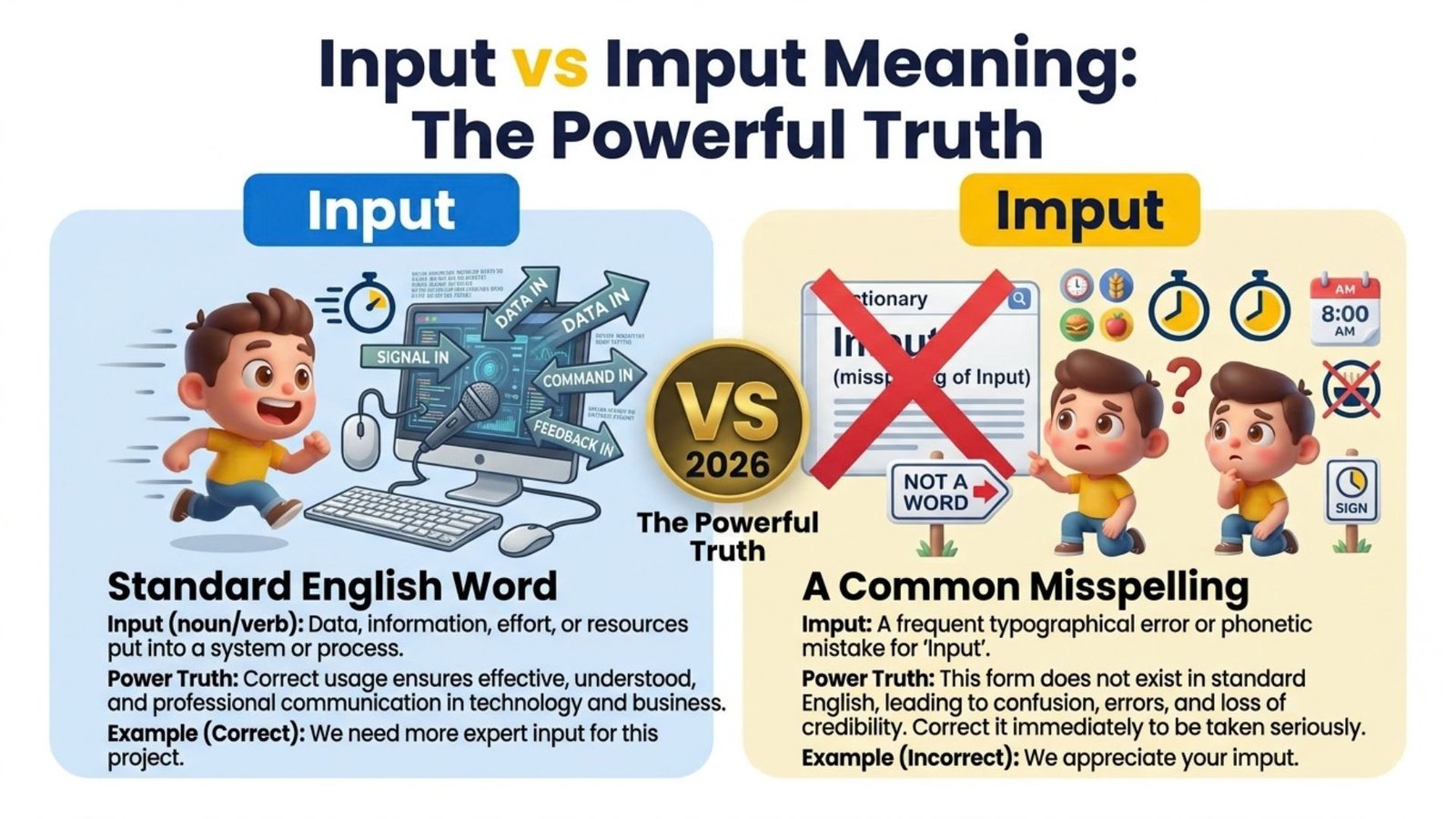
You typed a quick message, glanced at it, and suddenly your stomach dropped. Was it input vs imput, or did autocorrect just save you again? That tiny doubt feels silly, yet it nags almost everyone who writes fast.
This guide settles the input vs imput question once and for all. You will get clear definitions, the input or imput meaning explained simply, memory tricks, and real chat examples. Spelling worries matter because small slips change how readers see you, so stay with me for the answers.
Input vs Imput: Which Spelling Is Correct?
Ever frozen mid-sentence, wondering which spelling is right? Here, input vs imput gets a clear answer, and the input or imput meaning becomes simple to grasp, starting right here today.
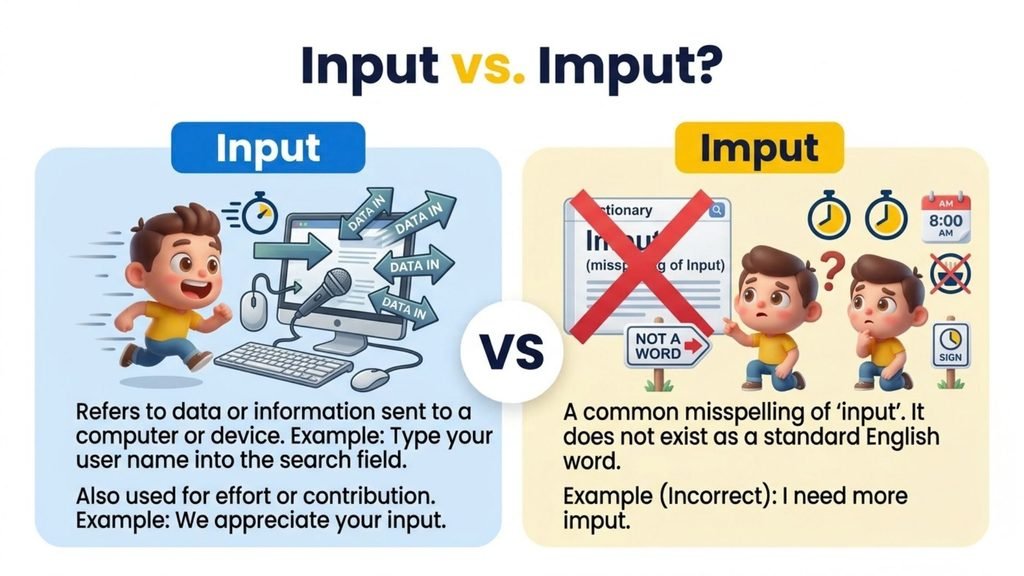
The short answer is that input is correct, and imput is a common misspelling that no dictionary lists. Whether you write a professional email, a school essay, or a quick DM, the same rule applies every time.
It is one of those tiny spelling facts that makes your writing look careful. Once it clicks, you stop second-guessing and just type.
Which Spelling Do Dictionaries Accept?
- Input appears in every major dictionary, including Merriam-Webster, Oxford, and Cambridge.
- Imput is never listed, so spell-checkers flag it immediately.
- Choose input for emails, reports, résumés, and homework without exception.
- Avoid imput even in casual chats, since bad habits spread quickly.
- Trust the pattern: in plus put equals input, nothing more.
Example in texting:
Friend 1: Did you get my imput on the plan?
Friend 2: You mean input? Yes, I loved your input!
Input vs Imput Meaning and Definition
Words feel safer once you know what they truly mean. Let’s unpack input vs imput together, and see why the input or imput meaning only points to one real word.
The input or imput meaning question has a tidy answer. Input is a real English word, while imput carries no definition at all. As a noun, input means information, opinions, or data put into something. As a verb, it means to enter or feed that information into a system, usually a computer.
What Does Input Mean in Simple Words?
- Noun: an opinion, advice, or contribution someone gives to a discussion.
- Noun: data or energy that enters a machine, system, or process.
- Verb: to type or enter information into a device or program.
- Imput: has no definition, so searching its meaning leads nowhere.
- Context tells you which sense is meant: people-talk or tech-talk.
| Word | Part of Speech | Meaning |
| Input | Noun | Information, ideas, or data put into something |
| Input | Verb | To enter data or details into a system |
| Imput | None | Not a word; a typo of input |
Example in texting:
Friend 1: Can you input the scores before 5?
Friend 2: Sure, done! Also, thanks for your input earlier.
Input vs Imput in English
English spelling can feel like a maze of surprises. Still, input vs imput is an easy case, and the input or imput meaning question has one calm, clear, simple answer.
In everyday English, you will meet input in offices, classrooms, and tech talk. Imput shows up mostly in rushed typing and social media comments. The standard English form never changes across American, British, or Australian writing, which makes this one of the easier spelling rules to learn.
Is Input Used the Same in American and British English?
- American English spells it input, with no regional variation at all.
- British English spells it input too, unlike color versus colour.
- Formal writing demands input, and informal chats should follow the same rule.
- Search engines often correct imput automatically, which hides the mistake.
- Learners of English benefit from treating input as one fixed word.
Example in chat:
Friend 1: Is it the same spelling in the UK?
Friend 2: Yep, input everywhere. Imput is just a typo!
The Correct Spelling: “Input” (Not “Imput”)
Picture the word written perfectly, no red squiggly line anywhere. That is exactly what input vs imput comes down to, and the input or imput meaning only belongs to one.
The word is built from two plain pieces: in and put. Nothing in that structure asks for an m. Because input is a compound word, the letter n stays exactly where it is, even though speech might blur the sound. Once you see the pieces, the correct spelling feels almost obvious.
How Is Input Built From Two Simple Words?
- In means going inside, as in inside, inbound, and indoor.
- Put means to place something, as in put away or put down.
- Compound words keep both parts intact, so the n stays in input.
- Pronunciation may sound like imput, but spelling follows structure, not sound.
- Proofread by splitting the word: in plus put, then check.
Example in texting:
Friend 1: Why isn’t it spelled with an m?
Friend 2: It’s in plus put, so input. Easy!
Why Do People Misspell “Input” as “Imput”?
Honestly, almost everyone has made this slip once. Curious why input vs imput trips people up, and why the input or imput meaning gets so muddled? Let’s find out together.
Blame the mouth and the keyboard. When we say input quickly, our lips close slightly early for the p sound, and the n drifts toward m. Linguists call this nasal assimilation. Add small keys sitting side by side and autocorrect that misses the slip, and the mistake spreads easily.
There is also a prefix trap. English has many words where in- becomes im- before p, like impossible and impatient. Your brain remembers that pattern and applies it where it does not belong.
What Causes the Imput Mistake?
- Nasal assimilation makes the n sound like m before the p.
- Typing speed causes finger slips between the neighboring n and m keys.
- Prefix confusion from impossible, impatient, and import tricks the brain.
- Autocorrect sometimes ignores the typo when context seems obvious.
- Hearing the word more than reading it weakens your visual memory.
| Cause | What Happens | Easy Fix |
| Pronunciation | The n sounds like m | Remember in + put |
| Fast typing | N and M keys sit close together | Reread before sending |
| Prefix patterns | Im- appears before p in impossible | Treat input as a compound |
Example in texting:
Friend 1: I typed imput again, ugh!
Friend 2: Happens to everyone. Just reread it before sending.
Input vs Imput: Detailed Comparison
Sometimes seeing things side by side makes everything click. This quick look at input vs imput lays out the facts, and the input or imput meaning finally feels truly settled.
Comparisons stick in memory. The table below shows spelling, dictionary status, and professional use in one frame. After reading it, the decision should feel automatic, whether you are writing a report, a post, or a text.
Which Spelling Should You Use in Professional Writing?
| Aspect | Input | Imput |
| Spelling | Correct | Incorrect |
| Dictionary Status | Found in all major dictionaries | Not recognized anywhere |
| Professional Use | Always acceptable | Never acceptable |
| Etymology | In + put | Typo only |
| Example | “Share your input” | “Share your imput” |
- Reports and proposals need input to keep your credibility intact.
- Emails to clients look sharper when every word is spelled correctly.
- Résumés with spelling errors get rejected faster than most people expect.
- Social posts feel more trustworthy with clean, correct spelling.
- Exams often penalize spelling slips, so lock in input now.
Example in texting:
Friend 1: Should I write imput in my cover letter?
Friend 2: No way. Input, always, so it looks polished.
How to Use “Input” Correctly
Knowing the right spelling is half the battle, and using it well is the rest. With input vs imput sorted, the input or imput meaning turns into real writing confidence.
Input is flexible. It works as both a noun and a verb, and the sentence tells you which one you are reading. Below are quick examples for each form, so you can copy the patterns and apply them in your own writing without second-guessing.
Input as a Noun
As a noun, input means ideas, data, or opinions that you give or receive.
- Offer your input in meetings to shape better decisions.
- Request input from teammates before finalizing the plan.
- Valuable input often changes a project’s direction.
- User input means data typed or clicked by a person.
- Plural form is inputs, as in several inputs from departments.
Input as a Verb
As a verb, input means to enter information. The past tense can be input or inputted.
- Input your password carefully before pressing enter.
- Input the sales figures into the spreadsheet today.
- Inputted is accepted, though plain input feels more modern.
- Inputting is the -ing form, spelled with n, never m.
- Check every entry after you input it.
Example in chat:
Friend 1: Did you input the grades?
Friend 2: Yes, I inputted them an hour ago.
Common Phrases and Collocations with “Input”
Words rarely travel alone; they bring friends along. When it comes to input vs imput, the right company matters, and the input or imput meaning shines through in common phrases.
Collocations are the words that naturally sit beside each other, and input has plenty of them. Learning these pairs makes your vocabulary richer and your sentences smoother. Each phrase below is real, common, and safe to use in both formal writing and everyday conversation.
What Are the Most Common Phrases With Input?
- User input describes data people enter into apps, forms, or websites.
- Input data means raw information fed into a system for processing.
- Provide input means sharing feedback, ideas, or suggestions with others.
- Input field is the box on a form where you type.
- Stakeholder input refers to opinions gathered from people affected by decisions.
- Constant input describes a steady supply of information or effort.
| Phrase | Meaning | Example |
| User input | Data entered by a person | “The app rejects invalid user input.” |
| Provide input | Share ideas or feedback | “Please provide input by Friday.” |
| Input field | Typing box on a form | “The input field is empty.” |
| Valuable input | Useful contribution | “Your valuable input helped.” |
Example in texting:
Friend 1: Can you give input on the design?
Friend 2: Sure! I’ll send my feedback tonight.
Inputting vs Imputting
Adding endings can double the confusion, and nobody enjoys that. Let’s check how input vs imput changes with -ing, and what the input or imput meaning tells us about it.
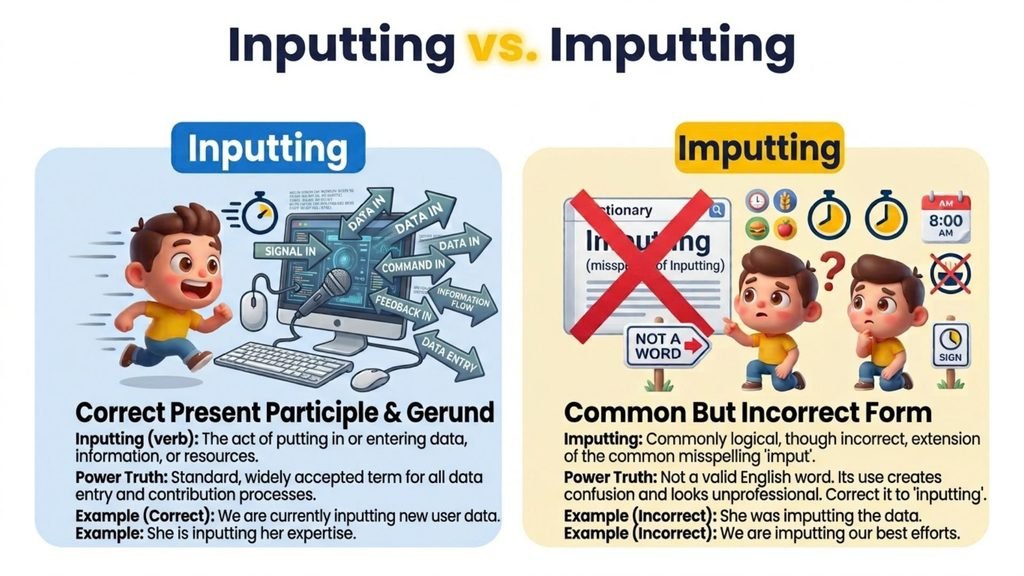
Adding -ing does not change the root. The correct form is inputting, with an n, and imputting is just the same typo wearing a new ending. Notice also the doubled t, which comes from the root put, as in putting.
How Do You Spell the -ing Form of Input?
- Inputting is correct, built from put and ing, like putting.
- Imputting is incorrect, and spell-checkers underline it right away.
- Doubled t follows the same rule as putting, sitting, and cutting.
- Inputted is the past form, though input alone also works.
- Inputs is the third-person present, as in she inputs data.
Example in texting:
Friend 1: I’m inputting the receipts now.
Friend 2: Nice, please add last month’s too!
Input Origin and Etymology Explained
Every word has a backstory, and this one is surprisingly simple. Looking closely at input vs imput through history, the input or imput meaning becomes much easier to trust and remember.
Input joins two old English building blocks, in and put, so its etymology is wonderfully plain. The noun sense, meaning something put in, existed long before computers. The computing sense of entering data took off in the mid-twentieth century with early machines and computer science.
When Did Input Become a Computer Term?
- Early noun use described something put into a business or process.
- Mid-twentieth century computing popularized input for data entering machines.
- Computer science paired input with output as opposite data flows.
- Everyday life now uses input for opinions, feedback, and advice.
- No version of this history includes an m in the spelling.
| Era | How Input Was Used | Spelling |
| Before computers | Something put into a process | input |
| Early computing | Data entered into machines | input |
| Today | Feedback, data, and commands | input |
Example in texting:
Friend 1: Where did input even come from?
Friend 2: In plus put! Computers made it super popular.
Input vs Output: What Is the Difference?
Every start has an end, and every entry has an exit. Next to input vs imput, comparing input with output sharpens the input or imput meaning even further for you.
You cannot fully understand input without its partner, output. One describes what goes in; the other describes what comes out. This pair appears in computing, business, economics, and even cooking, so knowing both words spelled correctly is genuinely useful.
What Is the Difference Between Input and Output?
| Feature | Input | Output |
| Direction | Goes in | Comes out |
| Computer example | Keyboard, mouse, upload | Screen, printer, speaker |
| Business example | Feedback, resources | Products, results |
| Verb form | To input | To output |
- Keyboard strokes and mouse clicks count as computer input.
- Printed pages and screen displays count as output.
- Feedback from colleagues is input to a project.
- Results a team delivers are the output.
- Both words stay spelled the same, with no hidden m.
Example in texting:
Friend 1: Is a mic input or output?
Friend 2: Input! Speakers are output.
Input vs Impute: Are They Related?
Here is a plot twist: one lookalike word really is in the dictionary. Let’s see how input vs imput connects with impute, plus the input or imput meaning behind it.
Here is why imput feels almost real: a genuine word, impute, sits nearby. It means to attribute something, often blame, to someone. In statistics, imputation fills in missing data. Neither word is a spelling of input, so keep them separate in your mind.
Is Impute the Same as Input?
| Word | Meaning | Example |
| Input | Something entered or contributed | “I need your input.” |
| Impute | To attribute or assign to someone | “Don’t impute bad motives to her.” |
| Imputation | Filling in missing data values | “Missing values need imputation.” |
- Impute comes from Latin, meaning to attribute or charge to someone.
- Input comes from English, meaning something put in.
- Imputation is a statistics method for filling missing data values.
- Imput is neither of these; it is only a typo.
- Context tells you instantly whether you need impute or input.
Example in chat:
Friend 1: Wait, is imput short for impute?
Friend 2: Nope. Impute is its own word. Input is what you want.
Is It Input or Imput in Texting and Emails?
Typing fast on your phone, it is so easy to slip. For input vs imput in messages, the habit matters, and the input or imput meaning stays the same everywhere.
Casual messages feel forgiving, yet a typo in a work email can linger in someone’s memory. The rule stays identical across texting, Slack, email, and formal documents. Always choose input, then reread before pressing send, especially when you reply quickly from your phone.
Does Spelling Matter in Casual Messages?
- Texting tolerates typos, but clean spelling still builds trust.
- Work chats on Slack or Teams reflect your professional habits.
- Emails to managers and clients deserve careful, correct wording.
- Voice typing usually spells input correctly, so use it when rushed.
- Proofread the one word that always trips you, every time.
Example in texting:
Friend 1: Sent my imput to the boss, oops.
Friend 2: Quick fix: send “*input” and move on!
Is Inputted a Real Word?
Past tense can feel like a trap, and this verb has two options. When thinking about input vs imput, the input or imput meaning guides us to the correct forms.
Yes, inputted is real. Dictionaries list both input and inputted as past tense forms. Many style guides lean toward input for brevity, while inputted is common in technical writing. Either way, the spelling keeps its n, so the input vs imput answer never changes.
Should You Use Input or Inputted as the Past Tense?
- Input works as past tense: “I input the data yesterday.”
- Inputted works too: “She inputted every receipt.”
- Consistency matters more than choice, so pick one per document.
- Past participle can be input or inputted: “has been input.”
- Imputted is wrong, a double typo of the real word.
Example in chat:
Friend 1: Is “inputted” even a word?
Friend 2: Yes! I inputted everything yesterday.
Synonyms for Input You Can Use Instead
Repeating the same word gets dull fast, and variety keeps writing fresh. Beyond input vs imput, a few strong alternatives fit the input or imput meaning in many different settings.
Sometimes the best fix is a fresh word. Synonyms keep your writing lively and avoid repeating input in every sentence. Choose based on context: casual feedback, technical data, or business advice each call for a slightly different alternative with the right shade of meaning.
What Are Good Alternatives to the Word Input?
| Context | Synonyms |
| Opinions | feedback, suggestions, advice, comments |
| Data | information, entry, data |
| Contribution | involvement, participation, contribution |
| Verb use | enter, type, key in, submit |
- Feedback fits when someone reviews work and shares reactions.
- Suggestions fits when people offer ideas to improve plans.
- Contribution fits when someone adds effort or ideas to a group.
- Enter fits when you type data into forms or software.
- Information fits when you describe raw facts given to a system.
Example in texting:
Friend 1: Need your feedback on my slides.
Friend 2: Sure, I’ll send my input after lunch.
How Do You Spell Input Correctly Every Time?
Nobody wants to second-guess a simple word forever. Learn exactly how input vs imput gets fixed for good, and how the input or imput meaning keeps your spelling steady, always.
Reliable spelling comes from small habits, not talent. Pair a memory trick with a quick proofreading pass, and your accuracy rises fast. Use the steps below, and the correct form of input will feel as natural as typing your own name.
What Habits Help You Spell Input Without Errors?
- Split the word into in and put whenever you doubt.
- Read aloud slowly, separating each syllable so the n is audible.
- Turn on spell-check, but still reread important messages.
- Add input to your phone’s text replacement shortcuts.
- Practice typing the word five times to build muscle memory.
Example in texting:
Friend 1: How do I stop typing imput?
Friend 2: Make a shortcut. Type “inp” and it expands to input.
Quick Tips to Remember the Correct Spelling
Ready for the simplest tricks you will ever need? These tips make input vs imput stick in your memory, and the input or imput meaning will never confuse you again.
Memory tricks work because they turn rules into pictures. Mnemonic devices, short checks, and tiny habits are the fastest route to correct spelling. Keep these tips handy, share them with classmates or coworkers, and they will keep you out of the imput trap for good.
What Is the Easiest Trick to Remember Input?
- IN + PUT = INPUT: information goes in, and you put it there.
- Compare with into; you would never write imto.
- Check your spell-checker: if it underlines the word, fix it.
- Remember that sound can fool you, but structure never does.
- Practice writing input ten times to train your fingers.
- Visualize typing data IN to a computer.
Example in chat:
Friend 1: Quick trick for input?
Friend 2: In plus put. If it has an m, it’s wrong!
FAQs
What is the correct spelling in input vs imput?
Input is correct. In input vs imput, only the first spelling exists.
Is imput ever correct?
Never. In the input vs imput debate, imput is always a typo.
What is the past tense of input?
Both work. Input vs imput aside, you can write input or inputted.
Can input be used as a verb?
Yes. Even in input vs imput questions, input works as noun and verb.
What is the difference between input and output?
Input goes in; output comes out. Input vs imput never changes that.
How do you spell the plural of input?
Add an s to get inputs. Input vs imput stays the same in plural.
Why do people write imput instead of input?
Fast typing and sound blending cause it. Input vs imput confusion is very common.
Conclusion
So, what did we learn about input vs imput? Only one spelling survives: input, built from in and put and listed in every major dictionary. Imput is a typing and pronunciation slip, and you now know why it happens. The input or imput meaning question is settled too, because imput has no meaning at all.
Remember that structure beats sound, and reread important messages before sending. With input vs imput cleared up, you can handle inputted, inputting, and impute with confidence. In the end, input vs imput is a small but powerful win for your writing. Check this one word next time you send an email, and watch your careful habits grow.

Ella Brooks is a passionate writer sharing thoughtful words, inspiring ideas, helpful tips, and engaging content for everyday readers.