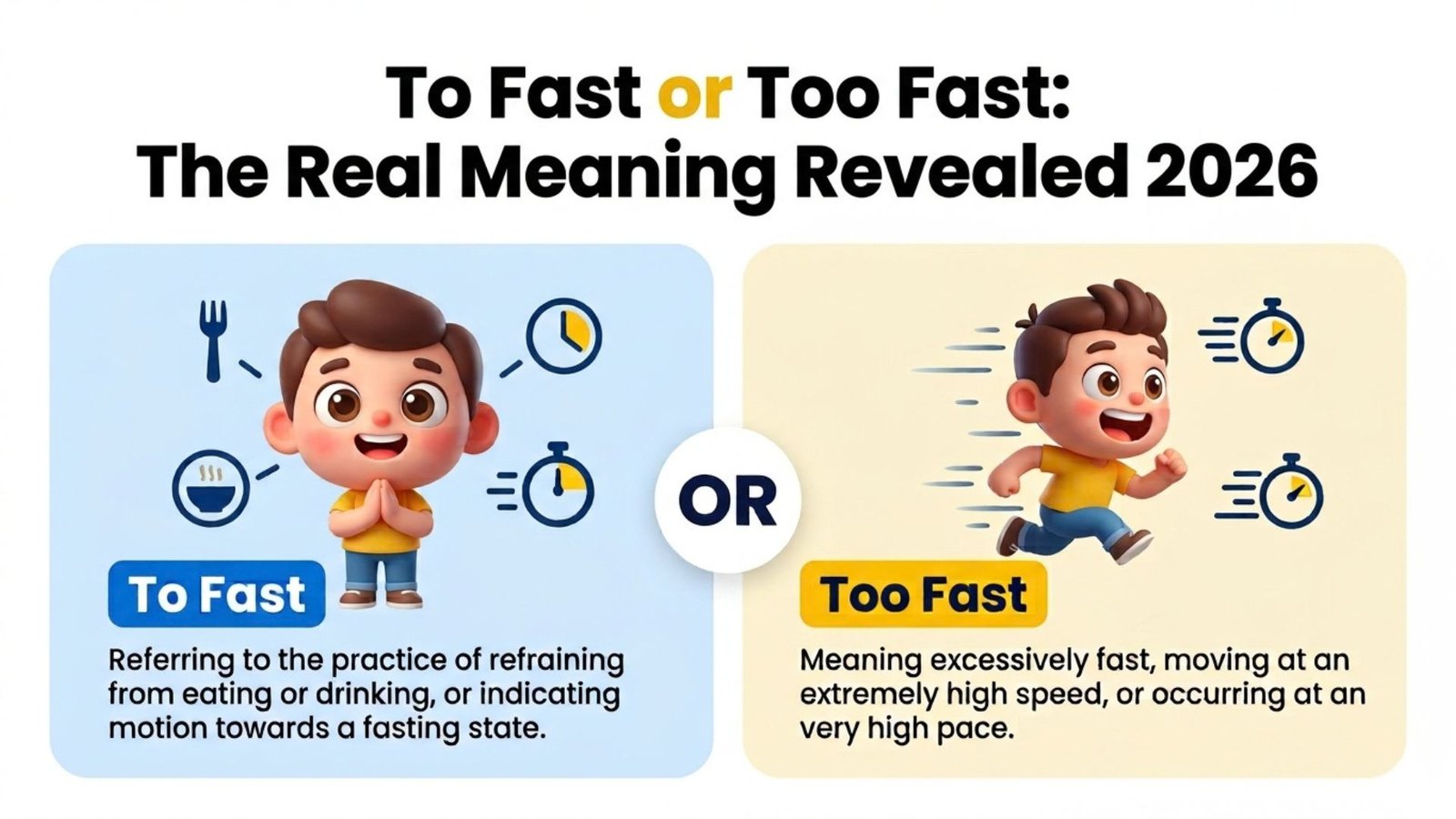
You typed “your driving to fast,” hit send, and then that little itch hit wait, was that right? You’re not alone. This tiny mix-up between to fast or too fast has embarrassed even confident writers, and it usually comes down to one missing letter that changes everything.
Here’s the good news: by the end of this guide, you’ll never second-guess it again. We’ll break down the way to fast or too fast confusion with real examples, quick memory tricks, and answers to the exact questions people type into Google. Keep reading this one’s short, simple, and sticks for good.
To Fast or Too Fast: Which Is Correct?
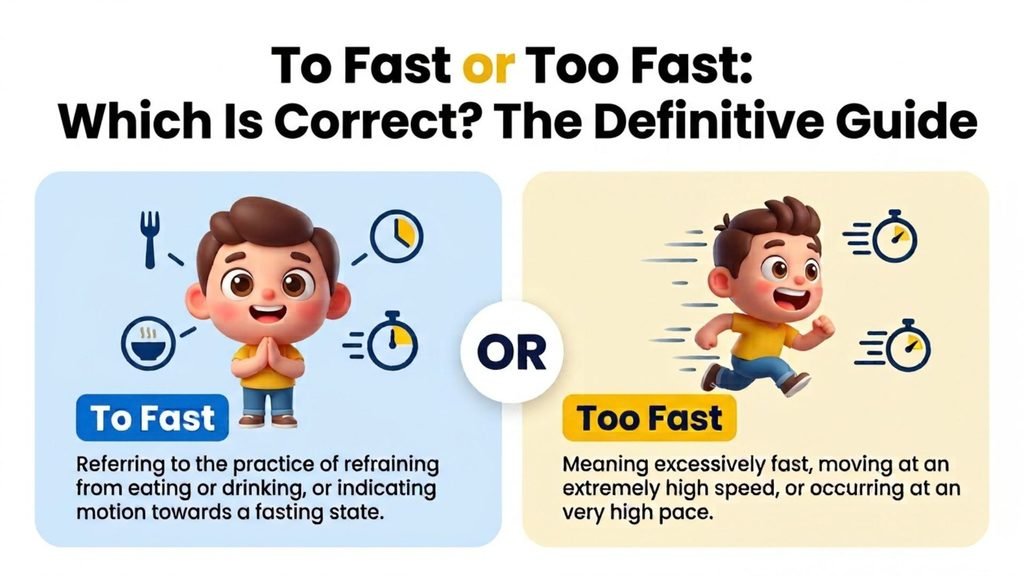
Most people searching to fast or too fast just want a fast, clear answer before they hit publish or send. Here’s the truth in one breath.
“Too fast” is correct when you’re talking about speed. The extra “o” in “too” means excessively think of it as one letter standing in for “extra.” “To fast,” on the other hand, only makes sense when you’re talking about fasting skipping food or drink on purpose.
What Makes This Mistake So Common?
Both words sound identical when spoken aloud, which is exactly why the mix-up happens so often in texting and casual writing.
- Pronunciation is identical, so your ear gives you zero clues.
- Autocorrect sometimes “fixes” the wrong word without you noticing.
- Speed of typing means people skip proofreading short sentences.
- Homophones like this trip up native speakers just as much as learners.
- Context is the only real way to catch which one you need.
| Situation | Correct Word | Why |
| Describing excessive speed | too fast | “Too” = excessively |
| Describing skipping food | to fast | “To” + verb “fast” |
| Texting quickly | either, depending on context | Meaning decides the word |
Example in texting:
Friend 1: “omg you’re replying way to fast lol”
Friend 2: “*too fast and yes, I’m bored at work 😂”
Way Too Fast or Way to Fast?
Adding “way” in front makes this phrase feel even more casual, but it also raises a new question about which spelling actually holds up.
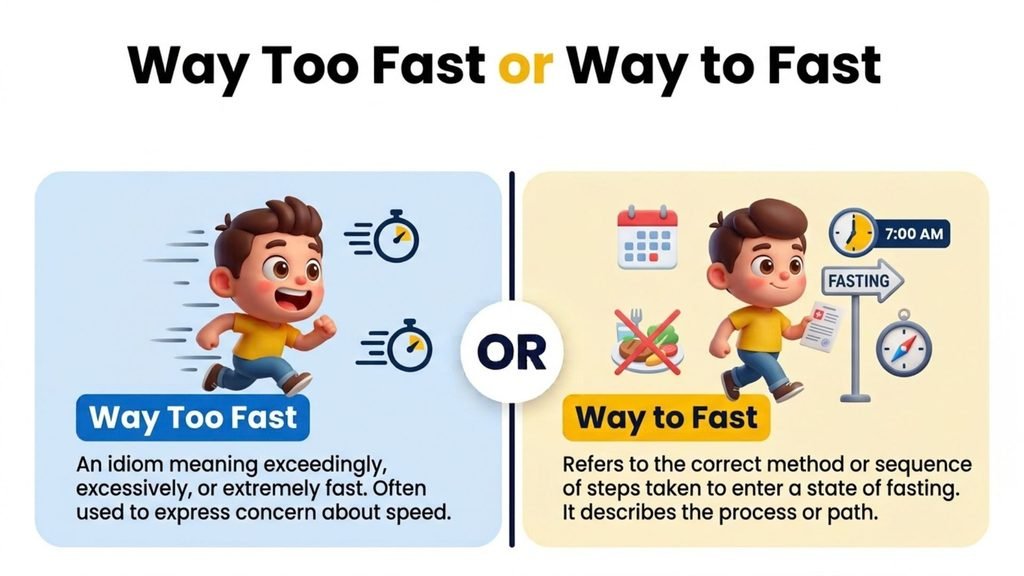
“Way too fast” is the only correct version “way to fast” is always wrong unless you’re literally saying “way to [a] fast.” The word “way” here works as an intensifier, boosting “too” the same way “very” or “extremely” would.
Does “Way” Change the Spelling Rule at All?
No “way” simply adds emphasis in front of “too,” so the same too fast vs. “to fast” logic still applies without exception.
- “Way” intensifies “too,” meaning “much” or “far.”
- Speed contexts always pair “way” with “too,” never “to.”
- Casual speech uses “way too fast” constantly in slang and texting.
- Formal writing should still favor “excessively fast” over slang.
- “Way to fast” only works if “fast” is a noun, like a religious fast.
Example in chat:
Friend 1: “he was driving way too fast on the highway”
Friend 2: “yeah I saw, scared me honestly”
The Quick Answer: To Fast or Too Fast
Sometimes you just need the shortcut version no grammar lecture, just the rule you can apply in three seconds flat.
When in doubt, ask yourself: am I describing speed, or am I describing not eating? If it’s speed, you need too fast. If it’s about skipping meals, you need “to fast.” That single question solves the to fast or too fast debate every time.
Is There a Simple Trick to Remember This?
Yes picture the extra “o” in “too” as a stretched-out word, the same way “too” stretches beyond a normal limit.
- Extra “O” = extra amount, extra speed, extra everything.
- One “O” in “to” means it’s just a short connector word.
- Say it slower in your head if you’re ever unsure while typing.
- Read the sentence back before sending it catches most mistakes.
- Trust context, not sound, since both words sound the same.
| Trick | How It Helps |
| Count the O’s | Two O’s = excessive amount |
| Replace with “excessively” | If it fits, use “too” |
| Replace with “toward” | If it fits, use “to” |
Way Too Fast Meaning
This exact phrase shows up constantly in reviews, complaints, and casual conversation, so it’s worth understanding exactly what it communicates.
“Way too fast” means something is happening at a speed far beyond what’s normal, safe, or expected. It’s stronger than plain “too fast” because “way” pushes the intensity even higher, almost like adding an exclamation point without punctuation.
Where Does “Way Too Fast” Show Up Most Often?
People reach for this phrase in driving complaints, product reviews, and moments where time or events felt rushed and overwhelming.
- Driving: “That truck flew by way too fast.”
- Reading pace: “The book moved way too fast for me to follow.”
- Relationships: “Things escalated way too fast between them.”
- Technology: “My phone battery drains way too fast.”
- Emotions: “My heart is beating way too fast right now.”
Example in texting:
Friend 1: “the movie ending happened way too fast, I’m confused”
Friend 2: “same!! they should’ve added 10 more minutes”
Is It “To Fast” or “Too Fast”?
This question gets typed into search bars thousands of times a month, usually right in the middle of writing an email or a text.
The answer stays consistent: “too fast” for speed, “to fast” for fasting. There’s no gray area, no exception based on tone or formality the meaning of your sentence is what decides which spelling you need.
What Does “Too Fast” Really Mean in a Sentence?
It signals that whatever is happening driving, talking, growing, changing is happening at an uncomfortable or excessive pace for the situation.
- Speed limits: describes exceeding a safe or legal pace.
- Conversations: describes talking faster than someone can follow.
- Time: describes moments or years passing unexpectedly quickly.
- Growth: describes children or trends developing rapidly.
- Machines: describes equipment running at unsafe or inefficient speeds.
Example in chat:
Friend 1: “she talks too fast when she’s nervous”
Friend 2: “haha I noticed, I can barely keep up”
Going Too Fast or Going to Fast?
The word “going” in front of this phrase almost always signals movement, which narrows down the correct spelling immediately.
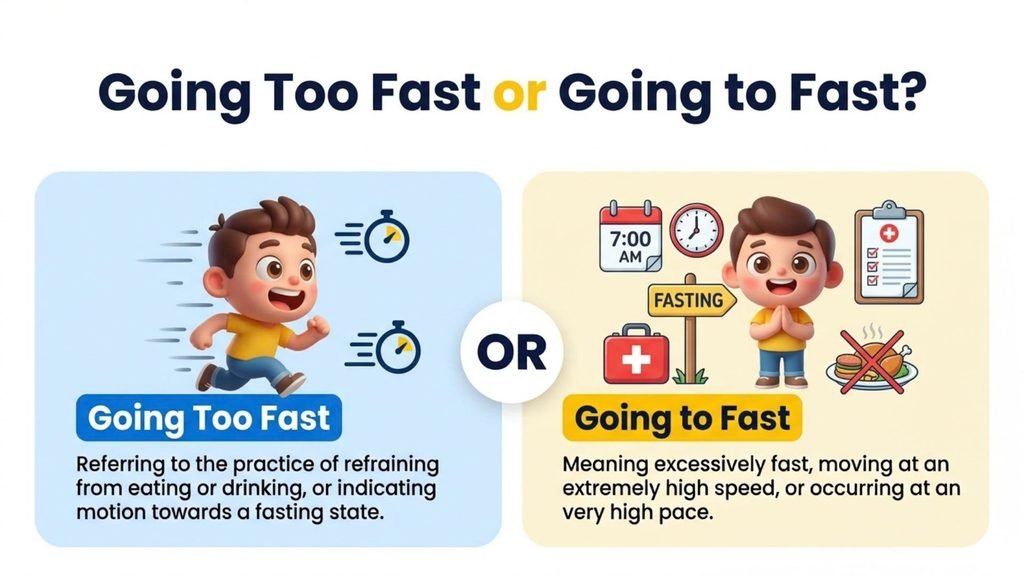
“Going too fast” is always correct for movement or pace “going to fast” is grammatically odd unless someone is literally heading toward a religious or medical fast. Since “going” implies motion, “too fast” naturally fits as the description of that motion’s speed.
Can “Going to Fast” Ever Be Correct?
Technically yes, but only in the rare case where “fast” means the noun as in “going to [observe a] fast” for religious reasons.
- “Going too fast” fits driving, running, talking, and reading.
- “Going to fast” only fits religious or medical fasting contexts.
- Ambiguity rarely exists once you read the full sentence.
- Speed contexts overwhelmingly dominate everyday use of this phrase.
- When unsure, default to “too fast” it’s the far more common need.
| Phrase | Correct? | Context |
| Going too fast | ✅ | Speed, pace, movement |
| Going to fast | ✅ (rare) | Planning to observe a fast |
| Going to fast food | ✅ | Heading to a restaurant |
What Does Too Fast Really Mean?
People search this exact phrase when they want the emotional weight behind the words, not just a textbook definition of grammar.
“Too fast” means something has crossed a comfortable or acceptable threshold of speed, whether that’s a car, a conversation, or even life itself. It carries a slightly negative undertone implying discomfort, danger, or missed details along the way.
Why Does “Too Fast” Feel Negative in Most Sentences?
Because “too” almost always signals excess, and excess implies something has gone past the ideal point, creating friction or concern.
- Discomfort is implied whenever “too fast” describes a pace.
- Safety concerns often accompany driving or machinery contexts.
- Missed details happen when things move too fast to process.
- Emotional weight appears in phrases like “life moves too fast.”
- Regret or nostalgia often follows phrases like “summer went too fast.”
Example in texting:
Friend 1: “time is going too fast this year, it’s already fall”
Friend 2: “don’t remind me, I feel like January was yesterday”
“Too” vs. “To”: Why It Matters
Getting this pair wrong doesn’t just look like a typo in professional writing, it can quietly undermine how credible you seem.
Understanding the actual function of each word makes the to fast or too fast decision automatic instead of a guessing game every single time you write.
What Does “Too” Mean?
“Too” means excessively, also, or very it always adds intensity or extra meaning to whatever comes right after it in a sentence.
- Excess: “This coffee is too hot to drink.”
- Addition: “I want to come too.”
- Intensity: “She’s too tired to keep working tonight.”
- Speed: “You’re driving too fast for these roads.”
- Emphasis: “That’s too much information for one email.”
What Does “To” Mean?
“To” functions as a preposition or an infinitive marker it points toward a direction or introduces a verb, but it never describes intensity or excess.
- Direction: “I’m heading to the store.”
- Infinitive: “I want to sleep.”
- Purpose: “She called to apologize.”
- Distance: “It’s five miles to the coast.”
- Fasting: “I plan to fast this weekend.”
Example in chat:
Friend 1: “wait is it to fast or too fast when you’re talking about speed”
Friend 2: “too fast! the extra o means excessive”
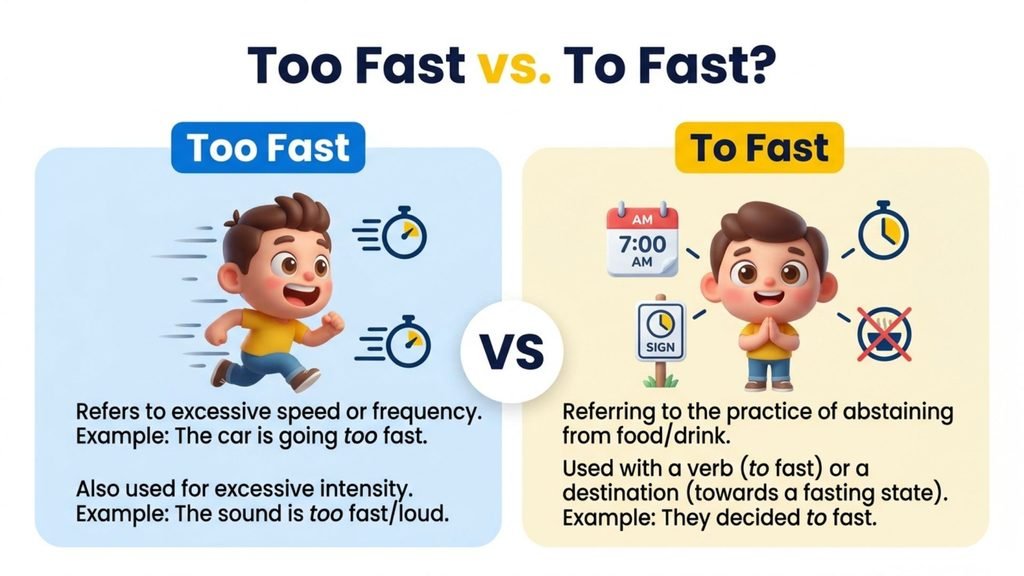
Too Fast vs. To Fast
Placed side by side, the difference becomes almost impossible to miss yet the mistake still slips through in emails, captions, and comments daily.
“Too fast” describes an excessive rate of speed, while “to fast” describes the deliberate act of not eating. These two phrases share zero overlap in meaning, even though they sound completely identical out loud.
Which Version Do Most People Actually Need?
The overwhelming majority of everyday writing calls for “too fast,” since conversations about speed come up far more often than conversations about fasting.
- Everyday use: “too fast” wins in about 90% of real sentences.
- Religious writing: “to fast” appears mostly in faith-based contexts.
- Medical instructions: doctors often say “to fast” before procedures.
- Casual texting: almost always calls for “too fast.”
- Formal essays: both can appear, depending entirely on topic.
| Feature | Too Fast | To Fast |
| Meaning | Excessive speed | Skipping food/drink |
| Part of speech | Adverb + adjective | Infinitive verb phrase |
| Common context | Driving, talking, time | Religion, health, medicine |
| Frequency in writing | Very high | Low, situational |
Why Do People Confuse To Fast and Too Fast?
This confusion isn’t really about grammar knowledge it’s about how quickly people type and how little English homophones warn you.
Most confusion around to fast or too fast happens because both phrases sound exactly the same when spoken, leaving spelling as the only clue. Add autocorrect, fast typing, and low proofreading time, and the mix-up becomes almost predictable.
Is This Mistake More Common in Texting Than Formal Writing?
Absolutely texting speed and informal tone make people far less likely to pause and double-check small function words like “to” and “too.”
- Speed typing skips the mental pause needed to check spelling.
- Autocorrect occasionally swaps the correct word without warning.
- Voice-to-text converts sound, not meaning, increasing errors further.
- Younger writers report this mix-up frequently in casual chats.
- Editors flag it constantly in first drafts of professional writing.
Example in texting:
Friend 1: “lol I always mix up to fast and too fast”
Friend 2: “same, I just picture two O’s for extra now”
The Only Time “To Fast” Is Correct
There’s exactly one scenario where dropping that second “o” is grammatically accurate, and it has nothing to do with speed at all.
“To fast” is correct only when describing the act of fasting skipping food or drink, typically for religious, spiritual, or medical reasons, with “fast” functioning as a verb rather than a description of pace.
How Do You Know “Fast” Is Being Used as a Verb Here?
Check whether “fast” could be replaced with another verb like “eat” or “sleep” if the sentence still makes sense, it’s functioning as a verb.
- Religious fasting: “I plan to fast during Ramadan.”
- Medical prep: “The doctor told me to fast before surgery.”
- Spiritual practice: “She decided to fast for clarity and focus.”
- Health routines: “It’s healthier to fast intermittently than skip randomly.”
- Verb test: swap “fast” for “eat” if it reads naturally, it’s correct.
Example in chat:
Friend 1: “do you need to fast before your appointment tomorrow”
Friend 2: “yeah, no food after midnight apparently”
When Should You Use To Fast Instead of Too Fast?
This is the exact question that separates confident writers from people still guessing, and the answer is refreshingly simple once you know it.
Use “to fast” only when your sentence is about abstaining from food, never when describing pace, tone, or intensity. If speed, urgency, or excess is anywhere in the sentence’s meaning, “too fast” is almost certainly what you need instead.
What’s a Quick Test to Pick the Right Word Every Time?
Ask whether the sentence is about eating or about speed that single question resolves nearly every instance of this confusion instantly.
- Ask “is this about food?” if yes, lean toward “to fast.”
- Ask “is this about speed?” if yes, use “too fast.”
- Read the sentence aloud and listen for the intended meaning.
- Check the verb right before “fast” for extra context clues.
- When unsure, “too fast” is statistically the safer everyday choice.
How to Use “Too Fast” Correctly
Once the rule clicks, applying too fast correctly across different situations becomes second nature almost immediately.
“Too fast” fits naturally into speed, time, and even emotional pacing it’s one of the most flexible excessive-speed phrases in everyday English, showing up in driving, conversation, and storytelling alike.
How Is “Too Fast” Used in Everyday Conversations?
People use this phrase constantly to describe cars, conversations, time, and even relationships that feel rushed or overwhelming in some way.
- Driving: “He was going too fast on the curve.”
- Talking: “Slow down, you’re speaking too fast.”
- Time: “This year went by too fast.”
- Work: “Don’t finish the report too fast check for errors.”
- Feelings: “Falling for someone too fast can be risky.”
- Reading: “You’re skimming too fast to catch the details.”
- Technology: “The update loaded too fast to actually read it.”
Example in texting:
Friend 1: “why does my battery drain too fast lately”
Friend 2: “probably too many apps running in the background”
Too Fast Synonyms and Alternatives
Sometimes “too fast” feels repetitive in a paragraph, and swapping in a natural alternative keeps writing fresh without losing the meaning.
Words like “excessively fast,” “recklessly quick,” or “at breakneck speed” all carry the same core meaning as too fast, while adding variety and tone depending on how formal or dramatic the sentence needs to feel.
What Are the Best Alternatives to “Too Fast”?
Choosing a synonym depends on tone casual writing wants something punchy, while formal writing wants something precise and professional.
- Breakneck speed: dramatic, great for storytelling or news writing.
- Recklessly quick: implies danger or lack of caution.
- Excessively fast: formal, precise, ideal for reports or essays.
- At full tilt: casual, energetic, common in narrative writing.
- Way too quick: conversational, matches “way too fast” in tone.
| Synonym | Tone | Best Use |
| Excessively fast | Formal | Reports, essays |
| Breakneck speed | Dramatic | Stories, news |
| At full tilt | Casual | Conversation, narrative |
| Recklessly quick | Cautionary | Safety writing, warnings |
Common Mistakes With Too Fast and To Fast
Even after learning the rule, small slip-ups still happen, especially under deadline pressure or while typing on a phone.
The most common mistake is dropping the extra “o” in too fast simply out of habit, muscle memory, or autocorrect interference, not because the writer doesn’t actually know the rule.
- Typing “to fast” when the sentence is clearly about speed.
- Forgetting proofreading on short, quick messages and captions.
- Trusting autocorrect blindly instead of double-checking the result.
- Mixing up homophones like to/too/two under time pressure.
- Overcorrecting and adding an extra “o” where it doesn’t belong.
Example in chat:
Friend 1: “wait did I just type to fast again”
Friend 2: “yep, happens to literally everyone lol”
FAQs
Is it “driving to fast” or “driving too fast”?
It’s always “driving too fast.” This describes excessive speed while driving, so it needs the extra “o.” “Driving to fast” is incorrect unless referring to fast food.
What is the difference between “to” and “too”?
“To” shows direction or introduces a verb, while “too” means excessively or also. You’d use “to” in “going to work” and “too” in “too tired to move.”
Can you say “to fast for someone”?
No the correct phrase is “too fast for someone.” This describes a pace that outpaces someone else’s ability to keep up, like “too fast for me.”
Is “way too fast” grammatically correct?
Yes, “way too fast” is completely correct and widely used. “Way” simply intensifies “too,” similar to saying “far too fast” or “much too fast.”
Why do “to fast” and “too fast” sound the same?
They’re homophones, so pronunciation gives no clues at all. The only way to know which one you need is by checking whether your sentence is about speed or about fasting.
Is “to fast” ever correct in casual writing?
Yes, but only when the sentence is about skipping food. In casual texts, this shows up in messages like “gotta fast before my appointment tomorrow.”
What’s an easy way to remember too fast vs. to fast?
Picture the second “o” in “too” as extra speed added on. If your sentence involves excess, speed, or intensity, you almost always need “too fast.”
Conclusion
At the end of the day, the to fast or too fast debate really comes down to one small letter carrying a lot of weight. Use too fast any time you’re describing excessive speed, urgency, or intensity driving, talking, time passing, all of it. Save “to fast” strictly for moments about skipping food, whether that’s for religion, health, or a doctor’s instructions.
Next time your fingers move way to fast or too fast across the keyboard, pause for one second and ask what the sentence is really about. That tiny habit is the difference between writing that reads clean and confident, and writing that quietly loses credibility over one missing “o.”

Ella Brooks is a passionate writer sharing thoughtful words, inspiring ideas, helpful tips, and engaging content for everyday readers.