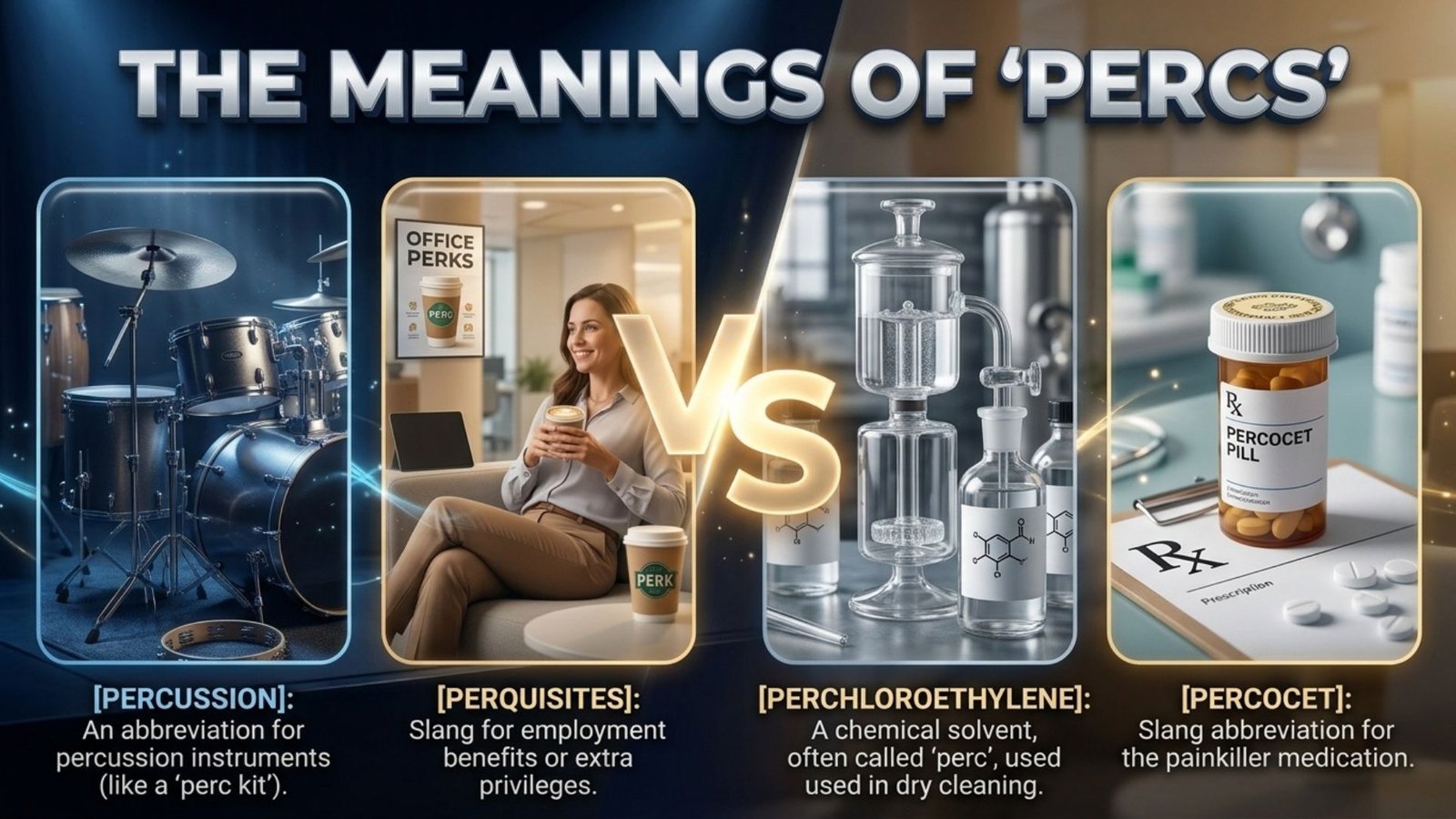
You saw the word “percs” in a text, a song, or a job listing, and now you’re stuck wondering which percs meaning the person actually meant. Same three letters, three totally different vibes — and guessing wrong in the wrong chat can feel awkward fast.
This guide breaks down the percs meaning in every context you’ll actually run into, plus the confusing overlap with perk. You’ll get real examples, a clear perc meaning slang breakdown, and a memory trick that finally sticks. Keep reading — you won’t second-guess this word again.
Perc vs. Perk
Perc and perk sound almost identical, and that’s exactly why so many people mix them up in texts, captions, and everyday conversation. Understanding the percs meaning starts with seeing how different these two words really are underneath the surface.

- Perk is standard English for a benefit or advantage
- Perk can also work as a verb, as in “perk up”
- Perc is far more context-dependent and informal
- Perc can relate to a percolator in casual coffee talk
- Perc or percs is also slang tied to prescription opioid pills
- The two words are not interchangeable in professional writing
How Are Perc and Perk Actually Different?
Even though they’re near-homophones, perk belongs to formal and casual English alike, while perc lives almost entirely in slang, abbreviation, and internet speech — which is why the percs meaning shifts so much depending on where you see it.
Example in texting: Friend 1: did you take the job? heard the perks are great Friend 2: yeah free gym and insurance, not gonna lie about it
Percs Meaning
The percs meaning isn’t one fixed definition — it bends entirely around context, tone, and where the word shows up. That’s the single biggest thing people misunderstand about it.
- In slang, percs usually points to Percocet, a prescription opioid
- In casual coffee talk, perc can shorten percolator
- Song lyrics and captions often use percs as drug slang
- Job posts almost never use “percs” — that’s a perk situation
- Spelling matters: swapping in “perc” for benefit is a common error
- Tone and platform (song, text, workplace) usually reveal the real meaning
What Does Percs Really Mean in Slang?
When people ask about percs meaning online, they’re almost always asking about the slang use — not the coffee one. In slang and music culture, percs most commonly refers to Percocet or similar prescription opioid pills, and the term shows up frequently in lyrics, captions, and casual chat where the speaker is referencing that pill culture rather than anything workplace-related.
- Percs in slang typically means Percocet-type pills
- The secondary keyword perc meaning slang covers this exact usage
- It’s an informal, imprecise term — not a medical label
- Context (song, caption, chat) usually signals this meaning
- It’s unrelated to perk, which means a benefit
Example in chat: Friend 1: this song keeps mentioning percs, what’s that about Friend 2: it’s slang for those pills, has nothing to do with perks
Quick Answer: Perc vs. Perk
Short on time? Here’s the percs meaning stripped down to one line, plus the perk comparison, so you can settle the confusion in seconds and move on with your day.
| Word | Core Meaning | Example |
|---|---|---|
| Perk | A benefit, advantage, or extra | “Free parking is a great perk.” |
| Perc (coffee) | Informal shortening for percolator | “The old coffee perc still works.” |
| Percs (slang) | Informal reference to prescription opioid pills | “The lyrics mention percs.” |
- Perk = benefit or advantage, always
- Perc = depends completely on context
- Never use perc when you mean a workplace benefit
- Percs meaning shifts between coffee talk and drug slang
- When unsure, look at the sentence around it
Perc Meaning Slang
The perc meaning slang version is the one causing the most searches, and it’s worth being precise about since the term gets tossed around loosely in music and online chat.
- Percs in slang usually = Percocet or opioid pills
- The usage is casual and imprecise, not clinical
- It shows up most in lyrics, captions, and texts
- It has zero connection to workplace perks
- Understanding it helps you read tone correctly in conversation
Why Do People Use Percs as Slang?
Slang terms like this usually form because a real name (Percocet) gets clipped down for speed and casual rhythm in speech, texting, and songwriting — the same way lots of prescription and brand names get shortened in everyday informal language.
Example in texting: Friend 1: he keeps talking about percs in his captions Friend 2: yeah that’s the slang term, not a job benefit at all
On The Perc
“On the perc” is a phrase you might come across in casual slang or song references, and it leans on the same perc meaning slang discussed above rather than anything related to perk.
- The phrase uses perc as shorthand slang
- It’s informal and shows up mostly in music or captions
- It is not a workplace or hotel-benefit phrase
- Context always confirms the percs meaning intended
- Mixing this up with “perk” is a common spelling mistake
What Does “Perk” Mean?
Perk is one of the most everyday words in English, and it earns its place in job listings, hotel brochures, and casual conversation alike — a world away from the percs meaning discussed above.
- Perk means an extra benefit or advantage
- It works as both a noun and a verb
- It’s the correct word for workplace benefits
- It’s standard, professional English — no slang baggage
- It’s the opposite of the informal, context-heavy perc
How Is “Perk” Used in Everyday Conversations?
People use perk constantly — describing job benefits, hotel extras, membership bonuses, or simply saying someone became more cheerful after good news, which is why it’s such a flexible, common word in daily English.
Example in chat: Friend 1: what’s the best perk at your new job Friend 2: honestly the free lunches, best perk I’ve ever had
Perk as a Noun
As a noun, perk means an extra benefit or advantage, and it’s especially common when people talk about jobs, memberships, or hotel stays.
- Free health insurance is a major job perk
- Working from home avoids commuting — a nice perk
- Free breakfast is a common hotel perk
- Flexible hours are frequently listed as a top perk
- Membership discounts count as perks too
Perk as a Verb
As a verb, perk means to become more cheerful, lively, alert, or energetic, most often in the phrase “perk up.”
- She perked up when she heard the good news
- Coffee helped him perk up before the meeting
- Plants can perk up after watering
- Someone’s mood can perk up with encouragement
- “Perk up” is far more common than “perk” alone as a verb
What Does “Perc” Mean?
Unlike perk, perc doesn’t have one settled definition — its meaning shifts entirely based on the sentence, the platform, and the intent of the person using it.
- Perc is not a correct spelling of benefit
- It can shorten percolator in casual coffee talk
- It can be slang for prescription opioid pills
- It’s informal in nearly every use case
- Reading the percs meaning correctly requires context every time
What Does Percs Mean When Used Online?
Online, percs shows up most in music references, captions, and DMs, and nearly always leans toward the slang meaning tied to prescription pills rather than the coffee-related shortening.
| Setting | Likely Meaning |
|---|---|
| Song lyrics or captions | Slang for opioid pills |
| Coffee-related chat | Percolator shorthand |
| Job or HR conversation | Not used — should be perk |
Perc as an Informal Shortening
In some niche contexts, perc informally shortens percolator or percolation, particularly in coffee talk.
- “The old coffee perc is still working”
- This use is far less common than the slang meaning
- It’s mostly conversational, rarely written formally
- It has nothing to do with benefits or perks
- Context (kitchen, coffee gear) usually makes this clear
Perc as Slang
As slang, perc or percs most often refers to Percocet or similar prescription opioid pills, and the usage tends to be loose rather than precise.
- The slang can be used imprecisely
- It appears often in music and social captions
- It’s completely unrelated to workplace perks
- The exact meaning should always come from context
- This is the core of the perc meaning slang search
Percs Meaning in Text Messages and Social Media
Texting and social platforms are where most people first encounter the slang percs meaning, so knowing how it reads in a DM or caption really matters for understanding tone.
| Platform | Typical Use |
|---|---|
| Song captions | Slang reference to pills |
| Group chats | Casual, context-dependent |
| Job-related posts | Rare — usually means “perk” instead |
- Percs in captions usually signals the slang meaning
- Texts referencing coffee gear may use perc casually
- Workplace-related texts should always say perk, not perc
- Spelling mix-ups happen most in fast typing
- Reading the full sentence clears up the percs meaning fast
Example in texting: Friend 1: saw “percs” in your caption, what’s that mean Friend 2: it’s slang, has nothing to do with a job perk
What Does Percs Really Mean in Slang?
To directly answer the most common search: percs, in slang, almost always refers to Percocet-type prescription opioid pills, and the term is used casually and imprecisely across music, texting, and social captions rather than in any clinical or medical sense.
- The primary keyword here matches exactly what people search
- Percs meaning in slang ≠ workplace benefit
- The secondary keyword perc meaning slang describes this use
- Tone and platform confirm which meaning is intended
- Never confuse this with perk, a completely different word
Perc vs. Perk: Main Difference
Side by side, the gap between these two words becomes obvious — one is standard English, the other is informal and context-heavy.
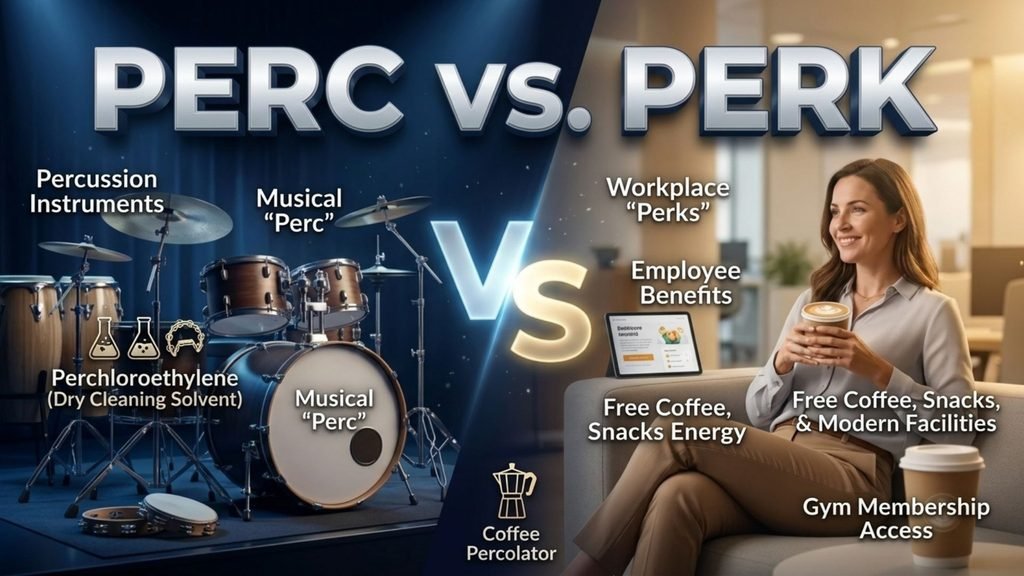
| Feature | Perc | Perk |
|---|---|---|
| Common meaning | Context-dependent abbreviation/slang | Benefit or advantage |
| Standard everyday word? | Less common | Yes |
| Can mean a job benefit? | No | Yes |
| Can be a verb? | Specialized uses only | Yes |
| Common phrase | Depends on context | “Perk up” |
| Slang use | Can refer to prescription pills | Generally no |
- Perk is the safe, professional choice for benefits
- Perc requires context to interpret correctly
- Swapping them in writing is a common, avoidable mistake
- The percs meaning debate mostly comes down to this table
- When in doubt, perk is almost always what you want
Perc vs. Perk: The Biggest Difference
If you remember only one distinction, make it this one — it settles almost every mix-up between these words.
- Perk = a benefit, full stop
- Perc = a context-dependent term, never a benefit
- “Free parking is a perk of the job” — correct
- “The song mentions percs” — slang, not a benefit
- Choosing wrong changes the entire meaning of your sentence
Real-World Usage Scenarios
Seeing these words in real situations makes the difference click faster than any definition alone — so here’s how perk and percs meaning play out in daily life.
- Workplaces almost always use perk, never perc
- Hotels and memberships also default to perk
- Mood-related “perking up” is a common verb use
- Music and social captions are where percs meaning turns to slang
- Each scenario below shows the correct word in action
Scenario 1: Workplace Benefits
“What’s the best perk of working here?” is a completely normal HR-style question, and “the flexible schedule is my favorite perk” is the correct, expected phrasing.
- Perk is the standard word for job benefits
- Common examples: insurance, remote work, bonuses
- Never substitute perc in this context
- HR documents always use perk, not perc
- This is the most frequent everyday use of the word
Scenario 2: Hotel Benefits
“Free breakfast is one of the perks of staying here” uses perks correctly to describe extra hotel benefits beyond the room itself.
- Hotel perks include breakfast, late checkout, or Wi-Fi
- Loyalty programs often advertise member perks
- The word works the same outside of employment
- Perc would be incorrect and confusing here
- Marketing copy almost always says perk, never perc
Scenario 3: Becoming More Energetic
“He perked up after getting some rest” uses perk as a verb, describing a shift toward feeling more alert or cheerful.
- Perk up = become more lively or cheerful
- Coffee, good news, or rest can all cause someone to perk up
- This use is entirely separate from the noun meaning
- It’s never spelled perc up in correct English
- Common in casual, everyday conversation
Scenario 4: Informal Drug Slang
“The lyrics mention percs” is a case where percs meaning shifts entirely into slang, referring informally to prescription opioid pills rather than anything positive or benefit-related.
- This use appears mostly in music and captions
- It’s casual and imprecise, not a clinical term
- It has zero relation to workplace perks
- Context is the only reliable way to confirm intent
- This is the core of most perc meaning slang searches
Percs Meaning in Music and Pop Culture
Music references are a major reason the slang percs meaning spread so widely, since lyrics and captions repeat the term far more than everyday conversation does.
- Song lyrics often use percs as slang shorthand
- Fans repeating lyrics can spread the term into captions
- The usage stays informal, never appearing in formal writing
- It’s unrelated to perk, despite the similar sound
- Recognizing this helps you read lyrics or posts accurately
Example in chat: Friend 1: why does every other song mention percs lately Friend 2: it’s just slang, it caught on in a lot of lyrics
Why Do People Confuse Perc and Perk?
Because these two words sound nearly identical when spoken quickly, it’s easy to see why percs meaning and perk get tangled together, even though their actual definitions have nothing in common.
- The confusion is mostly phonetic, not logical
- Fast speech blurs the small vowel difference
- Autocorrect sometimes makes the mix-up worse
- Reading context out loud usually fixes the confusion
- Writers should default to perk unless slang is clearly intended
Common Mistakes
A few small slip-ups account for most of the confusion around these words — here’s what to watch for.
| Mistake | Wrong | Right |
|---|---|---|
| Spelling “benefit” wrong | “a great perc” | “a great perk” |
| Assuming alt spelling | perc = perk | perc ≠ perk |
| Verb confusion | “perc up” | “perk up” |
- Always double-check spelling before sending work-related messages
- Never assume perc and perk are interchangeable
- Watch for autocorrect swapping the words
- Remember perc’s meaning depends heavily on context
- Reread sentences involving either word before posting
Mistake 1: Writing “Perc” When You Mean “Benefit”
Writing “free parking is a great perc” is incorrect — the correct word is “free parking is a great perk.”
- This happens because the words sound alike
- It’s the single most common mix-up
- Spellcheck doesn’t always catch it
- Proofreading workplace messages avoids this
- The fix is simple: benefit = perk, always
Mistake 2: Assuming “Perc” Is an Alternative Spelling of “Perk”
Perc is not an alternative spelling of perk when the meaning is “benefit” — the two words are simply different.
- Perk is the only correct spelling for a benefit
- Perc carries entirely separate meanings
- Treating them as spelling variants causes real confusion
- This mistake is common among fast typists
- Knowing the percs meaning prevents this error
Mistake 3: Confusing “Perk” and “Perk Up”
“The job has many perks” is a noun, while “she perked up” is a verb — both correct, but grammatically different.
- Perks (noun) = benefits
- Perked up (verb) = became more energetic
- Mixing the forms can sound awkward in a sentence
- Context makes the intended part of speech clear
- Both uses are common and completely correct
Mistake 4: Assuming Every “Perc” Has the Same Meaning
The percs meaning shifts depending on context, so assuming one fixed definition is itself a mistake.
- Perc can mean percolator, or it can mean slang for pills
- The surrounding sentence decides which meaning applies
- Music, texting, and coffee talk all use it differently
- Never assume the meaning without reading context
- This flexibility is exactly why the word confuses people
Perk vs. Benefit vs. Bonus
These three words overlap but aren’t fully interchangeable, especially in workplace or HR conversations.
| Word | Meaning | Example |
|---|---|---|
| Perk | Extra advantage | “Free parking is a perk.” |
| Benefit | Something that provides an advantage | “Health insurance is a benefit.” |
| Bonus | Additional reward, often money | “She received a performance bonus.” |
- Perk leans casual and everyday
- Benefit sounds more formal, often used in HR paperwork
- Bonus almost always implies money
- All three are unrelated to percs meaning in slang
- Choosing the right word depends on tone and setting
Easy Distinction
- Perk = extra advantage
- Benefit = something helpful or advantageous
- Bonus = extra reward, usually financial
- In workplace English, perk often means beyond-salary extras
- None of these overlap with the slang perc
Is Perc a Slang Word You Should Use Carefully?
Because the perc meaning slang version references prescription pills, it’s a word that carries more weight than casual coffee talk, so context and audience matter before using it.
- Percs in slang references a real prescription medication
- Using it casually can sound flippant in some settings
- It’s most common in music, captions, and informal chat
- Professional or formal writing should avoid it entirely
- When precision matters, use the full term instead of slang
Memory Tricks: Perc vs. Perk
If the definitions still blur together, these small tricks make the percs meaning and perk distinction stick for good.
- Perk = an extra — always positive, always a benefit
- Perc → Percolator for the coffee-related use
- Perc/percs → slang tied to prescription pills
- Picture the context (job, kitchen, song) before choosing a word
- Repetition of these tricks locks in the difference fast
Perk = Benefit
Remember: PERK = an EXTRA. If something is an extra advantage, it’s a perk.
Perc = Percolator
For the coffee-related use: Perc → Percolator.
Perc = Slang
For the slang meaning: Perc/percs → prescription-pill slang.
One-Line Memory Trick
A PERK gives you an advantage; a PERC depends entirely on context.
Expert Insight: Why “Perc” and “Perk” Get Confused
The mix-up is mostly phonetic — in many accents, especially fast, casual speech, the two words blur together almost completely, even though their meanings share no real connection.
- Perk has a firm, established place in standard English
- Perc leans on abbreviation, slang, and informal speech
- Employee perks include flexible hours and free parking, as one clear example
- Professional and academic writing has no reason to use perc
- The percs meaning only makes sense once context is added
When Should You Use Perk Instead of Perc?
Whenever you’re describing a benefit, advantage, or something that makes a situation better, perk is the correct word — perc should be reserved for slang or coffee-related casual talk only.
- Use perk for jobs, hotels, memberships, and benefits
- Use perk up for describing someone becoming more energetic
- Use perc only for casual percolator references
- Use percs only when intentionally referencing the slang meaning
- When unsure, perk is almost always the safer, correct choice
Quick Test: Perc or Perk?
Try these quick fill-in-the-blank examples to check whether the percs meaning or perk clicked for you.
| # | Sentence | Answer |
|---|---|---|
| 1 | “Free parking is a job ___.” | Perk |
| 2 | “She began to ___ up after hearing the news.” | Perk |
| 3 | “The company offers several employee ___.” | Perks |
| 4 | “The old coffee ___ is still in the kitchen.” | Perc |
| 5 | “The song refers to ___.” | Percs |
1. “Free parking is a job ___.”
Perk ✅ — a workplace benefit.
2. “She began to ___ up after hearing the news.”
Perk ✅ — “perk up” means becoming more energetic.
3. “The company offers several employee ___.”
Perks ✅ — extra workplace benefits.
4. “The old coffee ___ is still in the kitchen.”
Perc ✅ — informal shorthand for percolator.
5. “The song refers to ___.”
Percs ✅ — slang referencing prescription opioid pills, per the perc meaning slang usage.
FAQs About Percs Meaning
Is “perc” the same as “perk”?
No. Perk commonly means a benefit, while the percs meaning shifts between slang and casual shorthand depending on context.
Is “perc” a word?
Yes, but it’s far less standard than perk. Its percs meaning always depends on the surrounding sentence.
Is “perc” short for Percocet?
In slang, percs can refer to Percocet or similar prescription opioid pills, though the perc meaning slang usage stays casual and imprecise.
What does perk mean?
Perk usually means an extra benefit or advantage, completely separate from the slang percs meaning.
What does “perk up” mean?
Perk up means becoming more cheerful, alert, or energetic — unrelated to the percs meaning used in slang.
Is perk a noun or a verb?
It’s both. As a noun it means a benefit; as a verb it means to become more energetic, distinct from percs meaning.
What is the plural of perc?
It depends on context — percs is used for the slang meaning, while specialized coffee-related uses vary based on the percs meaning intended.
Conclusion
Once you see them side by side, percs meaning and perk stop being confusing. Perk is your everyday word for a benefit, advantage, or extra — think job perks, hotel perks, or simply perking up after good news. Perc, on the other hand, depends completely on where you find it: casual coffee talk, or the slang percs meaning tied to prescription pills in music and texting.
The perc meaning slang version is worth knowing, especially if you’re reading lyrics or captions where it shows up often. But for anything workplace or benefit-related, perk is always the correct, safe choice. Next time you spot either word, pause for a second, check the context, and you’ll land on the right percs meaning every time.
Meta Description (145 characters max): Percs meaning explained simply: the slang, the perk mix-up, real examples, and how to tell the difference in any context.

Ella Brooks is a passionate writer sharing thoughtful words, inspiring ideas, helpful tips, and engaging content for everyday readers.










2 thoughts on “Percs Meaning: The Truth Behind This Slang Word 2026”