Ever typed a sentence, paused, and wondered if it should be “I worked whole day” or “I worked the whole day”? You’re not alone this tiny mix-up trips up even confident English speakers, and it happens more often than anyone likes to admit.
This guide breaks down whole day or all day in plain, friendly language no confusing grammar jargon, just real examples you can actually use. We’ll settle Whole Day or All Day: Which Is Correct? for good, explore the meaning behind each phrase, and show you exactly when to reach for one over the other. Keep reading you’ll never second-guess this phrase again.
Whole Day or All Day: Which Is Correct?
Both phrases are grammatically fine, but they aren’t twins. Whole day or all day depends on context, tone, and whether you want to stress duration or completeness a debate worth settling once.
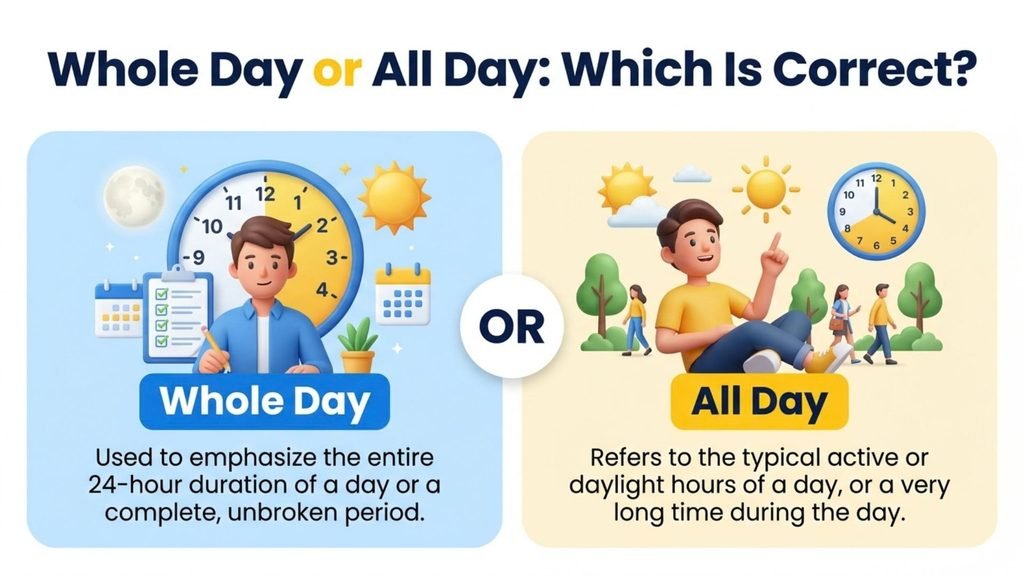
How Do Native Speakers Decide Which Phrase to Use?
- Context decides the phrase action verbs usually favor “all day.”
- Emphasis on completeness almost always calls for “the whole day.”
- Casual texts and quick messages lean toward “all day.”
- Formal writing or storytelling often prefers “the whole day.”
- Grammar structure differs one phrase needs an article, one doesn’t.
- Tone shifts from neutral to dramatic between the two options.
- Speed matters “all day” is shorter and flows faster in speech.
Example in texting: Friend 1: Ugh, I’ve been cleaning all day. Friend 2: Same. I spent the whole day scrubbing floors too.
Whole Day or All Day Meaning
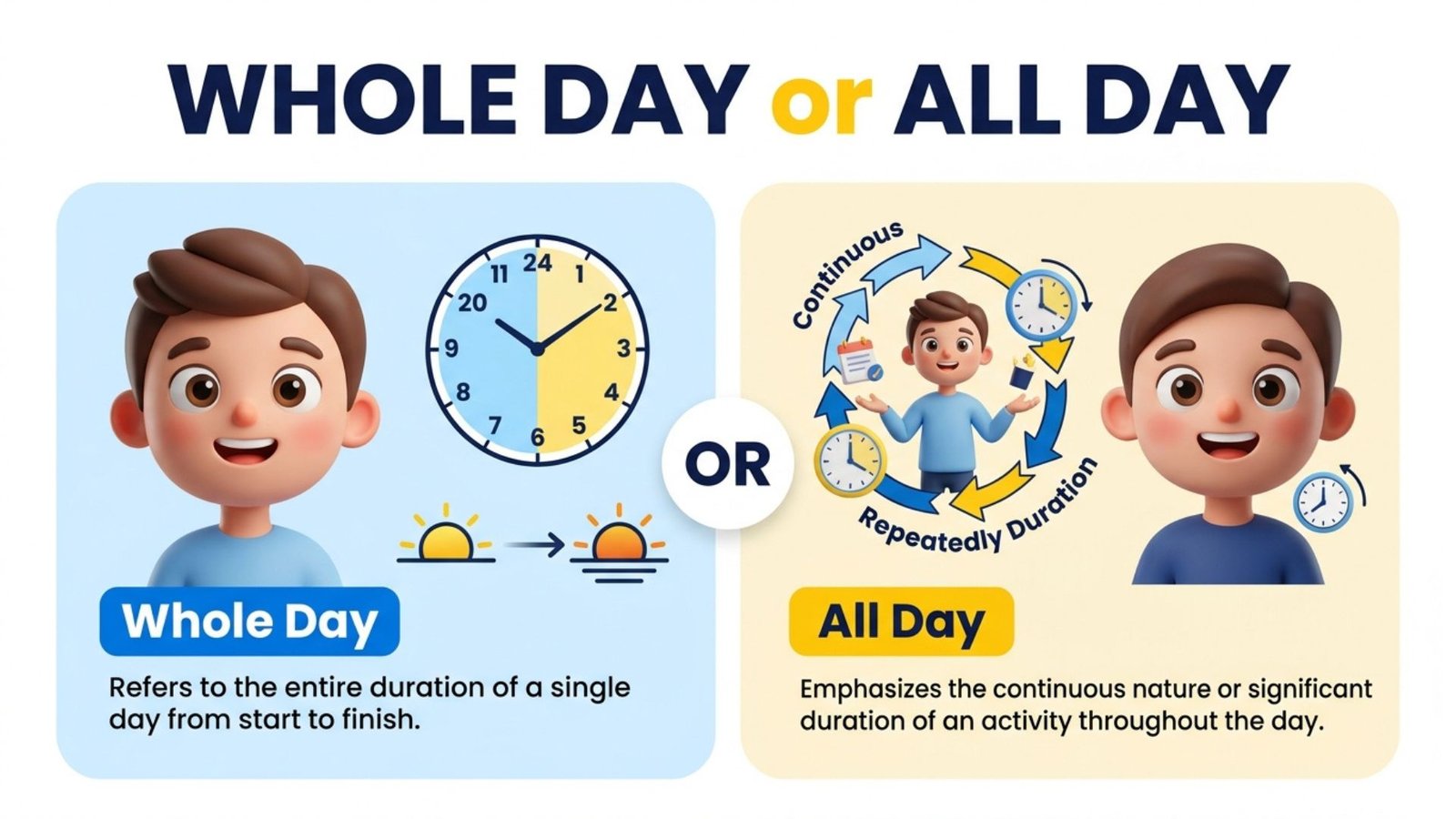
At the core, both phrases point to the same 24-hour stretch, yet the whole day or all day meaning shifts based on whether you’re describing an ongoing action or a complete, wrapped-up block of time.
What Is the Core Difference in Meaning Between These Two Phrases?
- “All day” functions as an adverbial phrase attached to a verb.
- “Whole day” functions more like a noun, describing a full unit.
- Duration is the focus when someone says “all day.”
- Completeness is the focus when someone says “the whole day.”
- Emotional weight is heavier with “the whole day” than “all day.”
- Everyday speech naturally gravitates toward the lighter “all day.”
| Aspect | All Day | The Whole Day |
| Grammar type | Adverbial phrase | Noun phrase |
| Focus | Duration | Completeness |
| Feel | Light, casual | Heavy, emphatic |
| Common setting | Texting, chatting | Writing, storytelling |
Example in chat: Friend 1: I studied all day for that exam. Friend 2: I studied the whole day and still feel unprepared.
What Does “All Day” Mean?
“All day” describes continuous action something happening nonstop from morning until night, with no gaps and no article needed before it in a normal sentence.
Why Doesn’t “All Day” Need an Article Before It?
- Function “all day” works as an adverb, not a noun.
- Attachment it connects directly to the verb in the sentence.
- Flow dropping the article keeps the phrase quick and natural.
- Common use “I worked all day” needs nothing extra before it.
- Consistency this pattern holds across almost every tense.
- Simplicity it’s one reason “all day” feels so casual.
Example in texting: Friend 1: Where were you all day? Friend 2: Stuck in meetings all day, honestly exhausting.
What Does “Whole Day” Mean?
“Whole day” treats the day as a single, complete package rather than a stretch of time. It’s not about the minutes passing it’s about the entirety of the day being used, spent, or affected.
Why Does “Whole Day” Always Need a Determiner Before It?
- Grammar rule “whole” is an adjective describing the noun “day.”
- Noun phrases in English typically require an article or determiner.
- Missing article makes “whole day” sound incomplete or broken.
- Correct forms include “the whole day” and “a whole day.”
- Common error dropping “the” is the most frequent mistake.
- Native ear instantly notices when the determiner disappears.
Example in chat: Friend 1: I spent the whole day baking cookies. Friend 2: A whole day for cookies? That’s dedication.
Whole Day or All Day What’s the Real Difference?
Same 24 hours, completely different feeling. Whole day or all day split apart the moment you look at grammar structure, emotional tone, and the kind of sentence each one naturally fits into.
Does One Phrase Sound More Dramatic Than the Other?
- “All day” feels neutral a plain statement of time.
- “The whole day” feels heavier, almost like a complaint.
- Storytelling often leans on “the whole day” for drama.
- Everyday chats rarely need that extra emotional punch.
- Formal tone pairs naturally with “the whole day.”
- Casual tone pairs naturally with “all day.”
| All Day | The Whole Day | |
| Grammar role | Adverbial phrase | Noun phrase |
| Needs article? | No | Yes (“the” or “a”) |
| Tone | Neutral, casual | Emphatic, expressive |
| Best used for | Duration, ongoing action | Completeness, full time block |
| Common in | Casual speech, texting | Formal writing, storytelling |
Example in texting: Friend 1: I waited all day for that package. Friend 2: I waited the whole day and it still didn’t come.
“All Day” vs “Whole Day” in Grammar Rules
Grammar rules are exactly why these two phrases behave so differently on paper, even though they describe the same stretch of hours in nearly every casual conversation.
Is “All Day” an Adverb or a Noun Phrase?
- “All day” works as an adverbial phrase modifying the verb.
- “Whole day” works as a noun phrase needing a determiner.
- Sentence position for “all day” usually sits after the verb.
- Sentence position for “the whole day” can shift more freely.
- Plural forms exist too “all week,” “the whole month.”
- Pattern recognition helps you apply this rule to similar phrases.
| Grammar Feature | All Day | The Whole Day |
| Part of speech role | Adverbial | Nominal |
| Article required | No | Yes |
| Modifies | Verb | Noun (day) |
| Flexibility in sentence | Fixed position | More flexible |
Example in chat: Friend 1: I’ve been coding all day. Friend 2: I’ve been coding the whole day too, my eyes hurt.
Is “All Day” Correct Grammar?
Yes and this simple question deserves a clear answer, because plenty of people quietly doubt themselves every time they type this everyday phrase into a message.
What Makes “All Day” Grammatically Acceptable in Every Context?
- Standard English fully accepts “all day” without an article.
- Verbs like work, rain, sleep, and wait pair naturally with it.
- No determiner is required because it functions as an adverb.
- Extended form “all day long” is equally correct and common.
- Formal and informal writing both accept this phrase comfortably.
- Confidence should be high this is not a shortcut or slang.
Example in texting: Friend 1: Is “I slept all day” correct grammar? Friend 2: Yes, totally fine no article needed there at all.
Quick-Use Guide When to Use Each Phrase
Choosing correctly gets easier once you treat this like a simple checklist instead of a grammar puzzle you have to solve from scratch every time.
What’s the Fastest Way to Pick the Right Phrase in a Sentence?
- Use “all day” when describing how long something lasted casually.
- Use “all day” in texting, chatting, or informal writing.
- Use “the whole day” to stress a full, complete block of time.
- Use “the whole day” in formal writing or emotional storytelling.
- Default rule “all day” is safer when you’re unsure.
- Memory trick All means action, Whole means one complete unit.
| Situation | Best Choice |
| Texting a friend | All day |
| Writing a formal report | The whole day |
| Describing weather | All day |
| Telling a dramatic story | The whole day |
| Casual conversation | All day |
Example in chat: Friend 1: Should I say “all day” or “the whole day” here? Friend 2: Texting a friend? Just go with all day, way more natural.
Synonyms for “Whole Day” and “All Day”
English gives you plenty of alternatives once you’re bored of repeating the same phrase over and over across texts, essays, or everyday conversation with friends.
What Are Some Natural Alternatives to These Two Phrases?
- “The entire day” works as a strong substitute for “the whole day.”
- “Around the clock” suggests nonstop, continuous activity like “all day.”
- “From dawn to dusk” adds poetic flair to completeness.
- “The full day” mirrors “the whole day” in formal writing.
- “Nonstop” captures the duration sense behind “all day.”
- “Throughout the day” softens the emphasis while keeping the meaning.
| Phrase | Closest To |
| The entire day | The whole day |
| The full day | The whole day |
| Around the clock | All day |
| Nonstop | All day |
| Throughout the day | All day |
Example in texting: Friend 1: I was on calls the entire day. Friend 2: Same, felt like I worked around the clock honestly.
Is It “The Whole Day” or “All Day”?
This exact question gets typed into search bars constantly, usually right after someone catches themselves mid-sentence and isn’t sure which version sounds right.
Which Phrase Should You Trust When You’re Not Sure?
- Default to “all day” when the sentence feels casual or quick.
- Choose “the whole day” when completeness matters to your meaning.
- Never say “whole day” alone without “the” or “a” attached.
- Check the verb action verbs often flow better with “all day.”
- Read it aloud the version that sounds smoother usually wins.
- Both are correct, so the real choice is about tone, not error.
Example in chat: Friend 1: Is it “the whole day” or “all day” here? Friend 2: Depends want it dramatic or casual? Pick accordingly.
Whole Day Meaning
Beyond grammar, the whole day meaning carries a sense of totality nothing skipped, nothing partial, just one complete stretch of time treated as a single, whole experience.
How Do People Use “Whole Day” to Express Emotion?
- Frustration often shows up in “I wasted the whole day.”
- Pride appears in “I dedicated a whole day to this.”
- Exhaustion pairs naturally with “the whole day” in complaints.
- Commitment gets emphasized when someone plans “a whole day” for something.
- Storytelling uses this phrase to slow down and add weight.
- Reflection often opens with “looking back on the whole day.”
Example in texting: Friend 1: I spent the whole day thinking about that conversation. Friend 2: A whole day? It must have really stuck with you.
“All Day” and “Whole Day” in Formal Writing
Formal writing has its own quiet preferences, and knowing which phrase fits a professional email versus a casual group chat can genuinely change how polished you sound.
Which Phrase Fits Better in Reports, Essays, and Professional Emails?
- “The whole day” often reads as more deliberate and polished.
- “All day” can still appear in formal writing without issue.
- Narrative essays frequently favor “the whole day” for emphasis.
- Business emails tend to use “all day” for simple scheduling.
- Academic writing leans toward precision, favoring complete phrasing.
- Tone consistency matters more than picking one phrase exclusively.
| Writing Type | Preferred Phrase |
| Business email | All day |
| Narrative essay | The whole day |
| Casual blog post | All day |
| Formal report | The whole day |
Example in chat: Friend 1: How should I phrase this in my report? Friend 2: Go with “the whole day” sounds more formal there.
Can You Say “I Slept Whole Day”?
Technically, no and this exact sentence is one of the most common grammar slips people make when they drop the tiny word that holds the whole phrase together.
Why Does This Sentence Sound Incomplete Without an Article?
- “Whole day” alone breaks a basic English noun-phrase rule.
- Correct version adds “the,” becoming “I slept the whole day.”
- Alternative fix swaps in “all day” instead, needing no article.
- Native speakers almost never drop the determiner in real speech.
- Non-native learners make this mistake more frequently than expected.
- Quick fix just insert “the” and the sentence instantly works.
Example in texting: Friend 1: I slept whole day yesterday lol. Friend 2: Haha say “the whole day” much better!
Whole Day in Tagalog
Language learners searching for whole day in Tagalog usually want a natural, everyday translation rather than a stiff, word-for-word dictionary version that nobody actually says out loud.
How Do You Naturally Say “Whole Day” in Tagalog?
- “Buong araw” is the most common translation of “whole day.”
- “Buong maghapon” adds extra emphasis on the full daytime stretch.
- “Sa buong araw” works when placed at the start of a sentence.
- Context still matters tone shifts slightly depending on placement.
- Casual speech in Filipino often shortens it to just “buong araw.”
- Everyday use makes this phrase extremely common in daily conversation.
| English | Tagalog |
| Whole day | Buong araw |
| All day | Buong araw / Sa buong araw |
| Whole day long | Buong maghapon |
Example in chat: Friend 1: Buong araw akong nagtrabaho today. Friend 2: Same, buong araw din ako sa opisina.
Common Mistakes With “Whole Day” and “All Day”
Even confident writers slip up here, usually by mixing grammar rules from one phrase into the other without realizing the two work in completely different ways.
What Are the Most Frequent Errors People Make With These Phrases?
- Dropping “the” before “whole day” is the top mistake.
- Adding an article before “all day” sounds unnatural and wrong.
- Overusing “the whole day” in casual texts feels overly dramatic.
- Mixing tenses incorrectly around either phrase confuses the sentence.
- Assuming interchangeability ignores the tone difference between them.
- Forgetting “long” in “all day long” changes emphasis, not correctness.
| Mistake | Correct Version |
| “I worked whole day” | I worked the whole day |
| “I waited the all day” | I waited all day |
| “Whole day was tiring” | The whole day was tiring |
Example in texting: Friend 1: I worked whole day today lol. Friend 2: Haha it’s “the whole day” small fix, big difference.
Is “Wholeday” One Word?
No “wholeday” is not a recognized English word, no matter how often it shows up as a typo in quick texts, social captions, or rushed emails.
Why Do People Mistakenly Write “Wholeday” as One Word?
- Speed typing often merges two words without noticing the error.
- Autocorrect doesn’t always catch this specific mistake.
- Similar words like “everyday” being one word cause confusion.
- Standard spelling always keeps “whole” and “day” as two words.
- Dictionaries do not list “wholeday” as a valid entry.
- Correct habit always write “whole day” with a space.
Example in chat: Friend 1: I was busy wholeday, sorry for the late reply. Friend 2: No worries small tip, it’s two words: whole day!
FAQs About Whole Day and All Day
Is “Whole Day” Grammatically Correct?
Yes, but only with a determiner. Whole day or all day both work, though “whole day” alone needs “the” or “a.”
Can I Use “All Day” and “Whole Day” Interchangeably?
Not always. In the whole day or all day debate, one stresses duration, the other stresses completeness and emotional weight.
Which Sounds More Natural in Everyday Conversation?
“All day” wins for casual speech. Between whole day or all day, it’s the lighter, more common everyday choice.
Is “All Day Long” Correct?
Yes, completely correct. It’s simply a stronger version within the whole day or all day family of time expressions.
Is There a Difference Between British and American Usage?
Slightly. Both dialects use whole day or all day, but British narrative writing leans more toward “the whole day.”
Can I Say “I Worked the Whole Day”?
Yes, that’s correct and natural. It’s one of the clearest whole day or all day examples showing proper article use.
What’s Wrong With Saying “I Worked Whole Day”?
The missing article breaks the rule. In whole day or all day usage, “whole day” always needs “the” or “a” first.
The Bottom Line
So, whole day or all day, which one wins? Honestly, neither beats the other; they just play different roles. Whole day or all day both describe a full 24 hours, but “all day” keeps things light, quick, and casual, while “the whole day” adds weight, emotion, and completeness to your sentence. Use whole day or all day based on tone, not fear of being wrong, since both are grammatically solid choices.
The single rule worth remembering: never drop the article before “whole day.” Get that one detail right, and your writing whether texting a friend or drafting a formal report will instantly sound more natural, confident, and clear.

Ella Brooks is a passionate writer sharing thoughtful words, inspiring ideas, helpful tips, and engaging content for everyday readers.










1 thought on “Whole Day or All Day: The Surprising Meaning 2026”