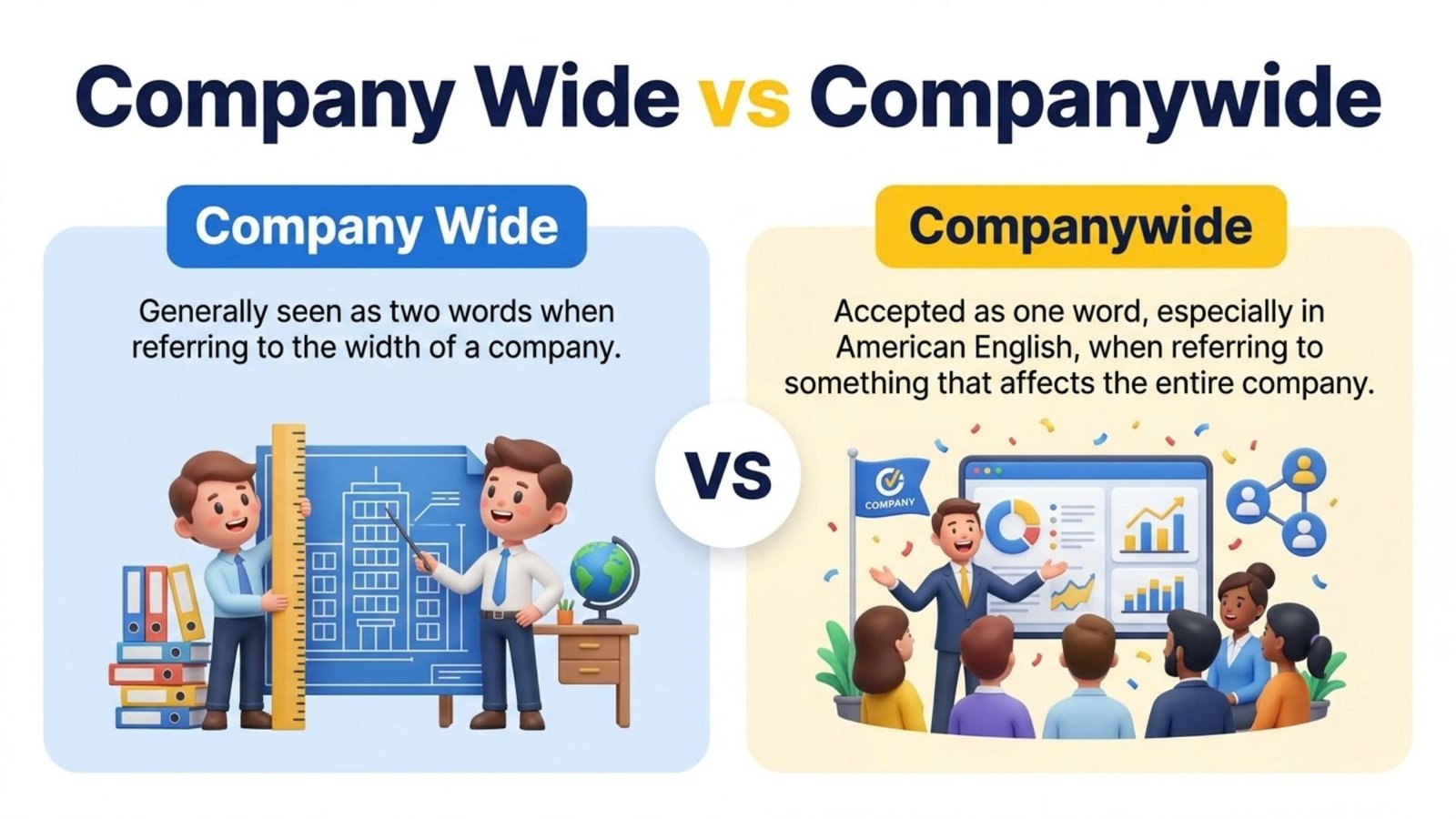
You type an email to the whole office, your cursor freezes at that one word, and suddenly you’re not sure if it should have a hyphen or not. It’s such a small thing, yet it makes you feel like you don’t know your own language anymore.
That little pause is exactly why this guide exists. Whether you’re drafting a memo, a Slack message, or a formal announcement, understanding company wide or companywide will save you from second-guessing yourself every single time. We’ll walk through the grammar, the company wide vs companywide debate, and real examples so you never freeze at that word again. Keep reading, because the answer is simpler than it feels.
Company Wide or Companywide: Which Is Correct?
Here’s the honest truth: both spellings are technically correct, but timing and context decide which one actually belongs in your sentence right now.
The short answer to company wide or companywide is that “company-wide” (hyphenated) works before a noun, while “companywide” (one word) works after a verb. Neither version is “wrong” in isolation — grammar just asks you to pick based on position.
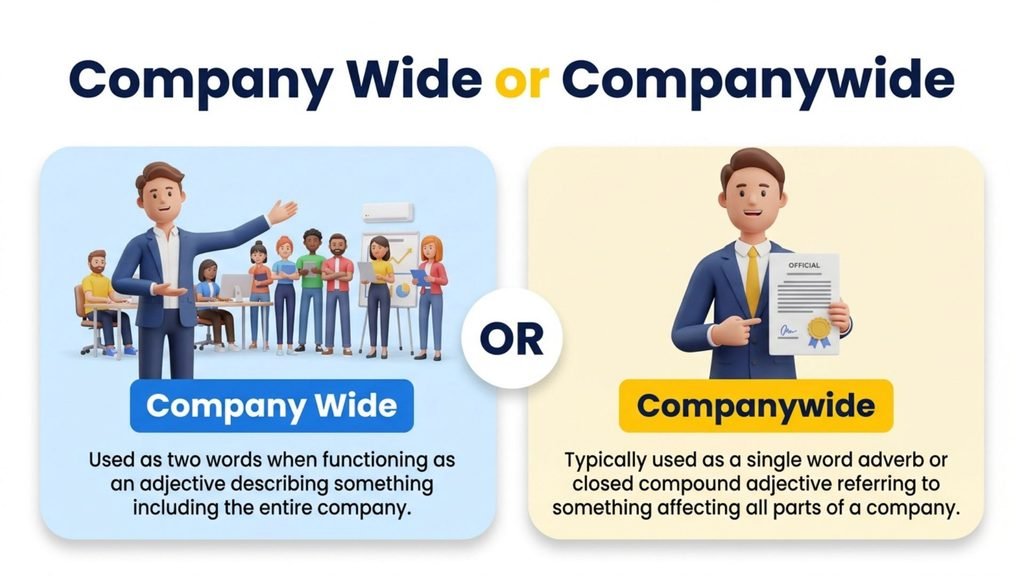
Is Company Wide or Companywide the Correct Spelling?
- Hyphenate it when it directly describes a noun, like “company-wide policy.”
- Skip the hyphen when it follows a verb, like “applies companywide.”
- Never write it as two plain words with no hyphen and no noun attached.
- Check the noun right after the phrase to decide instantly.
- Match your style guide since AP and Chicago disagree here.
- Stay consistent once you pick a version for a document.
| Position in Sentence | Correct Form | Example |
| Before a noun | company-wide | company-wide meeting |
| After a verb | companywide | rolled out companywide |
| Standing alone | companywide | effective companywide |
Example in texting: Friend 1: is the new dress code company wide or companywide? Friend 2: it’s a company-wide policy, so yeah, everyone’s included lol
What Does “Company Wide” Really Mean in Business Writing?
At its core, company wide simply means something that touches every department, every employee, and every level of an organization at once.
People search this phrase because job postings, HR emails, and internal memos throw it around constantly, and nobody explains what it’s actually signaling about scope and reach.
What Is the Real Meaning Behind Company Wide?
- Scope means the action affects the entire organization, not one team.
- Inclusion signals every employee is expected to participate or comply.
- Reach often applies to policies, training, or announcements.
- Contrast exists against terms like “departmental” or “team-specific.”
- Formality rises when the term appears in official documents.
- Consistency matters more than which spelling you personally prefer.
- Clarity improves when you pair the term with a specific noun.
Example in chat: Friend 1: why does everyone suddenly have to do this training? Friend 2: it’s a company wide thing, HR sent it to literally everyone
Company-Wide or Companywide?
This exact question shows up in search bars daily because writers want one definitive rule, but grammar rarely hands out absolutes.
The real answer depends on function. Company-wide acts as a compound adjective sitting right before a noun, while the one-word form typically slides in after the verb or noun it’s describing.
Does Company-Wide Always Need a Hyphen?
- Adjective position almost always calls for the hyphen.
- Predicate position usually drops the hyphen entirely.
- Formal writing leans toward the hyphenated compound adjective.
- Casual writing often simplifies to the one-word form.
- AP style prefers companywide regardless of placement.
- Chicago style keeps the hyphen before nouns.
- Readers rarely notice unless the switch happens mid-document.
| Scenario | Recommended Form |
| “The company-wide email went out.” | company-wide (before noun) |
| “The email went out companywide.” | companywide (after verb) |
| Journalism or news copy | companywide (AP style) |
| Academic or book publishing | company-wide (Chicago style) |
Example in texting: Friend 1: company-wide or companywide, which one do I use in this report? Friend 2: before “meeting” use the hyphen, after “applies” drop it
Companywide or Company Wide?
Notice the difference here — this version compares the correct compound spelling against the incorrect, unhyphenated two-word version many people accidentally type.
Writing “company wide” as two separate words with zero hyphen is the actual mistake, not a stylistic choice. It’s grammatically incomplete when placed before a noun.
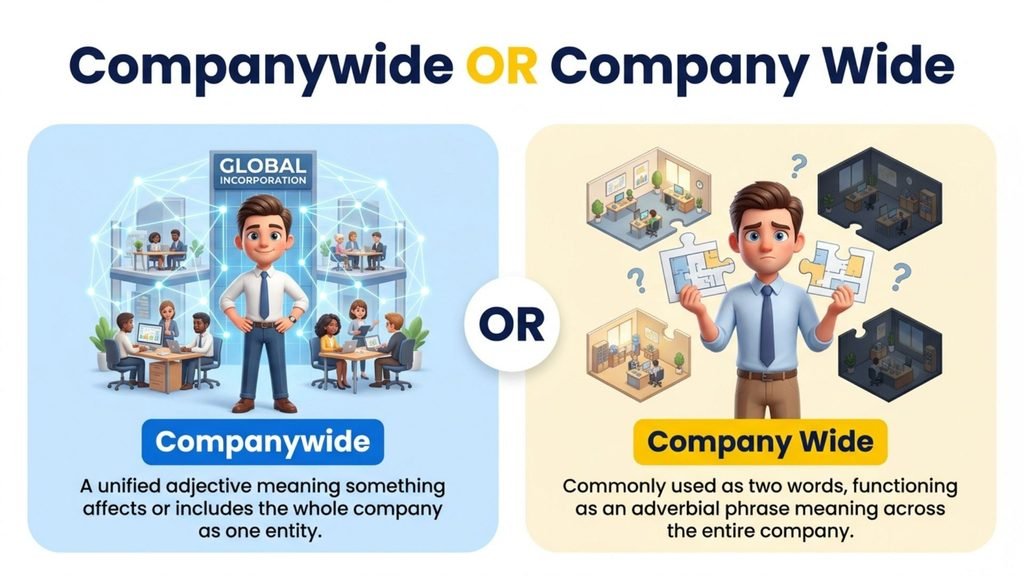
Why Do People Confuse Companywide With Two Separate Words?
- Autocorrect sometimes strips hyphens without warning writers.
- Speed typing skips punctuation that feels optional in the moment.
- Casual habits carry over from texting into formal emails.
- Visual similarity makes “company wide” look fine at a glance.
- Lack of awareness about compound modifier rules causes slip-ups.
Example in chat: Friend 1: I wrote “company wide meeting” is that fine? Friend 2: nah add the hyphen, it should be company-wide meeting
Is Companywide One Word or Two?
Search engines fill up with this exact question because people want a quick, confident answer without wading through grammar textbooks.
Companywide functions correctly as one solid word only when it’s not directly modifying a noun that follows it. Otherwise, the hyphenated version takes over.
- One word works after verbs like “applies,” “spread,” or “launched.”
- Two words with a hyphen work before nouns like “policy” or “email.”
- Zero hyphen, two words is never technically correct usage.
- Dictionaries list companywide as an accepted single-word entry.
- Context clues always reveal which version a sentence needs.
Example in texting: Friend 1: is companywide one word or two, genuinely asking Friend 2: one word after a verb, hyphenated before a noun, that’s it
Is It Company Wide or Companywide?
This phrasing usually shows up when someone is proofreading a finished draft and just wants a fast, final confirmation before hitting send.
The safest habit is scanning the word immediately after the phrase. A noun right after it usually means hyphenate; anything else usually means one word.
How Can You Instantly Check Which Form to Use?
- Read the next word after “company-wide” or “companywide” carefully.
- Spot a noun like “meeting,” “email,” or “training” nearby.
- Add the hyphen whenever that noun test comes back positive.
- Drop the hyphen if a verb or preposition follows instead.
- Reread the sentence aloud since awkward pauses often reveal errors.
- Use one version per document to stay professional and consistent.
Example in chat: Friend 1: is it company wide or companywide in “the update applies ___”? Friend 2: companywide, one word, since there’s no noun right after it
Hyphenation Rule: Company-Wide vs. Companywide
The hyphenation debate around company-wide versus companywide comes down to understanding compound modifiers, which is a term that sounds more intimidating than it actually is.
A compound modifier is simply two or more words teaming up to describe a single noun, and the hyphen exists to show readers that partnership clearly instead of letting them guess.
What Exactly Is a Compound Modifier in This Context?
- Two words join together to modify one noun as a unit.
- The hyphen prevents readers from misreading the phrase’s meaning.
- Position matters more than the words themselves in this rule.
- “Company” and “wide” behave like a single descriptive term here.
- Removing the hyphen after the noun doesn’t change the meaning.
- This rule applies to many similar compounds, not just this one.
Example in texting: Friend 1: why does grammar even need hyphens for stuff like this Friend 2: they stop confusion, like “company-wide” reads clean before a noun
When to Use the Hyphen in Company-Wide
Use the hyphenated form company-wide when it serves as an adjective directly before a noun. This creates clarity and prevents misreading entirely.
Common examples include company-wide meetings, company-wide initiatives, company-wide surveys, and company-wide communications. The hyphen signals that both words function as one modifier, working together instead of separately.
Think of the hyphen as glue. It bonds “company” and “wide” together so readers instantly understand you’re describing something spanning the entire organization, not two unrelated ideas sitting side by side.
The Case for Writing Companywide as One Word
Modern usage increasingly favors companywide as a single word, especially in digital communication and informal business writing. Many organizations have quietly adopted this streamlined approach over the last decade.
The one-word version appears more frequently in internal memos, email subject lines, and corporate announcements. It looks cleaner, saves a keystroke, and doesn’t sacrifice any clarity for the reader scanning quickly.
Company-Wide Synonyms and Related Business Terms
Sometimes the fastest way to understand a word is by meeting its neighbors — the terms people use interchangeably or alongside it in real business settings.
Knowing these related words helps you vary your writing naturally instead of repeating company wide in every single sentence of a long report or memo.
What Words Mean the Same as Company-Wide?
- Organization-wide describes the same full-scope reach in formal contexts.
- Enterprise-wide appears often in larger, multi-branch corporations.
- Firmwide is common in law firms and financial institutions.
- Across the board works as a casual, conversational alternative.
- Universal fits when emphasizing that nothing is excluded.
- Organization-spanning is rare but occasionally used in technical writing.
| Related Term | Typical Setting |
| Organization-wide | Nonprofits, large institutions |
| Enterprise-wide | Corporations, IT departments |
| Firmwide | Law firms, banks, consultancies |
| Across the board | Casual or spoken business English |
Example in chat: Friend 1: can I just say “organization-wide” instead of company-wide? Friend 2: yeah totally, same meaning, just sounds a bit more formal
What Do Major Style Guides Say About Company-Wide?
Different style guides offer genuinely different recommendations on company-wide versus companywide, which explains why even professional editors disagree at times.
Knowing which guide your workplace or publication follows removes the guesswork instantly, so you’re not relying on personal preference when consistency actually matters most.
Which Style Guide Should You Actually Follow?
- AP Stylebook recommends companywide as one solid word always.
- Chicago Manual of Style keeps the hyphen before nouns.
- Merriam-Webster accepts both spellings as valid entries.
- Corporate style guides vary widely by individual organization.
- Journalism typically follows AP over Chicago conventions.
- Academic writing usually defaults to the Chicago approach instead.
| Style Guide | Recommendation | Usage Context |
| AP Stylebook | Companywide (one word) | Journalism, news writing |
| Chicago Manual of Style | Company-wide (hyphenated before nouns) | Academic, book publishing |
| Merriam-Webster | Both accepted | General usage |
| Corporate Style Guides | Varies by organization | Internal communications |
Example in texting: Friend 1: our newsletter uses AP style, so which spelling do I pick? Friend 2: companywide, one word, no hyphen needed anywhere
Why Do Style Guides Disagree on Company-Wide?
It genuinely feels frustrating when two respected sources give opposite answers, especially when you just want one clean rule to memorize forever.
The disagreement traces back to how each guide treats compound adjectives overall, not just this specific phrase, so the inconsistency isn’t personal or arbitrary at all.
- AP prioritizes speed and simplicity for fast-paced news writing.
- Chicago prioritizes grammatical precision for long-form publishing.
- Neither guide is objectively more “correct” than the other.
- Your industry usually determines which guide carries more weight.
- Internal guides at your company should override general recommendations.
Example in chat: Friend 1: so neither AP nor Chicago is wrong about company-wide? Friend 2: nope, just different philosophies, pick whichever your workplace uses
Company-Wide vs. Companywide Usage
Seeing both forms laid out side by side, in their natural grammatical roles, usually clicks faster than any explanation written in paragraph form.
This comparison strips away the confusion by showing exactly where each version belongs, so you can reference it the next time you’re mid-sentence and unsure.
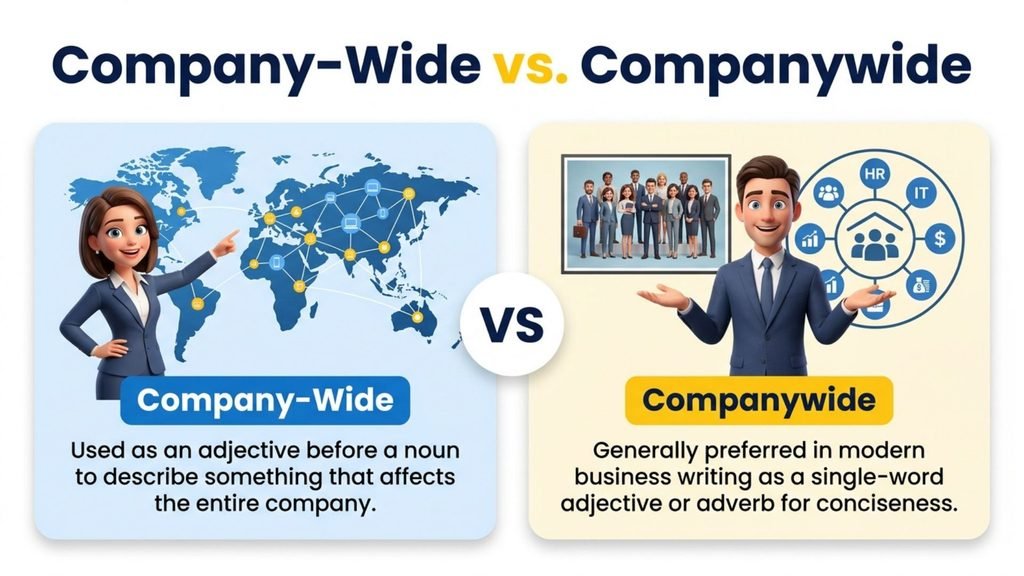
How Do the Two Forms Actually Differ in Practice?
- Grammar role separates a compound adjective from predicative usage.
- Placement before a noun always favors the hyphenated form.
- Placement after a noun or verb favors the one-word form.
- Meaning stays identical regardless of which spelling you choose.
- Professional documents should apply this rule consistently throughout.
| Before the Noun (Attributive) | After the Noun or Verb (Predicative) |
| Form: company-wide (hyphenated) | Form: companywide (one word) |
| Grammar Role: Compound adjective | Grammar Role: Predicative usage |
| Rule: Hyphen required for clarity | Rule: No hyphen needed |
| Explanation: Both words describe the noun together | Explanation: Describes scope, not a noun directly |
| Examples: company-wide email, company-wide budget | Examples: applies companywide, changes occur companywide |
Example in texting: Friend 1: give me one example of each form real quick Friend 2: “company-wide budget” vs “the cuts happened companywide,” easy
Companywide Email and Memo Writing Tips
Writing an actual announcement is where this grammar rule stops being theoretical and starts affecting how professional your message looks to hundreds of coworkers.
A single inconsistent spelling in a companywide memo can quietly undercut your credibility, even if the content itself is well-written and genuinely important.
How Do You Keep a Companywide Email Grammatically Clean?
- Pick one spelling before you start drafting the entire email.
- Use Find and Replace to catch inconsistent versions after writing.
- Read the subject line separately, since headers hide errors easily.
- Ask a colleague to proofread before a large distribution list.
- Avoid switching styles between the subject and the email body.
- Keep sentences short so the hyphenation choice stays visually clear.
Example in chat: Friend 1: proofread my companywide email before I send it to everyone? Friend 2: sure, just fix “company wide” to “company-wide” in line two
How to Use Company-Wide Correctly in Sentences
Mastering correct usage requires understanding how company-wide functions grammatically across different sentence positions, not just memorizing one isolated example.
The key factor is always whether the phrase modifies a noun directly or stands independently within the sentence, and that single check determines hyphenation every time.
What’s the Fastest Way to Build a Correct Sentence?
- Identify the noun the phrase is meant to describe first.
- Place the hyphen immediately if that noun follows directly.
- Remove the hyphen if a verb or preposition follows instead.
- Test both versions by reading the sentence aloud slowly.
- Trust the pattern once you’ve practiced it a few times.
Business Writing Examples
Here are practical examples from actual business contexts you’ll recognize instantly:
- “The CEO announced a company-wide restructuring during the quarterly meeting.”
- “Our companywide survey revealed important insights about employee satisfaction.”
- “The new policy will be implemented companywide starting January 1.”
- “HR is organizing a company-wide training program for all departments.”
Example in texting: Friend 1: is “company-wide restructuring” correct or should it be one word? Friend 2: hyphenated, “restructuring” is the noun right after it
When Should You Hyphenate Company-Wide in a Sentence?
This question keeps circling back because the rule feels simple in theory but gets genuinely tricky under deadline pressure when you’re typing fast.
A reliable shortcut is asking whether you could swap in “organization-wide” and still have the sentence make sense; if yes, the same hyphenation rule applies without exception.
- Before nouns, hyphenate every single time without exception.
- After verbs, drop the hyphen and write one word.
- In titles, follow whatever style guide governs that document.
- In casual chats, either form usually reads fine informally.
- When unsure, default to the hyphenated compound adjective form.
Example in chat: Friend 1: when should you hyphenate company-wide, like actually? Friend 2: whenever a noun comes right after it, that’s the whole trick
Company-Wide vs Nationwide vs Industry-Wide: What’s the Difference?
These three terms get mixed up constantly because they all describe broad reach, yet each one operates at a completely different scale.
Understanding the distinction helps you choose precise language instead of defaulting to company wide when a bigger or smaller scope word actually fits better.
How Does Scope Change Between These Similar Terms?
- Company-wide covers one single organization from top to bottom.
- Nationwide spans an entire country, always written as one word.
- Industry-wide covers every company within a specific sector.
- Nationwide never takes a hyphen, unlike company-wide before nouns.
- Industry-wide follows the same hyphenation logic as company-wide.
| Term | Scope | Hyphenation Behavior |
| Company-wide | One organization | Hyphen before nouns |
| Nationwide | Entire country | Always one word |
| Industry-wide | One entire sector | Hyphen before nouns |
Example in texting: Friend 1: is it nationwide or nation-wide, does it work like company-wide? Friend 2: nationwide is always one word, no hyphen ever, unlike company-wide
Common Mistakes with Company-Wide and Companywide
The most frequent error is inconsistent hyphenation within the same document, which quietly signals carelessness even when the actual content is strong and well-researched.
Switching between company-wide and companywide on the same page confuses readers and looks unprofessional, especially in formal reports, press releases, or client-facing communication.
What Mistakes Should You Actively Watch For?
- Inconsistent spelling across paragraphs in the same document.
- Missing hyphens before nouns that clearly need one.
- Extra hyphens added after verbs where none belong.
- Two separate words written with absolutely no hyphen at all.
- Copy-pasting from sources that use a different style guide.
- Ignoring autocorrect changes that silently strip out hyphens.
Example in chat: Friend 1: I keep mixing up company-wide and companywide in the same doc Friend 2: pick one rule, apply it everywhere, and proofread with Find and Replace
Incorrect Usage
Wrong: “The company wide initiative launches next week.” Right: “The company-wide initiative launches next week.”
Wrong: “We’re implementing this policy company wide.” Right: “We’re implementing this policy companywide.”
Wrong: “All company-wide employees must attend.” Right: “All employees must attend the company-wide meeting.”
FAQs
Is it company-wide or companywide in AP style?
AP style uses companywide as one word without a hyphen, no matter where it sits in the sentence.
How do you write company-wide in a sentence?
Write company-wide with a hyphen before a noun, or companywide as one word after a verb.
Is companywide one word or two?
Companywide is one word in AP style, though “company-wide” with a hyphen stays correct before nouns.
Should company-wide be hyphenated?
Company-wide should be hyphenated before nouns in Chicago style, but written as companywide in AP style.
What’s the difference between nationwide and company-wide?
Nationwide is always one word, while company-wide changes based on style guide and sentence position.
Can I use company wide as two separate words?
No, company wide without a hyphen is incorrect; always use company-wide or companywide instead.
Does companywide need a hyphen after a verb?
No, companywide after a verb like “applies” or “spread” stays one solid word without a hyphen.
Conclusion
At the end of the day, company wide or companywide isn’t about picking a favorite — it’s about matching the form to its position in your sentence. Use company-wide before a noun, and switch to companywide after a verb or when standing alone. The company wide vs companywide debate really just comes down to consistency and the style guide you’re following, whether that’s AP, Chicago, or your own workplace’s internal standard.
Next time your cursor hesitates over that hyphen, remember the simple noun test: check what word comes right after company-wide, and the answer reveals itself instantly. Pick one style, apply it everywhere, and your writing will read as polished and intentional every time.

Ella Brooks is a passionate writer sharing thoughtful words, inspiring ideas, helpful tips, and engaging content for everyday readers.










2 thoughts on “Company Wide or Companywide: The Real Meaning Revealed 2026”