Picture this: you finish a sentence, hit pause, and wonder if it should say “by” or “in.” That small doubt is common, and picking between by which or in which trips up even careful writers. Getting it right keeps your writing clear and credible.
This guide breaks the choice into simple rules, real examples, and fast tests. You will also see where in which is fits in formal sentences. Let’s settle by which or in which together, one clear step at a time.
By Which vs. In Which: What’s the Real Difference?
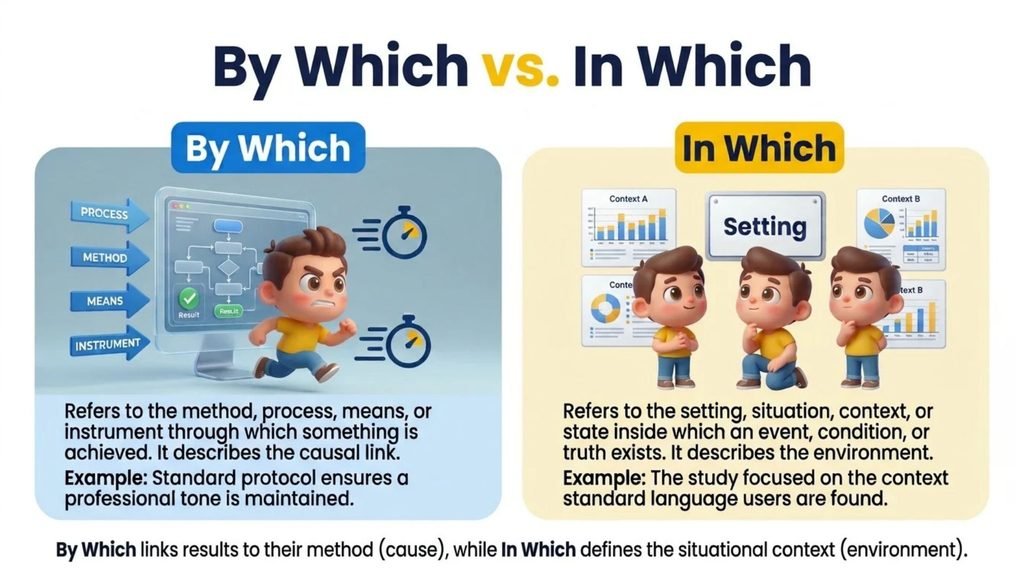
Here is the heart of by which or in which: one explains how, the other explains where. Once that clicks, even in which is patterns stop feeling scary at all.
What Separates “By Which” from “In Which” at a Glance?
- By which explains how an action happens or is achieved.
- In which explains where, when, or under what situation.
- The noun before the phrase usually gives the clue.
- Method words like process or plan call for “by which.”
- Setting words like room, year, or mood call for “in which.”
- Replace with through which for method sentences.
- Replace with where or when for setting sentences.
- Both are formal relative phrases built from a preposition plus “which.”
| Feature | By Which | In Which |
| Core idea | method or means | place, time, situation |
| Question answered | how? | where? when? |
| Swap word | through which | where / when |
| Sample | The plan by which we won | The hall in which we won |
Example in chat:
Friend 1: Is it “the house by which I grew up” or “in which”?
Friend 2: In which! A house is a place, not a method.
Keep one question in your pocket: how or where? That tiny prompt sorts most sentences correctly, and it keeps your editing fast, calm, and consistent.
By Which Meaning and Usage
Let us start with the method side. People often search by which meaning first, then compare by which or in which, and finally wonder exactly where in which is belongs.
What Does “By Which” Mean in Simple English?
- By which means “through the method that.”
- It also means “by means of which” in formal writing.
- The phrase refers back to a noun just before it.
- By which time means “at or before that moment.”
- Typical nouns include method, system, formula, rule, and criteria.
- It rarely appears in casual speech.
- Writers use it to sound precise, not fancy.
| Phrase | Meaning | Sample |
| by which | through the method that | The system by which we judge |
| by which time | by that moment | By which time, the shop had closed |
| by which means | using that method | He asked politely, by which means he got help |
| through which | by way of | A path through which we escaped |
Example in texting:
Friend 1: So “the rule by which we score” just means “the rule we use to score”?
Friend 2: Exactly. It names the method of scoring.
The meaning stays steady across contexts: method, means, or measure. If you can restate the clause with “how,” you have understood the phrase correctly.
When to Use “By Which” (Rules and Examples)
Rules help when instincts fail. For by which or in which questions, apply the method test first, because in which is reserved for settings and cannot rescue a method sentence.
When Should You Use “By Which” in a Sentence?
- Use it after method, process, plan, or system.
- Pair it with verbs like measured, judged, achieved, or calculated.
- Check the sentence with the “through which” swap.
- Place the phrase right after the noun it describes.
- Keep it for formal or academic writing.
- Avoid it for rooms, cities, or years.
- Use a comma only when the clause adds side information.
| Rule | Example |
| Method | The plan by which she saved money |
| Measurement | The scale by which we rate quality |
| Process | The process by which seeds grow |
| Authority | The law by which taxes are collected |
Example in chat:
Friend 1: The formula by which grades are calculated is confusing.
Friend 2: Same here! At least “by which” shows it’s about the method.
Every correct example above answers the how-question. When yours does not, stop and test the setting option before sending the sentence.
In Which Meaning and Usage
Now the setting side. Anyone searching in which meaning wants clarity on place and time, and comparing by which or in which shows why in which is matters so much.
What Does “In Which” Mean in Plain Words?
- In which means “inside which” or “within which.”
- It replaces where when you write formally about places.
- It replaces when when you write about years or eras.
- It describes situations, moods, and conditions.
- In which case introduces a possible outcome.
- It follows nouns such as house, year, world, and moment.
- The preposition stays in front of “which” in formal style.
| Sense | Replace With | Example |
| Place | where | The city in which she studied |
| Time | when | The summer in which we met |
| Situation | in what circumstance | A case in which rules failed |
| Condition | in what state | A mood in which everyone relaxed |
Example in texting:
Friend 1: The park in which we first met is closing.
Friend 2: Noooo. I still say “the park where we met,” though!
A good mental picture is a container holding events. If the noun can hold something, “in which” usually belongs there.
When to Use “In Which” (Rules and Examples)
Think of a container. When the noun holds a place, time, or situation, “in which” fits. In by which or in which choices, in which is the pick for settings.
When Should You Use “In Which” in a Sentence?
- Use it for locations, such as buildings or regions.
- Use it for time frames, such as years or seasons.
- Use it for conditions, such as states or circumstances.
- Test it with “where” or “when.”
- It suits nouns like era, context, scenario, and situation.
- It works with verbs like live, occur, happen, and unfold.
- Prefer plain “where” in casual messages.
| Context | Sample |
| Location | The office in which we work |
| Era | The age in which we live |
| Scenario | A scenario in which prices fall |
| Mood | A mood in which she felt safe |
Example in chat:
Friend 1: That was the week in which everything went wrong.
Friend 2: Haha yes, “in which” fits because it’s a time frame.
Settings can be real places or abstract ideas. Both count, which is why this phrase appears across essays, reports, and formal storytelling.
Examples of “By Which” and “In Which”
Seeing beats guessing. These sample sentences make by which or in which easier to feel, and one line even shows in which is clearly working in a longer, formal structure.
Which Sentences Show Both Phrases Clearly?
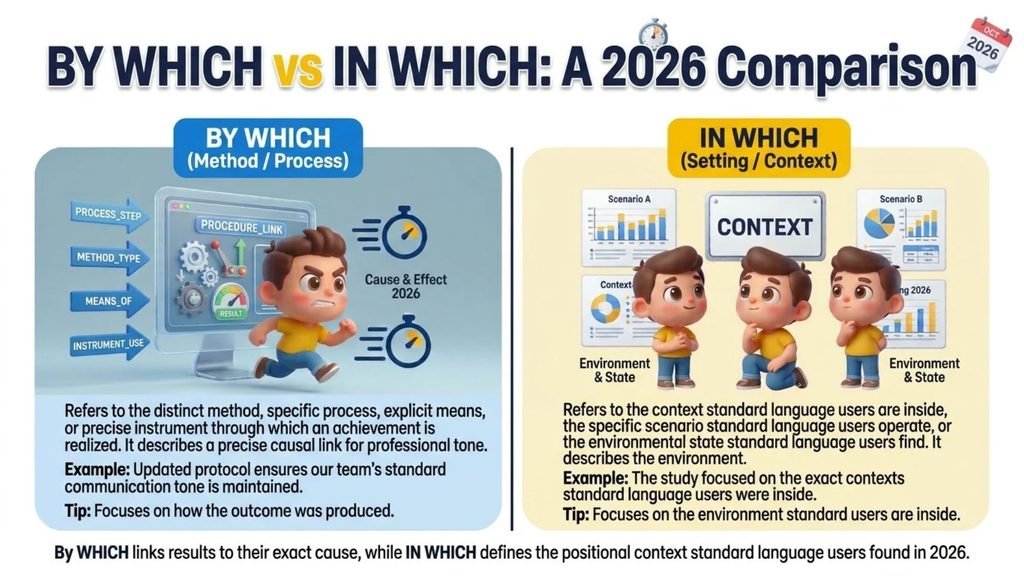
- By which: The method by which we cut costs worked well.
- By which: Here is the system by which orders are tracked.
- By which: The criteria by which judges decide are public.
- In which: The classroom in which we studied was quiet.
- In which: It was a year in which nothing felt certain.
- In which: The story in which she appears is short.
- In which is: A cabinet in which is stored every old receipt.
- In which is: A letter in which is hidden the final clue.
Example in chat:
Friend 1: Is “the criteria by which we choose” okay?
Friend 2: Yes, the criteria are the method, so “by which” fits.
Try changing the noun in each sentence and watch the phrase break. That quick experiment trains your ear faster than memorizing any list.
Common Mistakes with By Which or In Which
Small slips cost credibility. Most errors with by which or in which happen when meaning is ignored, and in which is sentences add confusion when subject and verb swap places.
Which Mistakes Do Writers Make Most Often?
- Writing “the building by which we work” instead of “in which.”
- Writing “the plan in which we won” instead of “by which.”
- Ignoring the verb or adjective that fixes the preposition.
- Writing “interested by” when the correct form is “interested in.”
- Stacking two prepositions, like “in which where.”
- Using the formal phrase where plain words read better.
- Dropping commas around extra-information clauses.
- Forgetting subject-verb agreement in “in which is” structures.
| Wrong | Right | Reason |
| The office by which she works | The office in which she works | Place |
| The plan in which we succeeded | The plan by which we succeeded | Method |
| The topic by which I am interested | The topic in which I am interested | “Interested in” |
| A box in which are a ring | A box in which is a ring | Singular subject takes “is” |
Example in chat:
Friend 1: I typed “the lab by which I work.”
Friend 2: Oops, “the lab in which I work” is the fix.
Nearly every mistake comes from rushing. Slow down for two seconds, check the noun, and your sentence will usually fix itself.
Is “By Which” Grammatically Correct?
Yes, absolutely, when the sentence clearly describes a method. Questions about by which or in which usually hide one small worry, and in which is only adds to it quietly.
When Is “By Which” Correct and When Is It Wrong?
- It is correct for methods, means, and measures.
- It is wrong for places, years, and moods.
- It is formal, not incorrect or outdated.
- It acts as a relative phrase linking two clauses.
- It must follow a noun that fits the idea.
- Style guides generally treat it as standard formal English.
- It is optional, because how often works instead.
Example in chat:
Friend 1: Is “the way by which she won” proper English?
Friend 2: Yes, it’s formal but correct.
Grammar correctness depends on fit, not on the phrase alone. A correct phrase in the wrong sentence still sounds off to careful readers.
Common Expressions and Idioms Using By Which and In Which
Idioms are shortcuts your brain loves. Learn the fixed phrases built around by which or in which, and the in which is structure will feel less formal and more familiar.
Which Fixed Phrases Appear Most Often?
- By which time introduces a deadline or earlier moment.
- By which means states how something was achieved.
- In which case introduces a consequence of a condition.
- In which way asks or describes the manner.
- In which sense clarifies the angle of a claim.
- The way by which works as a formal “how.”
- A situation in which sets up a scenario.
- Use them sparingly, since too many make paragraphs stiff.
Example in chat:
Friend 1: Does “in which case” sound too formal?
Friend 2: Slightly, but it’s perfect for emails.
Fixed phrases carry built-in meaning, so they are safe shortcuts. Learn them as chunks, and you will rarely need to rethink the preposition.
Expressions with “By Which”
Measurement language loves this phrase. Writers often use by which to show degree and method, and comparing by which or in which proves why in which is serves settings instead.
What Are the Most Common “By Which” Expressions?
- The degree by which something changes shows measurable difference.
- The extent by which performance improved shows scale.
- The mechanism by which a process works explains function.
- The formula by which interest is calculated shows exact method.
- The manner by which it operates describes technique.
- The method by which we solved it highlights approach.
- These suit science, law, finance, and technical writing.
Example in chat:
Friend 1: “The degree by which sales rose surprised us.”
Friend 2: Great sentence! It measures how big the change was.
Technical writers lean on these patterns because they sound precise. Use them when you measure, compare, or explain a mechanism.
Expressions with “In Which”
Background language lives here. Phrases with in which quietly set the stage, and a quick by which or in which comparison shows how in which is frames the whole scene.
What Are the Most Common “In Which” Expressions?
- The world in which we live describes present conditions.
- The context in which something occurs gives background.
- The environment in which children learn shapes outcomes.
- The moment in which it happened marks a turning point.
- A situation in which people disagree sets up conflict.
- An era in which technology rules signals a historical period.
- They suit essays, speeches, and reflective writing.
Example in chat:
Friend 1: “The world in which we live is changing fast.”
Friend 2: Yes! It sets the scene before your main point.
These phrases paint the background behind your point. Use them when readers need setting, mood, or context before the main idea lands.
Quick Tests to Pick the Right Phrase Fast
Rules are truly great, but shortcuts win deadlines. These quick tests settle by which or in which in just seconds, and they handle in which is sentences with equal ease.
Which Quick Tests Pick the Right Phrase?
- Swap in “through which” to confirm a method.
- Swap in “where” to confirm a place.
- Swap in “when” to confirm a time.
- Ask “how?” first; yes points to “by which.”
- Match the verb preposition, like “achieved by” or “situated in.”
- Read the line aloud and listen for awkward sounds.
- Split a long clause into two short sentences.
| Test | Question | Result |
| Through test | Can I say “through which”? | Use by which |
| Where test | Can I say “where”? | Use in which |
| When test | Can I say “when”? | Use in which |
| How test | Does it explain how? | Use by which |
Example in chat:
Friend 1: How do I choose fast?
Friend 2: Swap in “where.” If it fits, write “in which.”
Pick one test and use it for a week. Soon the check becomes automatic, and you will stop second-guessing simple relative clauses.
Can You Use “In Which” in Casual Writing?
Honestly, texting friends rarely needs these phrases. Still, by which or in which show up in emails and reports, and in which is can often sound stiff in everyday chat.
Where Does “In Which” Fit Best in Daily Writing?
- Use it in essays, reports, and formal emails.
- Avoid it in texts and casual chats with friends.
- Replace it with “where” or “when” in speech.
- Interviews and presentations welcome moderate formality.
- Legal and scientific writing uses it frequently and precisely.
- Too many in one paragraph make writing sound stiff.
- Match your audience, then choose the phrase.
Example in texting:
Friend 1: Why do you say “the place in which we met”?
Friend 2: Ha, essay brain. “Where we met” works for texts!
Formality is a dial, not a switch. Turn it up for essays and down for chats, and your phrasing will always feel right.
Other Preposition + Which Pairs You Should Know
Once you master by which or in which, pairs feel easy. Even in which is looks simple beside “with which,” “to which,” and “of which,” because all follow one pattern.
How Do “To Which,” “Of Which,” and “With Which” Work?
- To which follows verbs like belong, refer, and respond.
- Of which shows part, ownership, or description.
- With which shows tools, partners, or accompaniment.
- On which points to dates, surfaces, and bases.
- At which points to exact moments or specific places.
- For which shows purpose, reason, or beneficiary.
- Always pick the preposition that fits the verb naturally.
| Phrase | Shows | Example |
| to which | reference or direction | The article to which I referred |
| of which | part or description | The book, the cover of which tore |
| with which | tool or partner | The pen with which she wrote |
| on which | date or surface | The day on which we met |
| at which | exact point | The point at which prices fell |
| for which | purpose or reason | The reason for which we left |
Example in chat:
Friend 1: Is it “the pen with which she wrote”?
Friend 2: Correct! “With which” fits tools, just like “by which” fits methods.
Once you master one preposition-plus-which pair, the rest follow the same logic. Match the preposition to the verb or noun, and you are done.
How Do You Know Whether to Use By Which or In Which?
Here is a calm, repeatable routine. Check the noun, test the swap, and read aloud, since by which or in which choices get easier once in which is feels familiar.
What Checklist Helps You Choose Between Them?
- Identify the noun right before the phrase.
- Ask whether it names a method or a setting.
- Test with through which, where, or when.
- Check the verb that follows for natural pairing.
- Read the full sentence aloud once.
- Simplify with how or where if it still feels clumsy.
- Proofread again, since small prepositions hide easily.
Example in chat:
Friend 1: “The mood in which he spoke” right?
Friend 2: Right. A mood is a state, so “in which” fits.
Short routines beat long study sessions. Run this checklist on every tricky sentence, and it will soon take only a few seconds.
Easy Alternatives to By Which and In Which
Plain words are always allowed. When by which or in which sounds heavy, simpler options exist, and even in which is can often become “where there is” without losing meaning.
What Are Easy Alternatives to “By Which” and “In Which”?
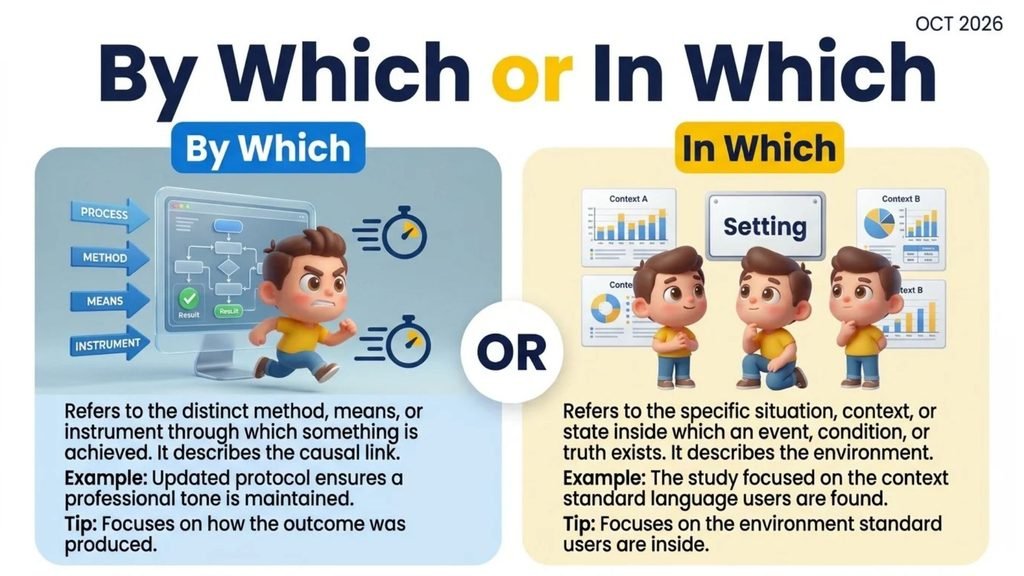
- Through which replaces “by which” in formal writing.
- How replaces “by which” in casual explanations.
- Where replaces “in which” for places.
- When replaces “in which” for time periods.
- That often works after nouns like “way” or “reason.”
- Drop the phrase and split the sentence if needed.
- Keep the formal version when precision matters most.
| Original | Simpler Option | Example |
| by which | through which / how | The method by which we won → how we won |
| in which (place) | where | The house in which I lived → where I lived |
| in which (time) | when | The year in which we met → when we met |
| in which is | where there is | A drawer in which is a letter → where there is a letter |
Example in chat:
Friend 1: Can I just write “where I grew up”?
Friend 2: Absolutely. It means the same as “the house in which I grew up.”
Clarity beats fanciness every time. Choose the formal phrase when precision matters, and choose plain words when your reader just wants the point.
FAQs
Is “by which” correct English?
Yes. By which or in which both work when meaning matches.
What does “by which” mean?
It means “through the method that.” Remember by which or in which by meaning.
What does “in which” mean?
“In which” means place, time, or situation. Use by which or in which logic.
What does “in which is” mean?
It means something is located inside a setting. See by which or in which rules.
Can “by which” and “in which” be used interchangeably?
No. By which or in which carry different meanings, so swapping changes sentences.
Are “by which” and “in which” formal?
Yes, both sound formal. Casual writers replace by which or in which with simpler words.
Is it “in which” or “where” in everyday writing?
Both work. Casual writing prefers “where,” while by which or in which suit formal prose.
Conclusion
Choosing by which or in which is really about meaning. “By which” explains how something happens, and “in which” shows where, when, or in what situation. Even the formal pattern in which is feels manageable once you notice the setting comes first.
Before you hit publish, run one quick check: can you swap in “through which,” “where,” or “when”? That habit prevents the mistakes readers notice fastest.
Keep practicing with your own writing, and by which or in which will soon feel natural. Today, pick one old paragraph, fix its prepositions, and notice how much clearer by which or in which choices make your voice.

Ella Brooks is a passionate writer sharing thoughtful words, inspiring ideas, helpful tips, and engaging content for everyday readers.